


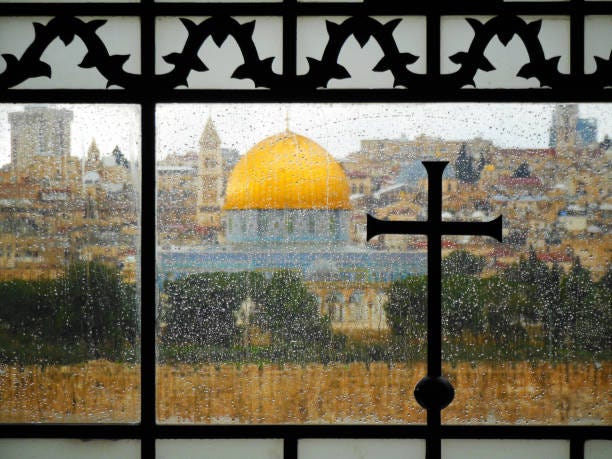
Every few years, the Middle East explodes, and evangelical Christians are reminded that we have a theology problem. What most Christians grab, without knowing where it came from, is the system John Nelson Darby cobbled together in the 1830s and C. I. Scofield pasted into the margins of a Bible in 1909. Dispensationalism is a position that suggests that God has two distinct peoples with two distinct programs, one for Israel and one for the church. It is a nineteenth-century novelty that, unfortunately, has become the default assumption of American evangelicalism. When Christians today declare that supporting the modern state of Israel is a biblical obligation, they are reciting Darby. The question we should be asking, however, is whether Darby was reciting Paul.
The confusion between ethnic Israel and the covenant people of God runs to the deepest roots of theological error, and Paul spent the better part of three letters (Romans, Galatians, and Ephesians) demolishing it. What does the Bible actually teach about Israel, the church, the covenants, and the promises of God?
The Master Principle: Not All Israel Is Israel
The Apostle Paul expressed sorrow so deep that he wished he could be accursed for the sake of his kinsmen according to the flesh. The apostle to the Gentiles was willing to be damned, if it were possible, for the sake of ethnic Israel. And yet three verses later, he writes, “For not all who are descended from Israel belong to Israel” (Romans 9:6).
This is the master principle of Romans 9–11. God’s promises did not fail. They were never addressed to all ethnic Israel. They were addressed to the Israel of God’s electing purpose, a people constituted by faith, of which ethnic Israel was always only a subset and a foreshadowing. Abraham had two sons. Isaac was the son of promise; Ishmael was not. Jacob was chosen; Esau was not. The pattern was built into the covenant from the beginning. Election, not ethnicity, is the operative category.
Paul presses this into a positive definition in Romans 2:28–29. A Jew, in the sense that matters before God, is one inwardly. Circumcision that counts is a circumcision of the heart, performed by the Spirit. The intent of the outward mark was always to point toward an inward reality, and the inward reality has always been born of faith. In the Old Covenant, circumcision was the defining mark of the Abrahamic covenant (Genesis 17:11) and the sign of inclusion amongst God’s people. Critically, in Romans 4, Paul points out that Abraham was justified in Genesis 15:6, before his circumcision in Genesis 17. His justification preceded his circumcision by decades. Circumcision was therefore a sign and seal of the righteousness he had already received by faith, not the instrument by which he received it. The sign pointed to the thing; the thing was always the faith. Paul’s conclusion follows: “the purpose was to make him the father of all who believe without being circumcised, so that righteousness would be counted to them as well” (Romans 4:11). Every justified Gentile could claim Abraham as father.
Colossians 2:11 names the reality the sign was always pointing toward: “In him also you were circumcised with a circumcision made without hands, by putting off the body of the flesh, by the circumcision of Christ.” Christ performed, in his own body and through his Spirit, what the knife in every Israelite tent was always gesturing toward. The 1689 London Baptist Confession of Faith confirms that all ceremonial ordinances “prefiguring Christ, his graces, actions, sufferings, and benefits” are now abrogated (19.3). The abrogation is the fulfillment. Anyone who insists on physical circumcision as a covenant requirement is, as Paul writes to the Galatians, “severed from Christ” (Galatians 5:4). Circumcision is not wicked in itself, but insisting on it as necessary implies that Christ’s work is insufficient.
The Abrahamic Covenant: Older, Deeper, and Always About Christ
Dispensationalism treats the Mosaic covenant as the primary lens through which to read the Old Testament and the Abrahamic covenant as the ground of a future political Israel. This gets it exactly backwards. The Abrahamic covenant predates Moses by four centuries. It is based on promise, not on law. And it was always, explicitly, for all nations.
Genesis 12:3 announces from the beginning, “In you shall all the nations be blessed.” Paul quotes this in Galatians 3:8 and identifies it as “the gospel preached beforehand to Abraham.” Not a prefiguring of the gospel, not a distant shadow of the gospel, but the gospel, preached beforehand, to Abraham. The blessing of Abraham was always heading for the Gentiles. The faith of the New Testament church and the faith of Abraham are the same faith, in the same Person, at different points in the unfolding of the same promise.
In Galatians 3:16, Paul drives the point home with a grammatical observation: the promise was made to Abraham “and to his offspring,” in the singular, not the plural. “It does not say, ‘And to offsprings,’ referring to many, but referring to one, ‘And to your offspring,’ who is Christ.” The ultimate heir of the Abrahamic covenant is Christ himself. All who are in Christ are in the Seed, and therefore in the covenant. The fulfillment of Abraham’s promise is a unified family under the Messiah, inheriting every spiritual blessing by grace alone. Romans 4:13 expands the horizon past anything a land-promise reading can handle: Abraham is “heir of the world,” not just a parcel of real estate in the Middle East. The people of God will inherit the entire cosmos, recreated and restored.
The Mosaic Law: A Temporary Custodian, Not a Competing Program
If the Abrahamic covenant was the original plan, what was the Mosaic law for? Paul identifies the purpose in three clauses in Galatians 3:19. The law was “added.” The law was never intended to be the means of conveying life. Its purpose was to bring home to men the necessity of seeking life elsewhere. It was subservient and preparatory to the gospel. It was added “because of transgressions,” exposing the depth of a problem that the promise alone could solve. It was added, “until the offspring should come.” The law was designed to prepare the way for Christ by making the need for Christ inescapable. The law is no rival to the promise; it is a temporary guardian, added to expose sin and point to Christ. The Judaizers Paul was confronting in Galatians sought to make it binding and permanent, but Paul reveals it as preparatory.
This is what Paul means when he calls the law a paidagogos, or a guardian, or a custodian. In the ancient world, the paidagogos was the slave who walked the heir to school, kept him from mischief, and delivered him to the teacher. He had genuine but temporary authority. His job was to bring the heir to the place where the heir could function as an heir. When the heir came of age, the paidagogos was no longer needed. The law functioned exactly this way for Israel, keeping the heirs in ordered obedience until they came into their inheritance in Christ.
Paul explains that everyone who relies on works of the law is under a curse, because God requires perfect obedience, and no one has delivered it. But Christ redeemed his people from the curse of the law “by becoming a curse for us” (Galatians 3:10–14). The penalty for law-breaking was transferred to him. His bearing of the curse is the precise means by which the blessing of Abraham is applied to the Gentiles. The law slays, Christ absorbs death, and the promise reaches all nations. This is not two programs. This is one program, with different instruments at different stages. Paul presses this same two-covenant framework into the patriarchal narrative itself, finding the whole structure already present in Abraham’s household.
The Two Covenants and the Hagar-Sarah Allegory
Paul’s typology in Galatians 4:21-31 maps the two-covenant framework onto the patriarchal narrative. Hagar represents the Sinai covenant: law, slavery, earthly Jerusalem, and bondage with her children. Sarah represents the covenant of promise: grace, freedom, and the Jerusalem above, which is the mother of all who are free in Christ. Martin Luther, commenting here, identifies the heavenly Jerusalem as “the church, that is to say, believers scattered throughout the world, who have the same gospel, the same faith in Christ, the same Holy Spirit and the same sacraments.” The church is the true heir of the promise from the beginning.
Critics of covenant theology will call this “replacement theology,” but that is a pejorative rhetorical device designed to make covenant theology sound like theft. The church has not replaced Israel any more than the substance replaces the shadow. John Calvin comments on Galatians 6:16 that Paul “gives the appellation of the Israel of God to those whom he formerly denominated the children of Abraham by faith, and thus includes all believers, whether Jews or Gentiles, who were united into one church.” The Israel of God is the people of the Messiah. The Israel of God has always been the people of the Messiah.
Every person who has ever lived relates to God through one of these two covenants. The covenant of works required the perfect obedience of Adam as the federal head of humanity, with life as the reward and death as the penalty. Adam failed, and all his posterity stand under that covenant in condemnation. The covenant of grace provides the remedy: God freely offers life and salvation by Jesus Christ, requiring faith (2LBC 7.1–2). There is no third option. The Jew under Moses and the pagan under natural law were, with respect to their standing before God, equally lost and under a covenant of works, both condemned by the standard they could not meet. The only escape is the covenant of grace, available through faith in Christ alone, to both alike. Any framework that grants ethnic Israel a separate track of covenant standing is a contradiction of this great truth.
Election, the Remnant, and the Question of God’s Faithfulness
If the promises were made to Israel and most of Israel has not believed, has God broken his word? Paul’s answer is that the premises are wrong. The promise was based on election, not blood. God reserved for himself a people within the people, an Israel within Israel, a remnant who would be the true Israel of God.
In Romans 11:1–5, Paul himself is the first exhibit. He is a believing Jew and proof that God has not cast off his people. He points to Elijah’s day when seven thousand had not bowed to Baal, unknown to Elijah, and were preserved by God. “Even so,” writes Paul, “at the present time there is a remnant, chosen by grace” (Romans 11:5). God’s faithfulness is proved by the faithful preservation of the elect within the nation, in every age.
Paul’s grief for his kinsmen is genuine, but his grief leads to theological clarity as he explains why Israel stumbled. Romans 9:30-32 poses the great paradox: Gentiles who were not pursuing righteousness attained it by faith, while Israel, pursuing righteousness through the law, did not attain it because “they did not pursue it by faith, but as if it were based on works.” In Romans 10:3, he explains that Israel was “ignorant of the righteousness of God” and sought to establish their own. This was not intellectual ignorance. They had the Scriptures, the prophets, the testimony of Christ himself. It was willful blindness.
So, the stumbling stone is Christ himself—the very Messiah their covenant history was designed to prepare them to receive. But this offense is not uniquely Jewish. Every moralist who does not live in light of justification by faith alone stumbles over the same stone. Israel’s failure is the paradigmatic instance of a universal human failure, a mirror held up to every self-righteous soul who has ever lived, designed to drive every one of us to Christ for forgiveness and for righteousness.
The Olive Tree: One People, One Root
Romans 11:11-24 presents Paul’s most extended image of the structural relationship between Israel and the church. The image is a single olive tree with a single root. Natural branches (unbelieving Jews) have been broken off. Wild branches (Gentile believers) have been grafted in, contrary to nature. The root sustains all the branches. There is one tree.
Two things follow immediately. First, Gentile believers have no grounds for arrogance: “It is not you who support the root, but the root that supports you” (Romans 11:18). Gentiles have been grafted into something that was already there, namely, a covenant community with deep roots in the history of redemption. Second, the broken branches can be regrafted. Jewish people who come to faith in Christ are natural branches returning to their own tree. But it is vital to recognize that Romans 11 says nothing about the restoration of an earthly Davidic kingdom. It says nothing about a return to the land. It says nothing about a church of Jewish Christians organized separately from Gentile Christians. The Israel of God is and has always been constituted by faith, sustained by the covenant root, comprising both Jews and Gentiles in one body.
“All Israel Shall Be Saved” and Getting the Grammar Right
Romans 11:25-26 is the verse on which entire theological systems have been balanced: “A partial hardening has come upon Israel, until the fullness of the Gentiles has come in. And in this way all Israel will be saved.”
The phrase that does the most work is kai houtos, translated “and in this way” or “and in this manner.” O. Palmer Robertson points out that of the approximately 205 uses of houtos in the New Testament, it never carries a temporal meaning. It does not mean “and then.” Paul is not saying that after the Gentiles come in, a mass Jewish conversion will follow as a subsequent event. He is saying that in this manner, by this process, through this means, all Israel is saved. In other words, the salvation of all Israel proceeds by the same mechanism as the salvation of every individual in every age: through faith in Christ, in response to the preaching of the gospel.
Thus, “all Israel” in verse 26 refers to the same Israel Paul has been discussing for three chapters: the Israel of God’s electing purpose, the full number of the elect from among the Jewish people across all ages. Robertson states the boundary: “Not all Jews will experience the blessing of participation in this kingdom, for ‘they are not all Israel who are of Israel’ (Romans 9:6). It will always be a remnant that is saved.” There is a future for the Jewish people, but it is the same future available to every person on earth: faith in the Messiah.
One Gospel, One New Man, No Dividing Wall
In Ephesians 2:14-16, Paul explains that at the cross, Christ “has broken down in his flesh the dividing wall of hostility by abolishing the law of commandments expressed in ordinances, that he might create in himself one new man in place of the two, so making peace.” The one new man is not a Jew and a Gentile in alliance. It is an entirely new creation in which the old ethnic distinction has been abolished as a category of covenant standing.
Galatians 2 confirms this practically. When Peter withdrew from table fellowship with Gentile believers at Antioch, he communicated, through his behavior, that Gentile Christians were not quite full members of the covenant community. Paul’s public confrontation was immediate: “If you, though a Jew, live like a Gentile and not like a Jew, how can you force the Gentiles to live like Jews?” Peter’s hypocrisy was a practical denial of the gospel. Any theology that rebuilds the Jew/Gentile distinction as a category of covenant standing, whether in the form of Messianic bilateral ecclesiology, which holds that Jewish believers are obligated to Torah in ways Gentile believers are not, or in the form of a dispensationalism that posits separate divine programs for two peoples, is doing precisely what Peter did at Antioch. It is reconstructing the wall Christ bled to tear down.
When Paul closes Galatians with the phrase “the Israel of God” (6:16), he is not naming a separate group of ethnic Jews who receive a distinct blessing alongside the Gentile church. He has spent six chapters arguing that “neither circumcision nor uncircumcision counts for anything” (6:15). The Israel of God and all who walk by the rule of the new creation are one group, named with the name that belongs to the true covenant people. John Stott summarizes that those who are in Christ are “the true circumcision” (Philippians 3:3), “Abraham’s offspring” (Galatians 3:29), and “the Israel of God.”
Land, Temple, and the Promises
The Old Testament promises concerning land, the temple, and national restoration are among the most contested texts in the Israel/church debate, and dispensationalism has staked its credibility on a literal, political fulfillment of all of them. If these promises require a geopolitical Israel, then Christians have covenant obligations toward the modern state of Israel derived from Scripture. If these promises are types and shadows that find their fulfillment in Christ and the new creation, those obligations evaporate entirely. The question is not political. It is hermeneutical. And the New Testament answers it directly.
Robertson helpfully explains that the concept of land as a theological category did not originate with Abraham; it originated in Paradise. When God promised Abraham a land, he was taking up the primal human longing for the lost paradise and directing it toward its eschatological goal. The land of Canaan was a type and a foretaste of the consummated cosmos. The writer to the Hebrews confirms that Abraham himself “was looking forward to the city that has foundations, whose designer and builder is God” (Hebrews 11:10) and was seeking “a better country, that is, a heavenly one”(Hebrews 11:16). Abraham understood the promise more expansively than his modern interpreters do. Romans 4:13 states that Abraham is “heir of the world,” not a parcel of real estate in the ancient Near East. God’s promise is nothing less than the entire cosmos, recreated and restored. The land promise has come of age in Christ. It was never only about Canaan.
The same logic governs the temple. Every element of the old covenant sacrificial system was designed to foreshadow the high priestly ministry of Christ and was therefore temporary. Hebrews 10:12 and 14 announce the fulfillment that Christ “offered for all time a single sacrifice for sins” and “has perfected for all time those who are being sanctified.” Rebuilding the Jerusalem temple and resuming its sacrifices would not constitute a restoration of Old Testament worship. It would be a repudiation of what Christ has done and would be a declaration in stone and blood that his one perfect sacrifice was insufficient.
The establishment of the modern state of Israel in 1948 is widely treated in American evangelical circles as the direct fulfillment of Old Testament prophecy. But the Old Testament prophecies of national restoration, such as Ezekiel’s valley of dry bones, the promised return from exile, and the rebuilding of the temple, describe events marked by the resurrection of the dead, the pouring out of the Spirit, and the renewal of life through faith. The twentieth-century return of Jewish people to Palestine fails to meet any of these conditions. Robertson concludes that these prophecies “are more properly interpreted as finding consummate fulfillment at the ‘restoration of all things’ that will accompany the resurrection of believers at the return of Christ.”
The most frequently cited proof text for the church’s supposed obligation to support the modern state of Israel is Genesis 12:3: “I will bless those who bless you, and him who dishonors you I will curse.” The argument runs that because God promised to bless those who bless Abraham’s descendants, Christians must bless modern Israel, and failure to do so invites divine curse. But the promise was addressed to Abraham personally, as part of the covenant of grace that constituted him the father of the faithful. There is no exegetical basis for extending its direct address to a modern nation-state. More decisively, Paul himself interprets this verse in Galatians 3:8, quoting “In you shall all the nations be blessed” and explicitly identifying it as the gospel preached beforehand to Abraham. F.F. Bruce comments, “If the promise was good news for Abraham, it is good news also for the nations (Gentiles) who are to be blessed in (or with) him.” Calvin reinforces this, noting, “These words unquestionably mean that all must be blessed in the same manner as Abraham; for he is the model, nay, the rule, to be universally observed. Now, he obtained the blessing by faith, and in the same manner must it be obtained by all.” Paul identifies the timeless scope of God’s redemptive plan through His promise to Abraham, fulfilled in Christ, as revealed in the authoritative Word of God.
The fulfillment of Genesis 12:3 is the gospel of Jesus Christ going to all nations. It has nothing to do with political alignment with a modern state. If the promise has any continuing application in the new covenant age, it applies to blessing the Israel of God—the global community of all who are in Christ. To invoke it as a basis for unconditional political support of a nation-state that has rejected the Messiah is to import an old covenant address to an individual patriarch into a new covenant context, with no exegetical justification.
The great inheritance of the new creation, the resurrection, and the renewal of all things is immeasurably greater than any parcel of real estate. To reduce the Abrahamic promise to a political claim on the territory of modern Israel is to trade the birthright for a bowl of porridge and call it faithfulness.
One People, One Promise, One Messiah
The conclusion is not complicated, though it is costly. The Israel of God is defined by faith in the God of Israel, who is Jesus the Messiah. The promises belong to everyone, Jew and Gentile, who comes to faith in him. Robertson’s final word is fitting: “The promises of redemption have never been offered to people without a true faith in the Messiah sent by God. In the past, those who did not exercise proper faith were driven out of the land and regarded as ‘not my people.’ On the other hand, any person who exercises true faith in the Messiah sent by God has been declared to be heir of all God’s promises.”
The Jewish person who comes to faith in Jesus is entering into the deepest fulfillment of his heritage. The Gentile who comes to faith in Jesus is a fellow heir, grafted into the same tree, sharing the same root. Both together constitute the Israel of God as the one people of the one covenant of the one God, in whom all the promises of the Old Testament find their Yes and Amen (2 Corinthians 1:20).
We owe to the modern state of Israel the same thing we owe every nation: the gospel of Jesus Christ. We owe its Jewish citizens the honest declaration that their Messiah has come, that the promises of God are fulfilled in him, and that the inheritance they were born into by flesh is available to them by faith. We do not owe them our uncritical political support, our silence about justice, or a hermeneutic invented in the nineteenth century that reads their ethnic identity as a divine guarantee the New Testament nowhere provides.
The promises of God are fulfilled in Christ Jesus alone. All of them. The land promise: yes, in the new creation. The temple promise: yes, in the body of Christ and the heavenly sanctuary he now ministers in. The national restoration: yes, in the resurrection of the dead and the renewal of all things. Every shadow has found its substance. Every type has found its antitype. Every promise has found its fulfillment in the one in whom “all the fullness of God was pleased to dwell” (Colossians 1:19). That is the Israel of God. That is the church.
“Election, not ethnicity, is the operative category” this hits the mark. You can literally summarize the whole text into this. Amazing. Well written Pastor Nick.
This whole article is absolute fire. Thank you sir.