


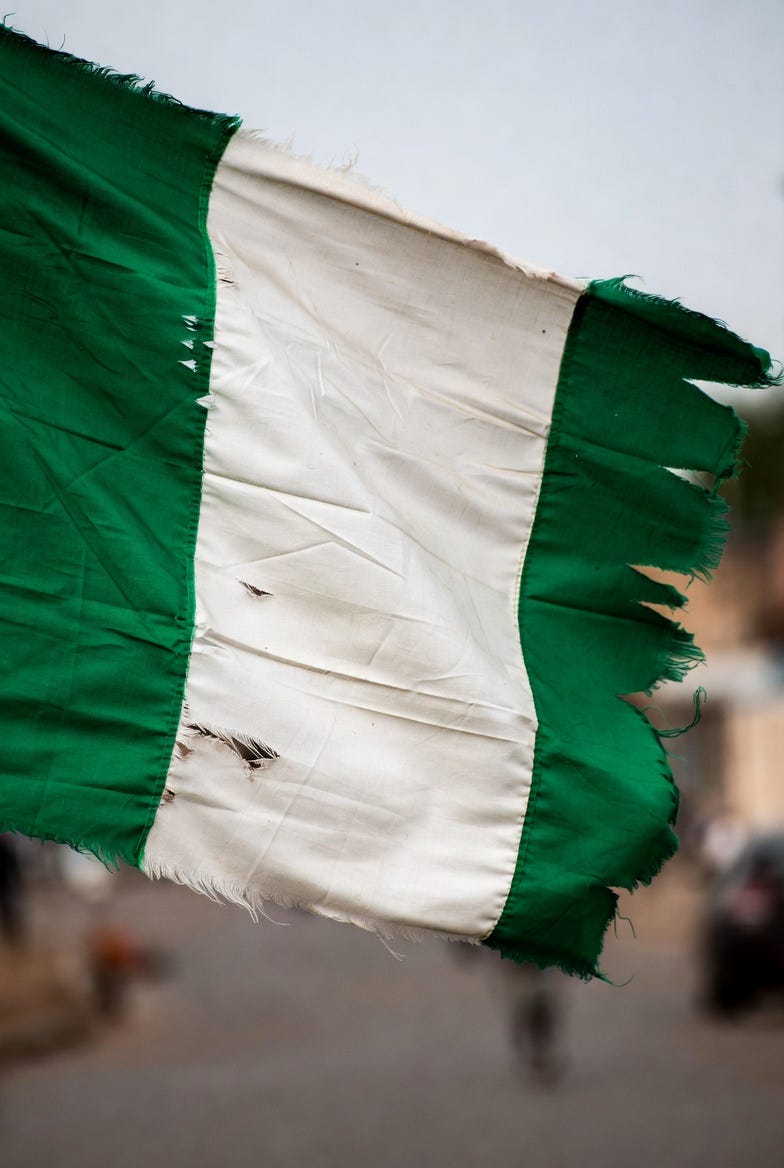
Nigeria, Africa’s most populous nation, stands at a critical juncture as the global spotlight has been turned upon its soil. On October 31, 2025, President Donald Trump announced Nigeria’s redesignation as a “Country of Particular Concern” (CPC) under the International Religious Freedom Act, citing the “mass slaughter” of Christians by radical Islamists, a move formalized by the State Department under Secretary Marco Rubio on November 3, 2025, reversing the Biden administration’s 2021 delisting.1 Backed by lawmakers like Rep. Riley Moore (R-WV) and Sen. Ted Cruz (R-TX), who highlight over 7,000 Christian deaths in 2025 alone from groups such as Boko Haram, ISWAP, and Fulani militants, the designation includes threats of aid cuts and potential military preparedness.
The United States Department of War is reviewing bilateral military aid, including counterterrorism support, though no public evidence indicates preparations for direct action. Trump’s designation of Nigeria has been backed by strong GOP support.2 The United States Commission on International Religious Freedom (USCIRF) hailed the move as an “important step to advance religious freedom” and as a form of relief after years of ignored recommendations.3
While Nigerian Christian advocates welcome this as overdue recognition of disproportionate suffering, others reject it as inflammatory, insisting violence transcends faith lines. The CPC designation, though vital for protecting vulnerable Christian believers, demands historical context: centuries of fragmentation, colonial legacies, and governance failures that entangle religion with resource rivalries and corruption, risking oversimplification of a shared national tragedy.
Pre-Colonial Nigeria’s Deep Divides
Long before European cartographers drew Nigeria’s borders, the nation was a mosaic of polities defined by stark ethnic, religious, and political contrasts. In the North, the Hausa city-states of Kano, Katsina, and Zaria thrived as commercial hubs along trans-Saharan trade routes with economies built on groundnuts, leather, and salt.4 By 1804, the Fulani jihad, led by Usman dan Fodio, had overthrown these Hausa rulers and established the Sokoto Caliphate, a centralized Islamic theocracy that stretched from modern-day Niger to Cameroon.5 Governance was hierarchical: emirs (Sarakuna)6 ruled under the Sultan, enforcing Sharia law, collecting zakat,7 and maintaining a feudal order.8 Polygamy, purdah,9 and early marriage became social norms. Education was Quranic, delivered through Almajiri10 pupils who memorized the Qur’an while often begging for sustenance.11 This system created a culturally cohesive, religiously uniform North that was over 95% Sunni Muslim by 1900, where Hausa became the common language of West African commerce.12
The South told a different story. The Yoruba in the southwest organized into city-states such as Oyo, Ife, and Ibadan, each governed by an oba (king) advised by councils of chiefs (Oyomesi).13 Oyo’s cavalry empire dominated the 17th–18th centuries, extracting tribute from Dahomey (modern Benin).14 Yoruba society was urban, literate in Ifá divination,15 and culturally syncretic, with ancestor worship coexisting alongside emerging Islamic and Christian influences.16 In the east, the Igbo rejected kingship entirely. Their village democracies operated through age grades, title societies (Ozo), and women’s councils (umuada), making decisions by consensus in open assemblies.17 Decentralization bred resilience, but also fragmentation; no single Igbo polity could rival those of Oyo or Sokoto.18 In the Niger Delta, the Ijaw, Itsekiri, and Efik communities formed riverine trading kingdoms, including Bonny, Calabar, and Nembe, which profited from the slave trade and later the palm oil trade. Their societies were stratified by canoe houses (Wari), with spiritual authority vested in water spirits (Owuamapu).19 Christianity arrived early through missionaries in Abeokuta (1840s) and Onitsha (1857), giving the South a decisive educational head start.20
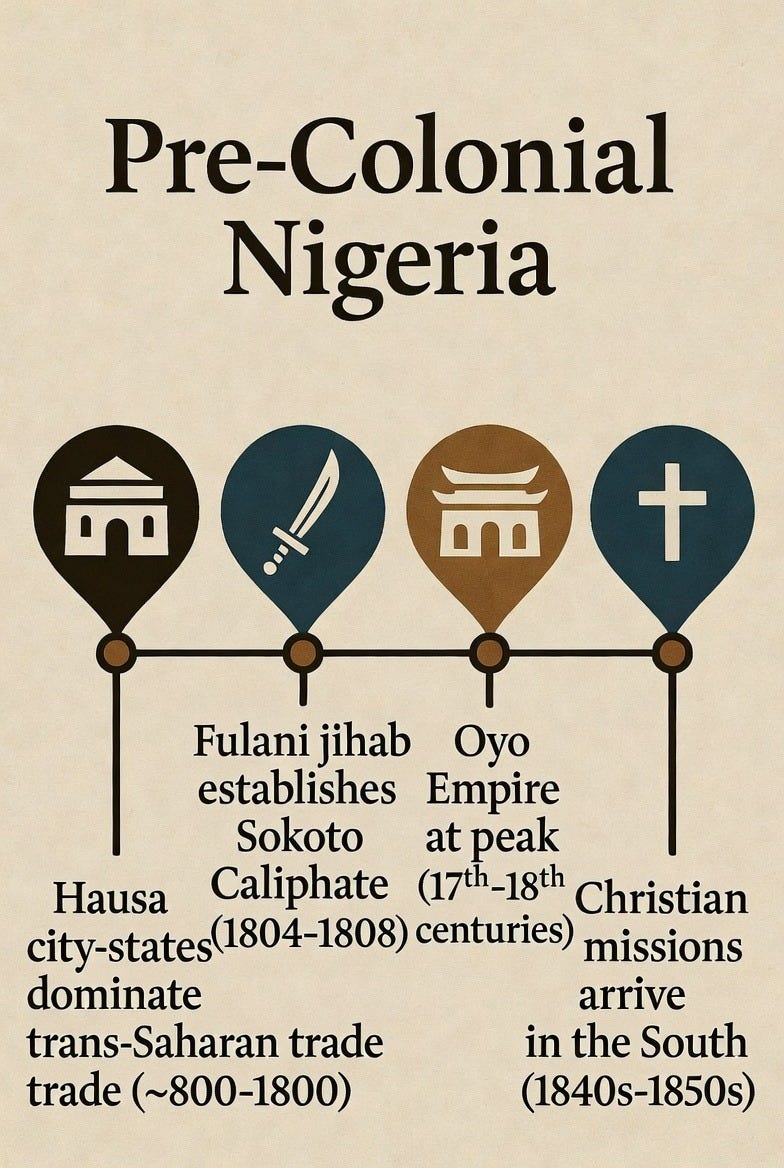
These pre-colonial systems, including centralized Islamic emirates in the North, monarchical city-states in the Yoruba west, stateless republics in the Igbo east, and riverine chiefdoms in the Delta, were not designed to coexist. They traded, warred, and occasionally allied, but never merged. The British arrival in the 19th century would force this fusion with catastrophic long-term consequences.
Forging a Fractured Federation
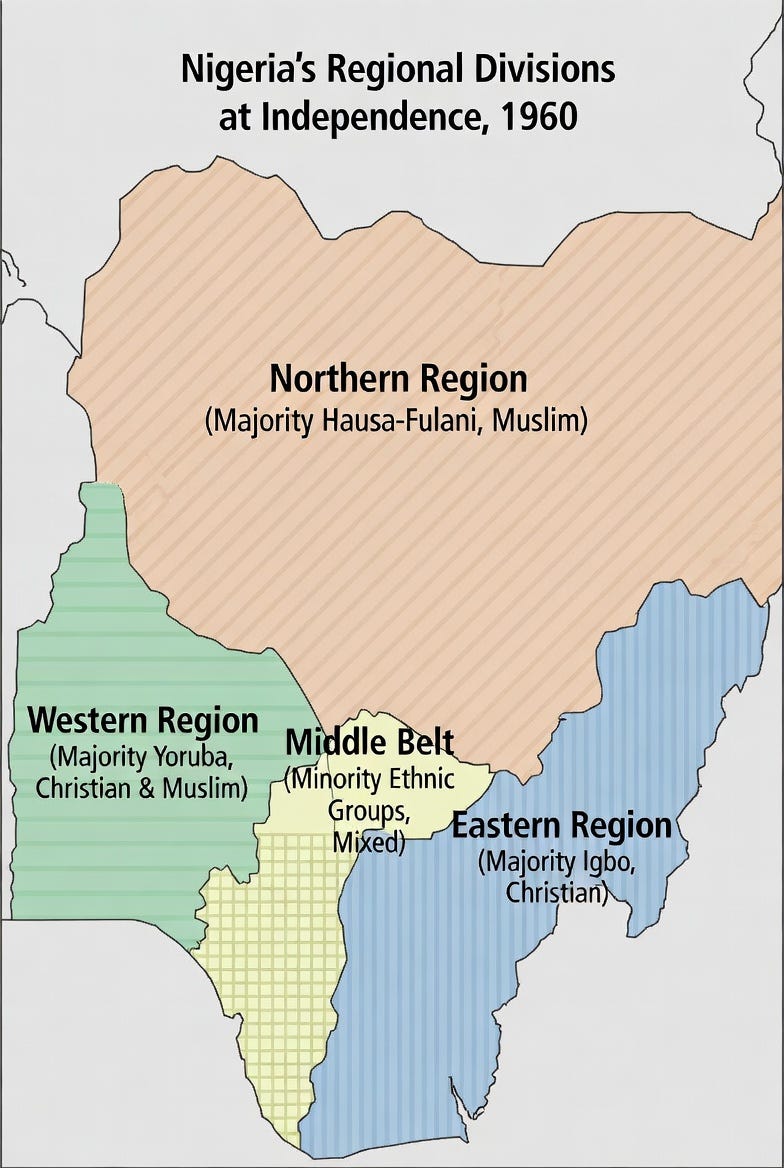
In 1914, Governor-General Frederick Lugard merged the Northern and Southern Protectorates into the Colony and Protectorate of Nigeria in a decision driven by fiscal necessity rather than cultural logic.21 The North, running deficits, would be subsidized by Southern customs revenue.22 Lugard’s indirect rule preserved Northern emirs as native authorities, shielding the region from Christian missionaries and Western education.23 By 1950, the North had only 12 government secondary schools for a population of approximately 17 million, while the South had over 100 secondary institutions for a population of about 14 million.24 The Middle Belt, the home to Tiv, Jukun, Berom, and other minority groups, remained administratively part of the Northern Region, despite widespread fears among its largely pagan and Christian populations of Hausa-Fulani political and cultural domination, a tension the Willink Commission acknowledged but did not resolve through regional separation, creating a fault line that would erupt in blood decades later.25
Politically, colonial reforms institutionalized regionalism. The Richards Constitution (1946) created three regional assemblies.26 The Macpherson (1951)27 and Lyttleton (1954)28 constitutions entrenched a loose federation. Nationalist parties crystallized along regional and ethnic lines after 1951: the Northern People’s Congress (NPC) under Ahmadu Bello defended Northern autonomy and Islamic identity; the Action Group (AG) led by Obafemi Awolowo championed Yoruba federalism and free education; and the National Council of Nigeria and the Cameroons (NCNC), originally pan-Nigerian, became increasingly Igbo-dominated following its 1951 election setbacks in the West.29
In 1953, the Kano Riots erupted after Southern legislators moved for self-government, killing 36 and exposing deep Northern fears of Southern political domination.30 The controversial 1952–53 census recorded the Northern Region at 16.3 million out of a national total of 31.6 million (~51.6%), fueling accusations of overcounting and setting the stage for regional power struggles.31 Nigeria had become a nation where demography equaled destiny.
Independence to Instability: The Seeds of Modern Conflict
On October 1, 1960, Nigeria gained independence with a federal constitution, a parliamentary system, and a coalition government led by Abubakar Tafawa Balewa (NPC, North) as Prime Minister and Nnamdi Azikiwe (NCNC, East) as Governor-General. The green-white-green flag symbolized agriculture and unity, but unity was fragile. The Northern Region used its population to dominate the House of Representatives, while the Western and Eastern regions controlled their own civil services and marketing boards.32 Economic disparities were stark: the North exported groundnuts and cotton; the East, palm oil; the West, cocoa; but oil, discovered in Oloibiri in Bayelsa State (1956), would soon dwarf all else.33
The First Republic (1960-1966) collapsed under ethnic tensions. In the West, the 1962 Action Group crisis, sparked by a party split, led to federal troops imposing emergency rule amid widespread arson and disorder; Awolowo was later jailed for treason in 1963, while the 1964-1965 “Operation Wetie” riots saw houses burned, killing hundreds.34 The 1964 federal elections were marred by rigging and intimidation; the East and West boycotted in December, delaying polls until March 1965 and plunging the nation into political chaos.35 In the Middle Belt, the Tiv riots (1960–64) arose as protests against Hausa-Fulani domination under the NPC and resulted in hundreds being killed by security forces, as documented by the 1964 commission.36 Corruption flourished as Northern elites diverted groundnut and cotton revenues, while Southern politicians expanded their patronage networks through the establishment of cocoa marketing boards. By 1965, the West had become ungovernable, marked by escalating assassinations and arson amid pre-election chaos.37
On January 15, 1966, mostly Igbo majors led by Chukwuma Kaduna Nzeogwu staged a coup, assassinating Balewa, Bello, and Western Premier Samuel Akintola.38 The coup failed to seize the East, and its ethnic skew led to sparing Igbo leaders, resulting in it being branded as an “Igbo plot.” General Johnson Aguiyi-Ironsi (Igbo) took power, abolishing regions through Decree 34, which transformed Nigeria from a federation into a unitary state, eliminating the four regions; a move viewed by Northerners as a form of Southern centralization.39 From May to September 1966, anti-Igbo pogroms swept Northern Nigeria, with massacres in Kano, Kaduna, and Jos killing an estimated 8,000 to 30,000 civilians and displacing over 1 million to the East.40
During the pogroms, Kaduna Radio broadcasts incited violence by labeling Igbos as “infidels” and a “cancer” on the nation, contributing to the massacres and exodus.41 The July 1966 counter-coup by Northern officers installed Yakubu Gowon and restored federalism, but trust was shattered.42
Civil War and Its Aftermath
On May 30, 1967, Odumegwu Ojukwu declared the Republic of Biafra, a partially recognized state that declared independence from Nigeria.43 The Nigerian Civil War (1967–1970) was the inevitable climax of ethnic, regional, and religious polarization. Biafra’s 1 to 3 million deaths, caused mainly by starvation under federal blockades, scarred the Igbo psyche.44 A “no victor, no vanquished” policy alongside a 3Rs plan (Reconciliation, Rehabilitation, Reconstruction) failed to heal wounds: Igbo officers were purged, Eastern banks lost deposits, and “abandoned property” in Port Harcourt was seized by non-indigenous people.45 The Biafran War ushered in a prolonged period of military rule (1966–1979), marked by ethnically tinged coups: Murtala Muhammed (Hausa-North, 1975) ousted Gowon (Angas-Middle Belt); Olusegun Obasanjo (Yoruba-South, 1976–1979) then handed power to civilians.46
The Second Republic in Nigeria (1979-1983) replicated the errors of the First Republic. The Northern-led National Party of Nigeria (NPN) won the 1979 presidential election amid minor disputes over vote thresholds, thereby thrusting Shehu Shagari into power. However, the 1983 elections were marred by widespread corruption, including the burning of ballot boxes in Ondo and Oyo, allegedly in favor of the NPN.47 The military returned to power under Muhammadu Buhari (North, 1983–85), then Ibrahim Babangida (Middle Belt, 1985–93).48 Babangida’s Structural Adjustment Program (SAP) devalued the Naira sharply (real effective rate falling ~80% by 1992), eroding urban middle-class living standards through inflation and import costs, while subsidy smuggling drained ~8% of GDP annually, including petroleum losses of $200 million to neighboring countries.49 The June 12, 1993, election was won by Moshood Abiola (Yoruba), but was annulled, sparking Yoruba alienation and the rise of the Oodua People’s Congress (OPC) militia.50
Nigeria’s Third Republic (1993–98), under the regime of Sani Abacha, reached its low point in 1995 when journalist Ken Saro-Wiwa and eight Ogoni activists were hanged after a sham trial for protesting Shell’s environmental devastation, a martyrdom that ignited armed Niger Delta militancy.51 Militant groups sabotaged pipelines, kidnapped expatriates, and demanded resource control.52 Abacha’s death in 1998 paved the way for the establishment of the Fourth Republic in 1999. The republic promised democratic renewal but inherited the fractures of its predecessors: ethnic patronage, resource inequities, and a security apparatus prone to corruption and impunity. Oil wealth, concentrated in the Christian-majority South, fueled Northern resentment.
The 1999 Constitution established term limits for the presidency (maximum two four-year terms), but zoning, an internal rule of the PDP political party to rotate the presidency between candidates from the North and South every eight years to promote ethnic balance, was never enshrined in the law.53 Olusegun Obasanjo (Southwest, 1999-2007) signed the Onshore-Offshore Dichotomy Abrogation Act (2004), which unified onshore and offshore oil revenue for derivation purposes and increased shares for Delta and other shore-side states amid debates over federal recentralization.54 President Umaru Yar’Adua (North, 2007-2010) died in office, so the nation’s first minority president, Goodluck Jonathan (South-South, 2010-2015), assumed office, facing Northern backlash, culminating in Boko Haram’s escalation.55
The Rise of Boko Haram
Boko Haram, formally known as Jama’atu Ahlis Sunna Lidda’awati wal-Jihad (“People Committed to the Propagation of the Prophet’s Teachings and Jihad”), was founded in 2002 in Maiduguri, the capital of Borno State in northeastern Nigeria.56 The group was established by Mohammed Yusuf, a charismatic Islamic cleric born in 1970 in Yobe State, who drew inspiration from Salafi and Wahhabi ideologies during his time studying in Saudi Arabia and under the guidance of Muslim clerics like Ja’afar Mahmud Adamu in Kano.57 Yusuf established a religious complex that included a mosque and an Islamic school (madrasa), attracting impoverished Muslim families from Nigeria and neighboring countries, such as Cameroon and Chad.58 The name “Boko Haram,” meaning “Western education is forbidden” in Hausa, reflects the group’s core ideology: a vehement rejection of Western-style education and secular institutions, which Yusuf viewed as corrupting Islamic values and promoting infidelity.59 Yusuf preached that subjects like Darwinism, a spherical earth, and even rainfall science contradicted the Qur’an, advocating instead for a return to “pure” Islamic knowledge.60
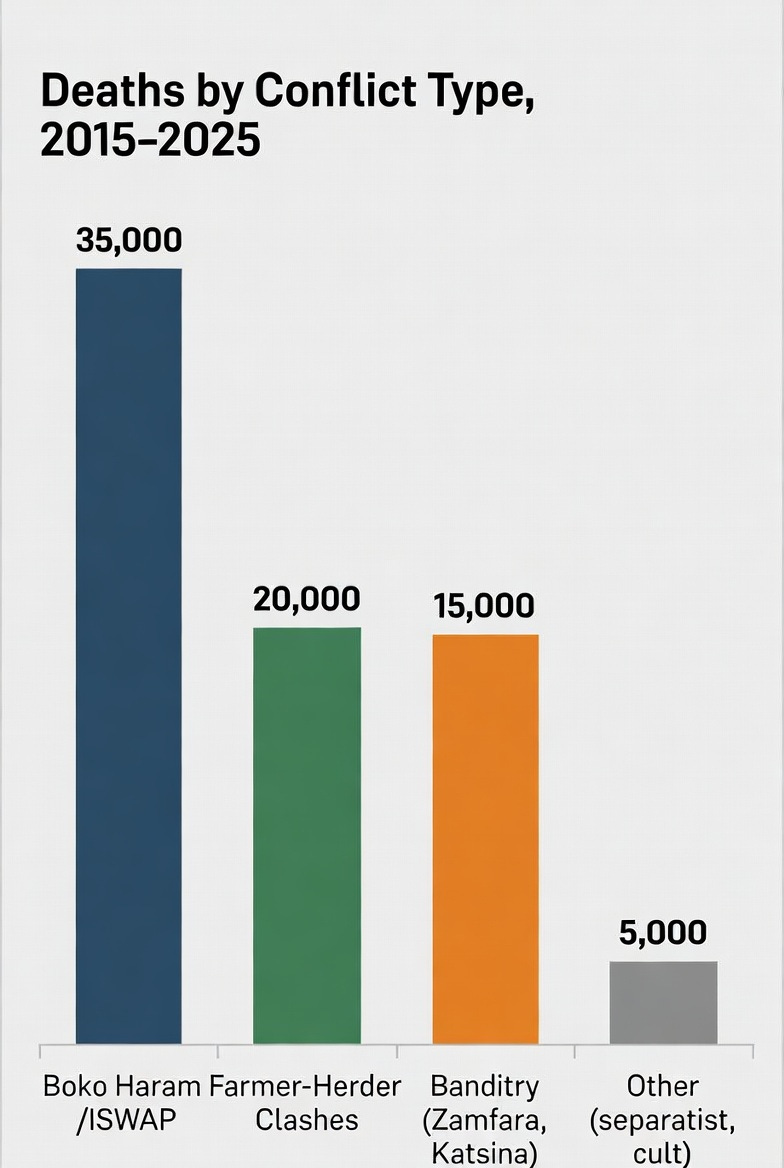
Yusuf’s ultimate goal was to overthrow the Nigerian government, which he saw as corrupt and influenced by Western imperialism, and establish a strict Islamic state governed by Sharia law across Nigeria or at least the northern regions.61 Drawing from earlier Islamist movements like Maitatsine (1970s) and the Izala sect, Boko Haram positioned itself as a pure religious force against Nigeria’s secular democracy, blending anti-Western sentiment with calls for jihad against perceived apostates.62 By 2004, the group had evolved into a self-sustaining community with farms and businesses; however, tensions escalated as Yusuf publicly denounced Western education and government service as haram (forbidden).63 This ideology led to clashes with authorities, culminating in the 2009 uprising, where Yusuf was captured and extrajudicially killed by police, fracturing the group under Abubakar Shekau’s leadership and transforming it into a full insurgency.64 The insurgency and Northwest banditry amplified cycles of violence, claiming thousands of lives annually across lines, yet Christians in the Middle Belt (Plateau, Benue) endure the brunt, with over 3,000 civilian deaths from 2014 to 2024 in targeted raids on Berom, Tiv, and Irigwe farming communities.65
By 2014, Boko Haram had escalated from sporadic attacks to a full territorial insurgency, controlling swathes of northeastern Nigeria estimated at around 20,000 square kilometers (approximately the size of the state of Maryland).66 This peak occurred after a series of offensives in late 2013 and early 2014, during which the group overran more than 20 local government areas in Borno, Yobe, and Adamawa states, capturing towns such as Mubi, Gwoza, and Gamboru Ngala.67 At its height, Boko Haram administered a “caliphate” with taxes, courts, and propaganda radio, displacing over 1.5 million people and killing nearly 7,000 in 2014 alone, making it the world’s deadliest terrorist group that year.68 The group’s expansion was aided by Nigeria’s military weaknesses, including poor equipment and intelligence, allowing Boko Haram to seize military bases and cross into Cameroon and Chad.69 This control peaked in August 2014, before a multinational force (comprising Nigeria, Chad, Niger, and Cameroon) launched counteroffensives, reclaiming most of the territory by early 2015.70
On April 14-15, 2014, Boko Haram abducted 276 girls (aged 16-18) from the Government Girls Secondary School in Chibok, Borno State, during their final exams.71 It was a clear indication to many of the Nigerian state’s profound failure to protect education, especially for girls, in conflict zones.72 The attack, by at least 60 gunmen in trucks, overwhelmed the school’s minimal security with gunfire and arson.73 Of the 276 abducted girls, 57 escaped immediately by jumping from trucks; 82 were released in 2016-2017 through negotiations; 103 remained missing or dead as of 2024, with reports of forced marriages, slavery, or suicide bombings.74 Boko Haram deliberately targeted schools.75 Initial government denial and slow response amplified outrage, sparking the global #BringBackOurGirls campaign. It exposed systemic failures: underfunded Safe Schools Initiative, corruption, military incompetence, and Boko Haram’s unchecked growth (2,000+ abductions total since 2014). The incident has inspired reforms like the Safe Schools Declaration, but has failed to prevent 1,400+ school abductions since.76
The Modern Era
Amid growing northern tensions, Muhammadu Buhari (North, 2015-2023) defeated President Goodluck Jonathan, ending the PDP’s 16-year rule.77 Buhari almost immediately alienated the Southeast when, in response to a question about why his government seemed to favor certain regions, he said, “I take this opportunity to appeal to all Nigerians that I won the election with 53 percent of the vote. We are going to concentrate on those areas that gave us 95 percent of the votes. It will be unfair to give priority to those areas that gave us only 5 percent of the votes.”78 The 95% referred to strong support in Northern states (e.g., Katsina, Kano, Jigawa, where he polled over 90%), while the 5% referred to low turnout or opposition in Southern states, such as Rivers, Delta, and Anambra (with support under 10% in some).79 Buhari’s intent, according to his defenders, was to highlight electoral geography for efficient resource allocation (e.g., prioritizing high-need Northern areas for poverty alleviation).80 However, critics viewed it as retaliatory and tribalistic, reminiscent of the colonial-era North-South divides.81 Buhari’s 2015 victory (53.1%) was historic, marking the first time an opposition candidate won the presidency, but it also exposed Nigeria’s ethnic fault lines. Northern Muslims (Hausa-Fulani) formed the base of his support, while Southern Christians and minorities (Igbo, Yoruba, Ijaw) largely backed Goodluck Jonathan (South-South, “Christian”).82 The comment reinforced perceptions of Northern favoritism, as Buhari’s cabinet was 70% Northern in 2015 (later adjusted to ~50%), and programs like those providing agricultural aid disproportionately benefited the North.83
The Indigenous People of Biafra (IPOB) under Nnamdi Kanu declared Biafra 2.0;84 the military’s Operation Python Dance II (Egwu Eke II), launched on September 10, 2017, killed at least 28 civilians in Aba and Abia State, including protesters at Ariaria Market, shot during a raid on Kanu’s residence.85 Farmer-herder clashes exploded. Fulani herdsmen, pushed south by desertification and Sahel drought, clashed with sedentary farmers in the Middle Belt, particularly in Plateau, Benue, and Nasarawa states.86 Between 2011 and 2020, over 10,000 died, exceeding Boko Haram fatalities in 2016 and 2018.87 In Plateau State, Berom Christians accused Fulani Muslims of ethnic cleansing, citing coordinated night raids and village burnings; Fulani countered with historical land rights claims, arguing that colonial and post-independence policies blocked ancestral grazing routes.88 The conflict intersected ethnicity (Fulani vs. Tiv/Berom), religion (Muslim vs. Christian), and geography (grazing routes blocked by expanding farms and anti-open grazing laws).89
Nigeria’s political landscape in 2023 marked a contentious transition of power, underscoring the nation’s persistent ethnic and regional fault lines. The presidential election on February 25, 2023, saw Bola Ahmed Tinubu, a veteran politician from the Southwest (Lagos State, Yoruba ethnicity), declared the winner by the Independent National Electoral Commission (INEC) with 37% of the vote (8.79 million votes).90 As the candidate of the ruling APC, Tinubu’s victory ended the dominance of the opposition PDP and highlighted the rise of third-party challenger Peter Obi (Labour Party), who garnered 25% and performed strongly among youth and urban voters.91 However, the election was immediately mired in controversy. INEC’s Bimodal Voter Accreditation System (BVAS) suffered widespread technical glitches, with results from over 150,000 polling units failing to upload in real-time to the IReV portal as promised, leading to accusations of deliberate sabotage and delayed collation.92 In Lagos, Tinubu’s home state, allegations of thuggery surfaced, including reports of ballot box snatching, voter intimidation by APC supporters (often called “area boys”), and violence at polling stations in areas like Eti-Osa and Amuwo-Odofin, where Obi’s lead was overturned amid chaos.93 International observers criticized the process as “unforgivably flawed,” citing poor logistics and a lack of transparency that eroded public trust in Nigeria’s democracy.94
Tinubu’s campaign rhetoric further inflamed tensions. His signature phrase “Emilokan” (“It is my turn” in Yoruba), delivered in a June 2022 speech in Abeokuta, Ogun State, framed his candidacy as a rightful Yoruba claim on the presidency, invoking the informal PDP zoning convention.95 The remark, meant to rally Southwest supporters frustrated by perceived Northern overrepresentation (e.g., Buhari’s two terms, 2015-2023), was widely parodied and criticized as entitled and divisive, reigniting debates over zoning’s role in preventing domination by any single group.96 Proponents argued that it promoted equity in a multi-ethnic federation; critics, including Northern elders and Southern rivals such as Atiku Abubakar (PDP, Northeast), called it a breach of national unity, exacerbating Yoruba exceptionalism and alienating other regions.97 The zoning controversy has since fueled calls for constitutional restructuring, with Tinubu’s win seen as perpetuating imbalances.
In 2025, Nigeria’s security crises have intensified, compounding economic woes and testing Tinubu’s administration. In the Northwest (states like Zamfara and Katsina), criminal gangs engaging in cattle rustling, kidnappings, and village raids have displaced over 1 million people, according to UN estimates, with 2,266 deaths in the first half of 2025 alone surpassing 2024’s total.98 These bandits, often Fulani herders turned criminals, control forested enclaves, extorting “taxes” from communities and disrupting trade routes, fueled by arms proliferation and weak governance.99 In the Northeast, Boko Haram’s splinter faction, the Islamic State West Africa Province (ISWAP), has resurged, launching over 300 attacks since January 2025, overrunning 16 military bases in Borno and Yobe states, and using drones for reconnaissance and bombings.100 This tactical evolution, including alliances with Sahel jihadists, has displaced 500,000 more in the Lake Chad Basin, exploiting military underfunding and inter-group rivalries.101
Meanwhile, in the oil-rich Niger Delta (South-South), militants from groups like the Niger Delta Greenland Justice Mandate have issued threats to sabotage pipelines over unpaid amnesty stipends, a legacy of the 2009 Presidential Amnesty Program that demobilized thousands of ex-fighters with monthly payments of N65,000 ($42) and training.102 In 2025, arrears totaling N15 billion ($9 million) have accumulated due to funding shortfalls, prompting warnings of renewed attacks that could cut oil output by 20–30%.103 These threats reflect post-amnesty grievances over environmental degradation and revenue inequality, with militants demanding full implementation of the 13% derivation formula.
The National Livestock Transformation Plan (NLTP), launched in 2019 to modernize herding and end open grazing through ranching and conflict resolution, has stalled amid Northern resistance, perpetuating further violence.104 Costing $179 billion over 10 years, it aimed to pilot in seven states. However, by 2025, only 10% of the targets (94 ranches) were operational because of land disputes, funding gaps (with $50 billion allocated but underutilized), and opposition from herder unions, who feared the loss of their nomadic traditions.105 Critics in the Middle Belt and South decry it as a “Fulani land grab,” while Northern governors cite insufficient federal support, leaving grazing routes contested and clashes unchecked.106
Religious Divide
Nigeria’s pervasive Muslim/Christian binary (56% Muslim, 43% Christian) obscures the 2–7% of the population who adhere to African traditional religions or are largely non-religious. In national census reports since 1963, “Christian” often functions as shorthand for “non-Muslim.” This generalization fuels zero-sum narratives, heightening a perception of Christian genocide while downplaying the varied nuances that have played out over decades of conflict. The result has been inflated figures and the masking of traditionalists who face violence in both the North and South.107 The Muslim/Christian dichotomy, institutionalized by Richards’ regionalism and the 1960 Constitution’s federal imbalances, fosters polarization. Northern zakat-funded feudalism versus Southern marketing boards, now echoed in herder-farmer clashes where “Christian farmers” symbolize ethnic-others to Fulani herdsmen.108
Nevertheless, what cannot be downplayed is that a Christian in northern Nigeria is 6.5 times more likely to be killed than a Muslim.109 Christians do suffer disproportionate casualties. Over 3,000 civilian deaths in the Middle Belt and North-Central states (2014-2024) have been recorded, which is a 3:1 victim ratio targeting Christian farming communities (Berom, Tiv, Irigwe).110 Open Doors’ 2025 World Watch List ranks Nigeria sixth globally for Christian persecution, documenting over 7,000 faith-related murders and 7,800 abductions in the first half of the year alone, many attributed to Fulani militants or Boko Haram remnants.111 These atrocities evoke the anti-Igbo pogroms of 1966, where radio broadcasts incited ethnic cleansing, and the Biafran starvation blockade. However, “genocide” is widely understood as requiring demonstrable state intent to destroy a group in whole or in part, and groups like Boko Haram are not demonstrably tied to the state, and, along with other less organized bandits, often target Muslims and Christians alike.112
Reactions to the CPC Designation
Internationally, reactions have varied. The UK-based Christian Solidarity Worldwide (CSW) welcomed the CPC designation as a wake-up call for Nigeria to address “grave violations.”113 The EU’s 2025 religious freedom report reiterated concerns but has framed the violence in a more nuanced approach, identifying it as multilayered, encompassing farmer-herder clashes over land, rather than solely as a religious issue.114 UN experts condemned ISWAP/Boko Haram attacks as terrorism affecting all faiths, with 53,000 civilian deaths since 2009.115
Nigeria’s government rebuffed the CPC, describing it as a “mischaracterization,” with President Tinubu welcoming U.S. anti-terror aid but rejecting invasion threats as a violation of sovereignty.116 The Nigerian Supreme Council for Islamic Affairs (NSCIA) decried it as political cynicism, refuting Christian genocide.117 They claim it is an attempt to inflame religious tensions and destabilize the country, insisting that no Christian genocide exists and that violence affects all faiths. Other religious leaders urged caution, warning of potential hidden agendas by the United States, such as resource grabs. Yet, many Christian leaders and groups hail it as a moral wake-up call. Opposition leader Peter Obi called it a “consequence of incompetence,” demanding internal reforms over foreign intervention.118 Nigerian lawmakers seek diplomatic pushback against actions of the United States, emphasizing complex security over religious binaries.119 Public sentiment is mixed. Some Christians celebrate the global spotlight, while others fear escalation; Muslims decry bias amid their own losses to bandits.
A More Complex Future
While the suffering of Nigerian Christians is profound and demands urgent global solidarity, this narrative risks oversimplifying a tragedy rooted not in a singular genocide, but in centuries of fragmentation, colonial mismanagement, and systemic corruption. Nigeria is widely reported as the deadliest country in the world for Christians, with more believers killed there annually than in the rest of the world combined. This stems in part from Nigeria’s unique religious diversity, a roughly equal split between Muslims and Christians, unlike more uniformly hostile nations such as Afghanistan or Somalia, where smaller Christian populations result in fewer recorded persecutions despite greater overall brutality toward the faith. Since 2009, over 19,000 churches have been destroyed and 1,100 communities have been displaced, overwhelmingly in the North. Nevertheless, the whole story requires tracing Nigeria’s history from pre-colonialism to the present, revealing how ethnic rivalries, resource inequities, and governance failures fuel today’s violence. A proper understanding of the circumstances and solutions lies in confronting this shared inheritance, condemning all murders, and supporting holistic reforms that protect vulnerable Christians without igniting further division. The CPC, while a call to action, highlights the need for nuance and balance. In Nigeria, violence spares no faith, but Christians bear a disproportionate burden in a nation where “Christians” are anyone who is not a Muslim.
In 2025, Nigeria is not merely the sum of its fractures; it is the collision of centuries of uncertainty, the weight of borders drawn by British hands, and sealed in blood on African soil. The abyss is a familiar one: 7,000 graves in a single year and entire villages erased from maps. The question, however, cannot be why the fires burn. We have always known the answer. But who still believes the house can be saved by shouting at the flames? Trump’s CPC designation is a mirror, not a rescue. It forces the world to confront real pain, real turmoil, and real tragedy, but it is also tempting to reduce a centuries-old issue to a single point of view. When a shared, tattered flag stitches one nation together, the solution is never easy, and the challenges are never small. The reality is that the Fulani herdsman and the Berom farmer are not always mortal enemies because one is a Muslim and the other a Christian; they are enemies because the grass is gone, the wells are dry, and the state that they have both depended on to arbitrate their survival has long since abandoned its promises and responsibilities in favor of a villa in Abuja.
Cutting aid and promising further pain to an already hurting people may sound reasonable, but it never hurts the people it intends to hurt. Battering a nation that has been bleeding since 1914 gains little. The entire nation shares the rot: a political class that weaponizes census figures, a judiciary that trades justice for envelopes of money, and an education system that graduates illiterates. National progress will require the North to imagine prosperity without Southern oil. The South will have to imagine security without Northern exclusion. The Middle Belt will have to be seen as more than a buffer zone in someone else’s war. For most Nigerians, it seems that day is impossible; a place where Nigeria has always lived.
Violence begets only graves; politics reshuffles the same broken pieces; foreign aid, however generous, cannot quicken a dead heart. The only true way forward is revival. It requires Christ’s true Church to be on her knees, filled with the power of the Holy Spirit, preaching faith and repentance to Fulani and farmers alike, binding wounds with the gospel of peace, and raising a generation that fears God more than men. When the salt becomes salty and the light of the gospel breaks forth, Nigeria will not merely survive; she will shine as a city on a hill, testifying that the God who raised Lazarus still raises nations from the dust. Can it be done? “With man this is impossible, but with God all things are possible” (Matthew 19:26).
International Crisis Group, “Why is President Trump Threatening a Humanitarian Intervention in Nigeria?” November 7, 2025, https://www.crisisgroup.org/africa/nigeria-united-states/why-president-trump-threatening-humanitarian-intervention-nigeria.
U.S. House Committee on Appropriations, “Cole, Díaz-Balart, Moore Commend President Trump’s CPC Designation for Nigeria,” October 31, 2025, https://appropriations.house.gov/news/press-releases/cole-diaz-balart-moore-commend-president-trumps-cpc-designation-nigeria-action.
U.S. Commission on International Religious Freedom (USCIRF), “Naming of Nigeria as a Country of Particular Concern is an Important Step,” November 2025, https://www.uscirf.gov/news-room/releases-statements/naming-nigeria-country-particular-concern-important-step-advance.
Paul E. Lovejoy, Caravans of Kola: The Hausa Kola Trade, 1700–1900 (Zaria: Ahmadu Bello University Press, 1980), 34–38.
“Usman dan Fodio,” Encyclopædia Britannica, last modified 2025, https://www.britannica.com/biography/Usman-dan-Fodio.
Sarakuna (singular: sarki) is a Hausa term meaning “kings,” “rulers,” or “chiefs.” In the context of the Sokoto Caliphate, it referred to the emirs, or local governors appointed by the Sultan, who administered provinces, enforced Islamic law, and maintained political order under a hierarchical feudal system.
Zakat (Arabic: zakāh) is one of the Five Pillars of Islam, meaning “purification” or “growth.” It is an obligatory annual charitable tax (typically 2.5% of wealth) levied on Muslims who meet the minimum threshold (nisab), distributed to the poor, needy, debtors, travelers, and other designated causes to purify wealth and promote social welfare.
Usman dan Fodio, Bayān Wujūb al-Hijra ʿalā al-ʿIbād (Statement on the Obligation of Emigration), November 1806, trans. in F. H. Babba and A. H. M. Kirk-Greene, The Sokoto Caliphate (London: Faber & Faber, 1967), 45–48.
Purdah is an Islamic practice that enforces the seclusion of women from public observation, requiring them to remain within the home or cover themselves with veils (such as the hijab or burqa) when outside to preserve modesty and protect family honor. Among Muslims, the practice varies by region and sect, ranging from strict spatial separation in conservative communities (e.g., Northern Nigeria) to the wearing of symbolic headscarves in more liberal settings, reflecting interpretations of Quranic verses on modesty (Surah 24:31).
Almajiri refers to a young male student (typically a child or adolescent) in northern Nigeria who leaves his family home to pursue Islamic religious education under the tutelage of a teacher known as a mallam at a Qur’anic boarding school, also referred to as a tsangaya. The term derives from the Arabic al-muhājirūn (المهاجرون), meaning “emigrants” or “migrants,” alluding to Muhammad’s migration (hijrah) from Mecca to Medina, symbolizing the student’s journey in pursuit of knowledge. The female equivalent is almajira, although the system is predominantly male-oriented. Today, the practice involves millions of boys (estimates range from 9.5 to 13 million out-of-school children in Nigeria, with 69–72% being almajirai from the north) who migrate from rural homes to urban tsangaya centers in cities such as Kano, Kaduna, or Maiduguri. Students memorize the Qur’an and learn basic Islamic tenets, but the system often lacks formal structure, leading to widespread street begging for food and funds to support the mallam and school. This has evolved into a social crisis, with almajirai facing poverty, neglect, health risks, and limited vocational training, making them vulnerable to exploitation, delinquency, or recruitment by groups like Boko Haram. Critics denounce it as child abuse and a driver of northern Nigeria’s educational gap, while proponents argue it fosters piety, humility, and resilience. Reform efforts, such as the 2012 Almajiri Integrated Schools initiative under former President Goodluck Jonathan (costing approximately N15 billion), aimed to blend Qur’anic and Western education but faltered due to poor funding and community resistance. The modern Almajiri system reflects deeper socio-economic challenges in northern Nigeria, including poverty, conflict, and unequal access to education.
Sunday Olawale Olaniran, “Almajiri Education: Policy and Practice to Meet the Learning Needs of the Nomadic Population in Nigeria,” International Review of Education 64, no. 1 (February 2018): 111–29, https://doi.org/10.1007/s11159-018-9705-2.
Murray Last, The Sokoto Caliphate (London: Longmans, 1967), 74–78.
Samuel Johnson, The History of the Yorubas: From the Earliest Times to the Beginning of the British Protectorate (1921; repr., Lagos: CSS Bookshops, 2001), 26–28, 120–125.
Robert S. Smith, Kingdoms of the Yoruba, 3rd ed. (Madison: University of Wisconsin Press, 1988), 112-114.
Ifá divination is a traditional West African spiritual and philosophical system of knowledge, prophecy, and guidance practiced primarily by the Yoruba people of southwestern Nigeria, Benin, and their diaspora. It is the central divinatory practice of the Yoruba religion (Ìṣẹ̀ṣe), serving as a means to interpret the will of Olódùmarè (the Supreme Creator) through the wisdom of Ọ̀rúnmìlà, the orisha (deity) of wisdom, knowledge, and destiny.
Johnson, 100–105, 149–152.
Victor Uchendu, The Igbo of Southeast Nigeria (New York: Holt, Rinehart and Winston, 1965), 41.
Ibid., 45.
“Efik,” Encyclopædia Britannica, last modified 2025, https://www.britannica.com/topic/Efik.
Church Missionary Society, CMS Mission Reports: Yoruba Mission, 1846–1850, Church Missionary Society Archive, Birmingham. And Church Missionary Society, Niger Mission Reports, 1857–1860, Church Missionary Society Archive, Birmingham.
Frederick Lugard, “Amalgamation Proclamation of 1914: Speech by the Governor-General on the Occasion of the Declaration of the Constitution of the Colony and Protectorate of Nigeria, January 1, 1914,” Biafran.org, accessed November 11, 2025, https://biafran.org/amalgamation-proclamation/.
Ibid.
Frederick Lugard, Political Memoranda: Revision of Instructions to Political Officers on Subjects Chiefly Political and Administrative, 1913–1918, CO 879/119 (London: HMSO, 1918), 175–198.
B.O. Fafunwa, History of Education in Nigeria (London: George Allen & Unwin, 1974), 132–35.
Great Britain, Report of the Commission Appointed to Enquire into the Fears of Minorities and the Means of Allaying Them (Willink Commission Report), Cmnd. 505 (London: HMSO, 1958), 12–15, 47–52.
Great Britain, Colonial Office, “Nigeria: Constitution (Richards Constitution), 1946,” CO 583/294/2, United Kingdom National Archives, Kew, October 1946.
Great Britain, Colonial Office, “Nigeria: Constitution (Macpherson Constitution), 1951,” CO 537/4221, United Kingdom National Archives, Kew, October 1951.
Great Britain, Colonial Office, “Nigeria: Constitution (Lyttleton Constitution), 1954,” CO 554/300, United Kingdom National Archives, Kew, October 1954.
National Council of Nigeria and the Cameroons (NCNC), “NCNC Election Manifesto, 1951,” in Nnamdi Azikiwe Papers, Series IV, Box 12, University of Nigeria, Nsukka. And Tekena N. Tamuno, “The Development of British Administrative Control in Southern Nigeria, 1900–1950,” in History of Nigeria, vol. 3, ed. Obaro Ikime (London: Longman, 1981), 412–15.
Great Britain, Colonial Office, “Nigeria: Kano Riots Dispatch,” CO 554/236, United Kingdom National Archives, Kew, May 1953.
“Census of Nigeria, 1952–53,” in Nigeria: A Country Study, ed. Helen Chapin Metz (Washington, DC: Federal Research Division, Library of Congress, 1991).
Abubakar Tafawa Balewa, “Independence Day Speech,” October 1, 1960, Radio Nigeria, Lagos. And Nigeria, Constitution of the Federal Republic of Nigeria (Lagos: Federal Government Printer, 1960), §§ 3, 84–86.
Shell-BP Petroleum Development Company, “Exploration and Production Report: Oloibiri Field,” January 1956, National Archives of Nigeria, Lagos (File No. CO 1029/123). And Federal Ministry of Commerce and Industry, Annual Trade Report, Nigeria, 1955–1960 (Lagos: Government Printer, 1961), 22–28.
Great Britain, Colonial Office, “Nigeria: Western Region Emergency Proclamation,” CO 554/298, United Kingdom National Archives, Kew, May 29, 1962. And “Operation Wetie,” Encyclopædia Britannica, last modified 2025, https://www.britannica.com/topic/Operation-Wetie. And Diamond L. “Crisis and Conflict in the Western Region, 1962–63,” Journal of Modern African Studies 1, no. 3 (1963): 341–63.
Great Britain, Colonial Office, “Nigeria: Federal Elections, December 1964,” CO 1033/45, United Kingdom National Archives, Kew, December 1964. And Larry Diamond, “The 1964 Federal Election Crisis,” in Class, Ethnicity and Democracy in Nigeria: The Case of the First Republic, ed. Larry Diamond (Basingstoke: Macmillan, 1988), 131–65.
Nigeria, Federal Government, Report of the Tribunal of Enquiry into the Disturbances in Tiv Division, Benue Province (Tiv Riots Commission Report), 1964, National Archives, Makurdi (File No. MH/1/2/64). And “Tiv in Nigeria,” Minority Rights Group International, last modified April 12, 2024, https://minorityrights.org/communities/tiv/.
Federal Ministry of Commerce and Industry, Annual Report on Marketing Boards, 1960–1965 (Lagos: Government Printer, 1966), 45–52. And Nigeria, Western Region Police, “Security Situation Report: Ibadan and Environs, October 1965,” in Western Region Files, CSO 26/Vol. 5, National Archives, Ibadan.
Chukwuma Kaduna Nzeogwu, “Coup Broadcast,” January 15, 1966, Radio Nigeria, Kaduna.
Johnson Aguiyi-Ironsi, “Decree No. 34: The Constitution (Suspension and Modification) Decree,” Federal Republic of Nigeria Official Gazette 53, no. 34 (May 24, 1966).
United Nations High Commissioner for Refugees (UNHCR), “Nigeria: Report on the Situation of Refugees from Eastern Nigeria,” September 1966, UNHCR Archives, Geneva. And Herbert Ekwe-Ekwe, “Igbo Genocide and Its Aftermath,” in The Tragedy of Africa’s Unlearned Lessons (Dakar: CODESRIA, 2007), 45–52.
British Broadcasting Corporation Monitoring Service, Summary of World Broadcasts: Middle East and Africa, Part 3, no. 1966/180 (September 29, 1966): 12–14. And Chinua Achebe, There Was a Country: A Personal History of Biafra (New York: Penguin Press, 2012), 67–69.
Yakubu Gowon, “Yakubu Gowon - July 29, 1966 Counter Coup Address,” filmed July 29, 1966, in Lagos, Nigeria, video, 8:42, posted by “Nigerian History TV,” August 1, 2016,
Chukwuemeka Odumegwu Ojukwu, “Biafran Declaration of Independence,” May 30, 1967, Radio Biafra, Enugu.
International Committee of the Red Cross (ICRC), “Nigeria-Biafra Relief Operations: Annual Reports, 1968–1970,” ICRC Archives, Geneva.
Yakubu Gowon, “No Victor, No Vanquished Speech,” January 15, 1970, Radio Nigeria, Lagos.
Max Siollun, Oil, Politics and Violence: Nigeria’s Military Coup Culture (1966–1976) (New York: Algora Publishing, 2009), 234–45. And “Nigeria: History,” GlobalEDGE: Michigan State University, accessed November 11, 2025, https://globaledge.msu.edu/countries/nigeria/history.
Federal Electoral Commission (FEDECO), Report on the Presidential and National Assembly Elections, 1979 (Lagos: Government Printer, 1980), 45–52. And Larry Diamond, “Nigeria: Pluralism on the Retreat,” in Democracy in Developing Countries: Africa, ed. Larry Diamond, Juan J. Linz, and Seymour Martin Lipset (Boulder: Lynne Rienner, 1988), 227–30.
“Nigeria: From Independence to the Present,” Oxford Research Encyclopedia of African History, April 2018, https://oxfordre.com/africanhistory/display/10.1093/acrefore/9780190277734.001.0001/acrefore-9780190277734-e-1349.
World Bank, Nigeria: From Crisis to Sustained Growth (Washington, DC: World Bank, 1994), 15–22, 45–52, https://documents1.worldbank.org/curated/en/959091468775569769/pdf/multi0page.pdf.
“Decree No. 61: Annulment of the Presidential Election of June 12, 1993,” Federal Republic of Nigeria Official Gazette 80, no. 35 (June 23, 1993).
Amnesty International, Nigeria: Time to End Contempt for Human Rights (London: Amnesty International, 1996), 12–18. And Movement for the Survival of the Ogoni People (MOSOP), “Ogoni Bill of Rights,” August 26, 1990, http://www.mosop.org/ogoni_bill_of_rights.html.
Wilson Center, “Violence in the Niger Delta: A Threat to Peace?” (Washington, DC: Wilson Center, 2011), 3–15.
Federal Republic of Nigeria, Constitution of the Federal Republic of Nigeria, 1999 (Lagos: Government Printer, 1999), §137(1)(b), https://www.wipo.int/edocs/lexdocs/laws/en/ng/ng014en.pdf. And Rotimi Suberu, “Nigeria’s Muddled Elections,” Journal of Democracy 18, no. 4 (2007): 95–110.
National Assembly of the Federal Republic of Nigeria, Allocation of Revenue (Abolition of Dichotomy in the Application of the Principle of Derivation) Act, 2004 (Cap. A27 L.F.N. 2004), assented February 16, 2004. And “Onshore-Offshore Dichotomy,” Encyclopædia Britannica, last modified 2025, https://www.britannica.com/topic/onshore-offshore-dichotomy. And Augustine Ikelegbe, “The Perverse Manifestations of Civil Society: Evidence from Nigeria,” Journal of Modern African Studies 39, no. 1 (2001): 1–24.
Council on Foreign Relations, “Nigeria’s Conflict with Boko Haram,” June 13, 2023, https://www.cfr.org/nigeria/nigeria-boko-haram-conflict. And “Boko Haram Insurgency,” Wikipedia, last modified November 10, 2025, https://en.wikipedia.org/wiki/Boko_Haram_insurgency.
Alexander Thurston, Boko Haram: The History of an African Jihadist Movement (Princeton: Princeton University Press, 2018), 21-23.
Ibid., 45-48.
Ibid., 52-55.
John Campbell, Nigeria: Dancing on the Brink (Lanham: Rowman & Littlefield, 2013), 112-114.
Mohammed Yusuf, “Open Letter to the Federal Government of Nigeria,” June 12, 2009, in Boko Haram: Islamism, Politics, Security and the State in Nigeria, ed. Marc-Antoine Pérouse de Montclos (Ibadan: IFRA-Nigeria, 2014), 135-140.
Marc-Antoine Pérouse de Montclos, Boko Haram: Islamism, Politics, Security and the State in Nigeria (Ibadan: IFRA-Nigeria, 2014), 9-12.
Thurston, 67-70.
Campbell, 115-117.
de Montclos, 15-18.
Johnson Aguiyi-Ironsi, “Decree No. 34,” Official Gazette 53, no. 34 (May 24, 1966).
International Crisis Group, Curbing Violence in Nigeria (II): The Boko Haram Insurgency (Africa Report No. 216, 2014), 12–14.
Ibid., 16-18.
United States Institute of Peace, Boko Haram: A Threat to Nigeria’s Democracy (Washington, DC: USIP, 2015), 8-10.
Thurston, 120-125.
International Crisis Group, The Lazy Overreach: Nigeria’s Anti-Terrorism Law and the Boko Haram Insurgency (Africa Briefing No. 89, 2013), 10-12.
Amnesty International, Nigeria: “Our Job Is to Shoot, Slaughter and Lam the Suspects”: Unlawful Killings by Security Forces (London: Amnesty International, 2016), 20-22.
Human Rights Watch, Nigeria: 10 Years After Chibok, Schoolchildren Still at Risk (New York: HRW, 2024).
Amnesty International, 22-24.
Human Rights Watch, Nigeria: Decade After Boko Haram Attack on Chibok, 82 Girls Still in Captivity (New York: HRW, 2024).
United States Institute of Peace, Boko Haram: A Threat to Nigeria’s Democracy (Washington, DC: USIP, 2015), 15–17.
Amnesty International, 24.
Nkwachukwu Orji, “The 2015 Nigerian General Elections,” Africa Spectrum 50, no. 2 (2015): 79–93, https://journals.sagepub.com/doi/full/10.1177/000203971505000204.
Sanya Oni, “Buhari’s 95% Comment: A Study in Retaliatory Politics,” Jacobin (April 2023), https://jacobin.com/2023/04/muhammadu-buhari-economic-policy-nigeria-all-progressives-congress-neoliberalism-development.
Lola Adeyemo, “United We Stand: How the Election Results Dismiss the Narrative of a Divided Nigeria,” Africa at LSE (April 29, 2015), https://blogs.lse.ac.uk/africaatlse/2015/04/29/united-we-stand-how-the-election-results-dismiss-the-narrative-of-a-divided-nigeria/.
Rotimi Suberu, “Nigeria’s Muddled Elections,” Journal of Democracy 18, no. 4 (October 2007): 95–110, https://muse.jhu.edu/article/223456.
Oge Onubogu, “Nigeria’s Buhari Vows a Credible Election to Bolster Democracy,” United States Institute of Peace (December 21, 2022), https://www.usip.org/publications/2022/12/nigerias-buhari-vows-credible-election-bolster-democracy.
Orji, 79–93.
Farooq Kperogi, “Tinubu’s Buharization of the NNPC,” Notes From Atlanta (December 2024), https://www.farooqkperogi.com/2024/12/tinubus-buharization-of-nnpc.html.
Chukwuma B. Okoli and Afam E. Uzodike, “State Repression and Separatist Agitation in Nigeria: The Case of the Indigenous People of Biafra (IPOB),” Journal of Asian and African Studies 55, no. 6 (2020): 813-829, https://doi.org/10.1177/0021909620917379.
Amnesty International, They Never Stopped Beating Me: Nigeria’s Operation Python Dance and the Repression of Pro-Biafra Agitation (London: Amnesty International, 2018), 12-15, https://www.amnesty.org/en/documents/afr44/8358/2018/en/.
International Crisis Group, Herders against Farmers: Nigeria’s Expanding Deadly Conflict (Africa Report No. 252, 2018), 8-12, https://www.crisisgroup.org/africa/west-africa/nigeria/252-herders-against-farmers-nigerias-expanding-deadly-conflict.
John Campbell and Matthew T. Page, Nigeria: What Everyone Needs to Know (New York: Oxford University Press, 2018), 145–47; Council on Foreign Relations, “Nigeria Security Tracker,” accessed November 12, 2025, https://www.cfr.org/nigeria/nigeria-security-tracker/p29483.
Adam Higazi, “Farmer-Pastoralist Conflicts on the Jos Plateau, Central Nigeria: Security Responses of Local Vigilantes and the Nigerian State,” Conflict, Security & Development 16, no. 4 (2016): 365–85, https://doi.org/10.1080/14678802.2016.1200313.
Leena Koni Hoffmann and Raj Navanit Patel, Collective Action on Corruption in Nigeria: Farmer-Herder Conflicts (London: Chatham House, 2017), 14-18, https://www.chathamhouse.org/2017/05/collective-action-corruption-nigeria.
Nkwachukwu Orji, “The 2015 Nigerian General Elections,” Africa Spectrum 50, no. 2 (2015): 79-93.
Freedom C. Onuoha, “Nigeria’s 2023 Elections: A Contested Transition,” Journal of Democracy 34, no. 3 (2023): 112-26.
European Union Election Observation Mission, Nigeria 2023: Final Report on the General Elections (Brussels: EU EOM, 2023), 45-52.
Amnesty International, Nigeria: “They Shot Us Like Animals”: Post-Election Violence in Lagos (London: Amnesty International, 2023), 10-15.
EU EOM, 5-10.
Rotimi Suberu, “The 2023 Nigerian Elections and the Future of Zoning,” Journal of Modern African Studies 61, no. 4 (2023): 567-89.
Ebenezer Obadare, “Entitlement and the Yoruba: Tinubu’s ‘Emilokan’ and Nigerian Politics,” African Affairs 122, no. 488 (2023): 345-67.
Suberu, 575-580.
United Nations Office for the Coordination of Humanitarian Affairs (OCHA), Nigeria Humanitarian Response Plan 2025 (New York: OCHA, 2024), 22-25.
International Crisis Group, Nigeria’s Banditry Crisis: A Threat to National Stability (Africa Report No. 295, 2024), 8-12.
United States Institute of Peace, ISWAP’s Resurgence in Northeast Nigeria (Washington, DC: USIP, 2025), 5-7.
Good Governance Africa, Unseen Advances: ISWAP’s Strategic Resurgence (Johannesburg: GGA, 2025), 10-15.
Amnesty International, Nigeria: Unpaid Amnesty Stipends Fuel Delta Militancy (London: Amnesty International, 2025), 12-18.
Reuters, “Niger Delta Militants Threaten Oil Facilities Over Unpaid Stipends,” May 15, 2025, https://www.reuters.com/article/nigeria-oil-threats-idUSKBN2ZJ0K8.
International Crisis Group, Herders Against Farmers: Nigeria’s Expanding Deadly Conflict (Africa Report No. 252, 2018), 20-25.
Adam Higazi, “The National Livestock Transformation Plan: Between Promise and Peril,” Journal of Modern African Studies 62, no. 3 (2024): 456-78.
Chatham House, Collective Action on Corruption in Nigeria: Farmer-Herder Conflicts (London: Chatham House, 2017), 14–18
Andrew McKinnon, “Christians, Muslims and Traditional Worshippers in Nigeria: Estimating the Relative Proportions from Eleven Nationally Representative Social Surveys,” Review of Religious Research 63, no. 2 (2021): 200–205.
Olufemi O. Vaughan, Religion and the Making of Nigeria (Durham, NC: Duke University Press, 2016), 145–152.
Open Doors, “10 Things You Need to Know About Violence in Nigeria,” 2025, https://www.opendoorsus.org/en-US/stories/10-things-you-need-to-know-about-violence-in-nigeria/.
ACLED, “Nigeria Violence Dashboard,” 12–15.
Open Doors International, “2025 World Watch List: Nigeria Country Profile” (Santa Ana, CA: Open Doors, 2025), 67–70; International Society for Civil Liberties and Rule of Law, “Genocide in the Sahel: Nigeria’s Hidden Crisis” (Enugu: Intersociety, August 2025), 22–28.
Olayinka Ajala, “Is There a Christian Genocide in Nigeria? Evidence Shows All Faiths Are Under Attack,” The Conversation, November 5, 2025.
Christian Solidarity Worldwide (CSW), “UK-Based Rights Foundation Hopes CPC Designation Will Move Nigeria to Act,” November 6, 2025, https://www.aciafrica.org/news/18475/uk-based-rights-foundation-hopes-cpc-designation-will-move-nigeria-to-act-on-persecution-of-christians.
European Union Agency for Fundamental Rights, “EU Annual Report on Religious Freedom 2025,” (Vienna: FRA, 2025), 45–50.
United Nations Office of the High Commissioner for Human Rights (OHCHR), “Nigeria: Update on Violence and Human Rights,” 2025, https://www.ohchr.org/en/countries/nigeria.
Al Jazeera, “Nigeria Rejects Claims of Christian Genocide as Trump Mulls Military Action,” November 2, 2025, https://www.aljazeera.com/news/2025/11/2/nigeria-welcomes-us-assistance-to-fight-terrorism-after-trumps-threats.
PRNigeria, “NSCIA Condemns US ‘CPC’ Designation as Political Cynicism,” November 9, 2025, https://prnigeria.com/2025/11/09/nscia-condemns-cpc/.
Vanguard News, “US Designation of Nigeria as CPC: It’s Consequence of Incompetence—Obi,” November 3, 2025, https://www.vanguardngr.com/2025/11/us-designation-of-nigeria-its-consequence-of-incompetence-obi/.
Premium Times, “Nigerian Lawmakers Move to Counter US Senate Bill Targeting Nigeria,” October 8, 2025, https://www.premiumtimesng.com/news/headlines/826601-nigerian-lawmakers-move-to-counter-us-senate-bill-targeting-nigeria-over-religious-freedom.html.
The matters are well represented. One of the well coherent understandings of the Nigerian problem.
I am glad Jamie Walden had shared this on his YouTube platform. This goes beyond what is President.