


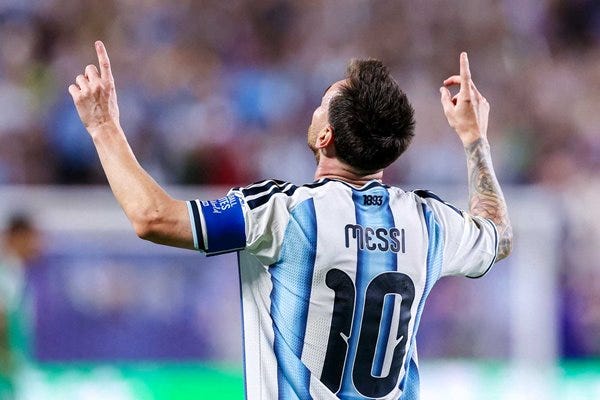
I have a privilege that millions of people around the world would give almost anything for. I get to see Lionel Messi play for Inter Miami CF at every home game. Despite the silly arguments, there really is no dispute: he is the greatest of all time. If you combine many of the greatest achievements of the legends of the game, Messi has accomplished more. In terms of greatness in the game, he is in a league of his own. As for me and my household, we have pink and black jerseys, t-shirts, hats, and even socks and shoes, and we wear them proudly as we march to Nu Stadium in Miami to cheer for our club. The window is closing since the GOAT is now 39 years old, but as long as he continues to play, we will be there with #10 on our backs.
I have been a soccer/football fan my entire life. I played as a young boy, then throughout high school, and had the joy of coaching for several years before having children of my own. When I was a kid, I attended the first Colorado Rapids game in Denver when the MLS was just starting. Now, the MLS has become one of the top 10 leagues in the world, and game days are filled with excitement. All around America, clubs are building their own stadiums, have developed strong supporters sections, and have attracted some of the biggest names in the sport. It is long past time for the most popular sport in the world to gain a foothold in the Land of the Free.
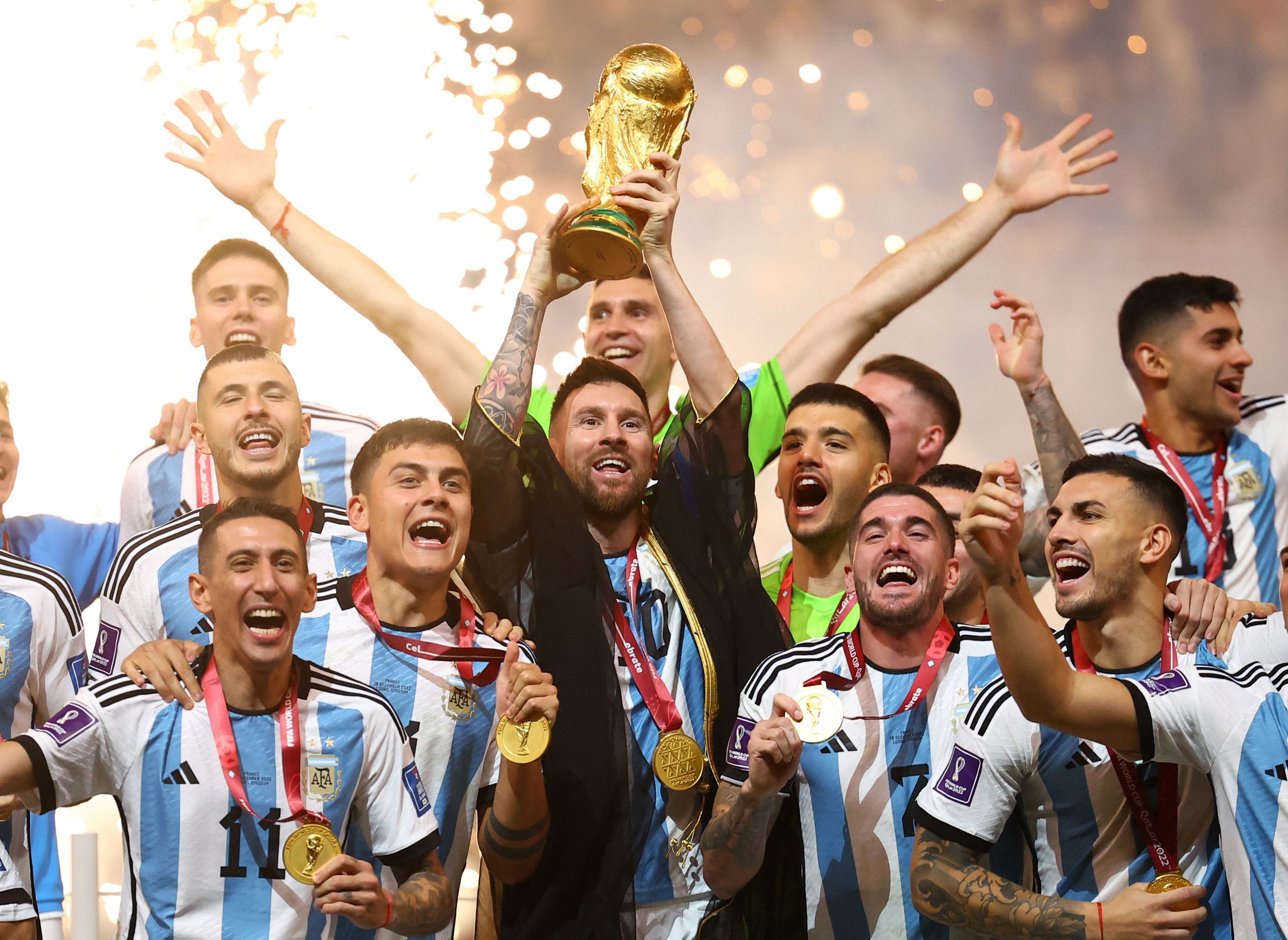
It has been an absolute joy this summer to see the World Cup in my own country. For a few weeks, a nation that mostly ignores the sport has paid attention. The United States played above expectations and then lost in the round of sixteen. While we all would have loved to see them go further, for an American men’s team, it was a real accomplishment. In my house, we have switched from our pink and black for a few weeks to our blue-and-white stripes, hoping that Argentina goes all the way so Messi can lift the trophy one more time before he retires.
One of the things I have always loved about soccer outside the United States is the culture it creates. Americans certainly love their sports and are loyal to their teams, but soccer culture is an entirely different animal. It builds community and a sense of belonging. The fans are just as much a part of every match as the players, through the highs and the lows. Entire communities shut down on match days while the pubs fill, the flags wave, and the cheers and boos echo through the neighborhoods.
Yes, soccer (and let’s be honest, it should always be called football, but that got hijacked by the pigskin, so we’ve settled) is only a game. It’s a game that generates billions of dollars in revenue, but it is a game. And many people will look at the World Cup and say that the whole pageant of flags and anthems is nationalism in fancy dress, the tribal instinct that gives us our wars, wearing shin guards. Neither argument is new, and the Greeks, who invented this kind of contest, answered both.
The plaything of God
The Greeks refused to set play against seriousness. Near the end of the Laws, Plato has his Athenian say that man “is contrived... to be a plaything of God, and the best part of him is really just that,” and that therefore “every man and woman ought to pass through life... playing at the noblest of pastimes.” He is not being precious. He means that a human being is most himself when he is caught up in something done for its own sake, the way a child is wholly given over to a game. Aristotle worked toward the same point from another direction. He observed that we labor in order to have leisure, and that the free activities we choose for their own sake, and not for what they produce, stand closest to happiness. A culture that can justify an activity only by its usefulness has lost the thread.
Johan Huizinga argued that play runs underneath civilization, that law, poetry, and worship all carry the marks of the game. Josef Pieper argued that leisure has the character of a feast and that culture grows out of it. A game is fenced by rules it does not need, aimed at a goal that means nothing outside the game, and played for no reason except the playing. That uselessness is the point. When eighty thousand people rise at once for a goal, they are practicing a posture the modern world has nearly mislaid, the posture of doing a thing purely because it is worth doing.
The New Testament shows no embarrassment about the stadium. Paul, who spent time in Corinth near where the Isthmian games were run, reached for the runner and the boxer when he wanted a picture of the Christian life. He told the Corinthians to run so as to win, and noticed that the athletes deny themselves for a wreath that withers while the church runs for one that does not (1 Cor. 9:24-27). The man who wrote much of the New Testament found the discipline of sport close enough to the discipline of holiness to preach from it.
A truce among the nations
Now, the second charge is that the flags are the trouble. Here, too, the games came first. Every four years, the Greek city-states, which spent most of their history at war with each other, sent their young men to Olympia, the sanctuary of Zeus, to compete. A sacred truce, the ekecheiria, was announced by heralds across the Greek world so that athletes and spectators could travel to the games and return home unharmed. It did not stop the Greeks from fighting. It did open a space, under the eye of the god, where rival peoples met as rivals and went home as neighbors, and where the thing they shared, a contest and a reverence, held for a season against the things that split them. The World Cup, like the Olympics, is the direct heir of that arrangement. It takes the tribal energy that gives us wars and binds it to a field, a referee, and ninety minutes, and it lets the nations meet as nations without anyone reaching for a sword.
A Christian has his own reasons to think the nations are not a mistake to be canceled. Scripture treats them as something God made and means to keep. The peoples were scattered at Babel under judgment, their single language broken into many (Gen. 11). Yet Paul told the philosophers in Athens that God “made from one man every nation of mankind to live on all the face of the earth, having determined... the boundaries of their dwelling place” (Acts 17:26). The nations are on purpose. When the Spirit fell at Pentecost, the disciples spoke in the many tongues of the crowd, and each man heard the gospel in the language of his birth (Acts 2). Babel’s scattering was healed by a gift that left the many languages standing and made them carriers of one message. And the vision John was given of the end keeps every particular in place: “a great multitude... from every nation, from all tribes and peoples and languages,” still distinct, on their feet before the throne (Rev. 7:9).
None of this blesses everything done under a flag. The same love of one’s own that fills a stadium with song fills the terraces with hooligans, and the nation a man should love the way he loves his father, is very easily loved as a god. The love is good, but the idol stands close beside it. The cure is to love the thing rightly, in its place, under God, which is a difficult discipline.
What the argument about the greatest is really about
If you’ve had any attachment to soccer, you know there are arguments, usually at volume, about the greatest of all time. To argue about the greatest is to assume that greatness is real and open to judgment, that there is a standard by which Messi, Maradona, and Pelé can be measured, and that certain human beings genuinely come near it. Aristotle had a word for that realized excellence. He called it a thing’s aretē, the full flourishing of what the thing is for, and he held that you cannot speak of a good knife or a good horse or a good man without it. To watch Messi take the ball in a crowd of defenders and come out the far side is to watch a human capacity carried to its edge, a body doing what a body can only just do. Plato would tell you the beauty you see there is really in the thing you are watching. In the Symposium he has the priestess Diotima describe a ladder that starts at the beauty of a single body and climbs toward Beauty itself, of which every lovely thing here below is a reflection. The phrase the commentators use without thinking, the beautiful game, is truer than they know. The beauty is really there.
Creatures of a day
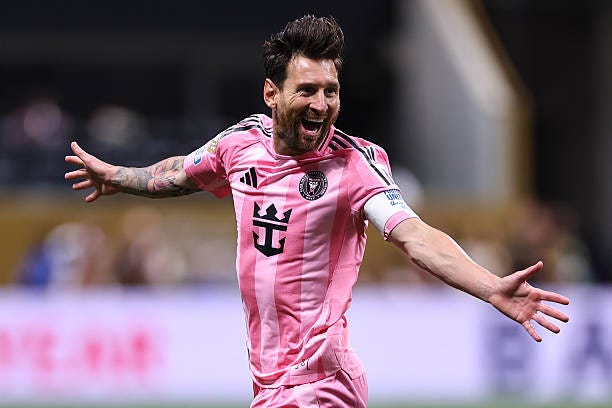
The Greeks who built the games also knew the thing I feel watching Messi now, and they hired their finest poet to say it. Pindar wrote victory odes for the champions of the games, and the lines of his that everyone still remembers close an ode written for a wrestler. “Creatures of a day,” he says. “What is someone? What is no one? Man is the dream of a shadow.” He set that inside a song of triumph, for a young man at the height of his powers, with the crowd still loud around him. The glory and the passing of the glory arrive in the same breath. Pindar’s next line is that when “the brilliance given by Zeus comes,” a light settles on a man and his days turn sweet. That gleam is what I am chasing when I walk into Nu Stadium. I want to see the light rest on the GOAT once more before it lifts.
The Greeks had one answer to how short it all is. Glory, kleos, the name kept alive by poets and by the bronze statues they raised to their victors at Olympia, so that the runner who died young keeps running inside the song. The Christian answer is even more physical. The body Messi has trained to its edge is not going to be thrown away. Paul says it is sown perishable and raised imperishable, that this mortal will put on immortality (1 Cor. 15). The excellence you catch for half a second on the field, and the ache that comes because it won’t last forever, are both telling the truth about a body glorified and a play with no clock on it.
So I will watch the rest of this World Cup with more than my ordinary investment. I will hope Argentina wins, and I will hope Messi lifts the trophy, and I will know while I am hoping that the trophy stands in for something larger than itself. What I am really after, when I want to see him hold it once more, is a world where greatness does not fade, where the nations come to the feast and keep their languages and their flags and their particular glory, and where the play runs on without a whistle. The World Cup cannot hand me that. It was never built to. What it can do, ninety minutes at a time, is show me the shape of the thing, and remind a distracted man that he was made for a feast he has not yet sat down to. That is what the World Cup is for.
And this is what the beauty of music is also all about. It points to the “altogether Lovely One”.