


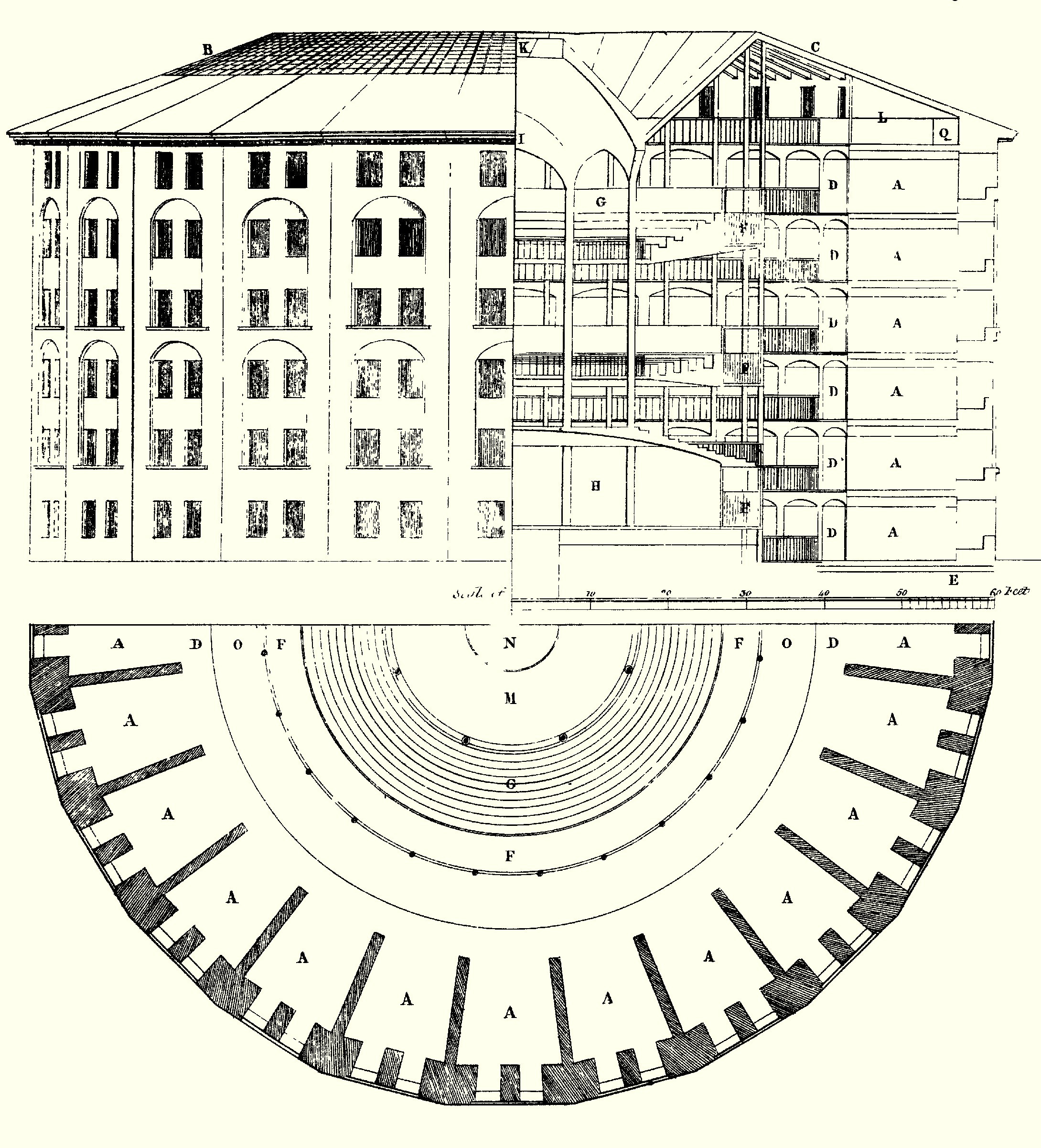
In 1787, Jeremy Bentham sketched a building. In this building, prisoners would sit in cells arranged in a ring, lit from behind, each one visible from a tower at the center. The inspector in that tower could see all of them, and none of them could see him. Of course that also meant the inspector didn’t have to be there at all. If a man doesn’t know whether or not he’s being watched, he will behave as though he always is.
Bentham was pleased with himself. He promised “Morals reformed, health preserved, industry invigorated, instruction diffused,” and then he called it “a new mode of obtaining power of mind over mind, in a quantity hitherto without example.” He named it the Panopticon, from the Greek for all-seeing. He described the plan’s central advantage as “the apparent omnipresence of the inspector.”
On June 29, 2026, the Supreme Court of the United States decided Chatrie v. United States. Justice Kagan wrote the majority, joined by Roberts, Sotomayor, Kavanaugh, and Jackson. Gorsuch also concurred in the judgment. The question was whether police conduct a search under the Fourth Amendment when they provide Google with a map and a time window and demand a list of every phone inside it. The Court said they did, then vacated and sent the case back to the Fourth Circuit to determine whether this particular warrant satisfied the probable cause and particularity requirements at each step. The government argued that two hours of location data is too small a slice to matter, a “Constitution-free zone” as Kagan characterized the claim. She answered that the size of the slice was never the problem, but that the government “can access all of a cell-phone user’s movements, in both public and private places,” and therefore “possesses a virtual panopticon with which to scrutinize its citizens’ activities.”
There was Bentham’s word. An eighteenth-century prison design was being used to describe an American’s telephone. Gorsuch wrote that the third-party doctrine “amounts to little more than a doubtful application of Katz that lets the government search almost whatever it wants whenever it wants.” When Kagan and Gorsuch find agreement, we can be certain there’s a problem with what the government wants.
One circle, one hour
Under the third-party doctrine, information you hand over to somebody else is no longer yours to protect. You gave your dialed numbers to the phone company, so the phone company can give them to the police, and no warrant is required. The rule was built for bank deposit slips and pen registers in the 1970s, but has been applied to cell phones. In 2018, in Carpenter v. United States, Chief Justice Roberts held that the government needs a warrant to obtain historical cell-site records, because a person does not surrender all privacy in his movements merely by carrying a phone that pings towers. A single observation can be innocuous, while a thousand of them stacked together are something of a different kind. He wrote, “A person does not surrender all Fourth Amendment protection by venturing into the public sphere.”
Chatrie is the sequel. On May 20, 2019, at about 4:50 in the afternoon, a man handed a teller at a credit union in Midlothian, Virginia, a note demanding $100,000, walked out with $195,000 in a bag, and disappeared. Witnesses and surveillance footage showed he had come from the corner of the church next door while appearing to talk on a cell phone. The police had nothing else to work with, so on June 14, they asked a Virginia magistrate for a geofence warrant directed at Google, drawing a 150-meter circle around the credit union and demanding the Location History of every phone inside it between 4:20 and 5:20 that afternoon. Location History records a phone’s position about every two minutes.
That circle took in all the data from the church next door, which the Supreme Court pointed out when it decided the case, quoting Google’s own amicus brief, where the company said that in its experience it is “common for a geofence to cover private homes, apartment buildings...hotels, [and] places of worship.” The scan returned 19 devices. Justice Jackson wrote that officers initially sought unbounded data and account information on all 19, and eventually settled on nine, though “even this shorter list may have been overbroad.” The data they received at step two was never confined to the circle, and for three of those nine devices it traced people to their homes, a school, and a hospital. So one scan to find one criminal took in a bank, a church, and the private movements of people whose only connection to the crime was being near it. Liberty should never be abandoned because it makes an investigator’s job easier.
Twenty billion scans a month
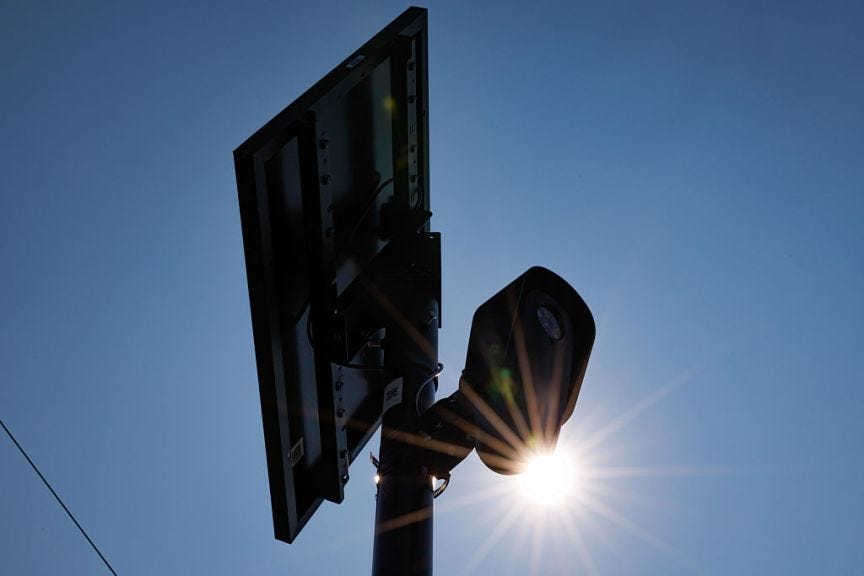
Flock Safety mounts small black cameras on poles that photograph every car that goes by, read the license plate, and log the time and location. The system also builds what the company calls a Vehicle Fingerprint, cataloging the car’s color, make, body style, and bumper stickers. Flock says it operates in more than 5,000 communities across 49 states and scans over 20 billion vehicles a month. Most people had no idea the cameras were being installed or that their city councils were signing the contracts.
Of course, a license plate is issued by the state, bolted to the outside of your car, and displayed on a public road for anyone to read. A police officer standing on a corner with a notepad has always been free to write down every plate that passes him, and nobody has ever thought he needed a warrant to do it. A camera on a pole does the same thing, but much faster. The problem, pointed out by Justice Roberts, is that the officer on the corner sees you once. He goes home with no memory of the eleven thousand cars that drove past him; however, a network of cameras and a searchable database does not merely observe you more quickly. It remembers and can be queried backward in time by anyone with a login.
Two residents in Norfolk, VA sued the city with the Institute for Justice, and discovery in that case produced the numbers. Over roughly four months, Norfolk’s cameras logged Lee Schmidt’s car 526 times and Crystal Arrington’s 849 times, about four to seven sightings a day. Neither had been charged with anything, nor were any crimes suspected. They were simply driving to work and running errands. The case is currently on appeal.
The arguments in favor of these cameras point to finding stolen cars and abducted children. Just this week in Florida, there was a report of an elderly man with dementia who was found because he was seen on a Flock camera. Some good things have resulted from the presence of the cameras. What the good results cannot do is answer who gets to use the data and for what, because that question is settled by the people behind the cameras.
Asad Zahir, an officer with the Shively Police Department in Kentucky, ran 2,048 searches on two vehicles registered to his ex-girlfriend between January and May of 2026. Two hundred forty-one of those came while a protection order against him was in force. He logged the reason as a drug investigation even though she had no drug history. In Haines City, Florida, Officer Christopher Goodson searched his estranged wife’s license plate 717 times over 21 months, from September 2024 through the end of June 2026. He filled in the reasons as road rage, drug possession, theft, fleeing police, and assault and battery even though she was never a suspect. Robert Josett of the Costa Mesa Police Department in California used Flock to find his mistress’s car and the cars of the other men she was seeing. He ran 13 unauthorized queries in California’s law enforcement database on her, on one of those men, and on his own wife. He contacted her thousands of times by phone and text over nine months and admitted driving past her home in violation of a restraining order. He pleaded guilty in April 2026 to three misdemeanors and was sentenced to three years of probation and a 52-week domestic violence program, with no time in custody. Each of these was an unauthorized use, and that is the point. The machinery seems fine when it is pointed at what we dislike, but it is also available to those who will use it on you without a warrant and without you ever knowing.
On August 31, 2026, the Florida Department of Transportation revoked all permits for automated license plate readers installed in state highway rights-of-way and gave agencies 30 days to take the devices down, citing the technology’s rapid expansion, reports of misuse, and data privacy concerns. Governor DeSantis said at a press conference that he wanted to keep Florida from becoming a “digital AI surveillance state where everything we’re doing is being tracked at all times.” Unfortunately, the order only addresses state roads, so cameras on city streets and county roads remain legal for now. So far, Florida is the only state to order the removal of hardware. Virginia, Oregon, Washington, Illinois, California, Tennessee, Arkansas, Colorado, Idaho, Kansas, Nebraska, and Utah have all passed rules governing how data is retained and used. More than fifty localities have canceled their contracts in the past year.
Flock has tightened its rules, requiring a case number for searches and shortening the time the data sits on the server. But Flock is only one, albeit the largest of many companies. Motorola Solutions doesn’t disclose camera counts, but it mounts cameras on repo trucks, parking enforcement vehicles, and commercial fleets that drive all day, and it pools scans through a system it calls the National Vehicle Location Service. Axon started selling plate readers on police dashcams in 2021 and rolled out two fixed models in 2025. When the city of Syracuse dropped Flock, it installed Axon and went on reading plates. Canceling a contract with one vendor often means nothing more than switching to another.
Flock CEO Garrett Langley went on Fox News in August and said that when people talk about privacy or safety, “they’re prioritizing the wrong thing, and what we have to prioritize as a country is compromise.” At the end of that month, his company held a police convention in Atlanta. Benn Jordan, a YouTube host who has been publicly critical of Flock, bought a ticket, and Flock revoked the ticket once it learned he would be there. A Flock employee even called his hotel and canceled the room he had booked for himself. So, Jordan parked on a public street outside the hall, ran a drone over the attendees as they left, intercepted the wireless microphone signals coming out of the building, and logged who was there. His summary was “Flock values their privacy. Oh well.”
At one point, nearly 200 police leaders complained that “activists” were reading publicly available audit records, so Flock stopped displaying the searching officer’s name, the plate queried, and the typed reason on its public logs. All searches went private. In Dunwoody, Georgia, Flock’s own employees pulled up cameras inside the Marcus Jewish Community Center to demonstrate the product to prospective buyers. One feed was labeled “Main Pool Right.” Another was labeled “Gymnastics.” In other words, a pitch to sell the cameras was relying on live footage of children at a Jewish community center without anyone’s knowledge. Gross.
So the compromise Langley wants is that his officers have their names withheld, his convention’s guest list is protected, and his employees are protected from surveillance, while the rest of us get photographed on the way to work, our children swim in the pool, or do gymnastics in a gym. Apparently, we are supposed to be good with that.
Is your car watching you?
In 2021, section 24220 of the federal infrastructure bill directed the Secretary of Transportation to issue a federal safety standard requiring every new passenger vehicle in America to carry what the law calls advanced drunk- and impaired-driving prevention technology. The statute defines it as a system that can “passively monitor the performance of a driver of a motor vehicle to accurately identify whether that driver may be impaired” and then “prevent or limit motor vehicle operation if an impairment is detected.” Congress wrote into its findings that this equipment “must be standard equipment in all new passenger motor vehicles.”
It is not a kill switch operated by someone outside your car, as some have claimed. The determination is made inside the vehicle by the vehicle’s software. NHTSA has admitted, “There is no clear and consistent engineering or industry definition of ‘impairment.’” The agency went on to explain that impaired “can mean anything that diminishes a person’s ability to perform driving tasks,” which it says could include drowsy driving and distracted driving alongside drunk driving. So there is an undefined standard with automatic enforcement, and no way to appeal a decision your car makes on its own. The agency laid out three options: detect blood alcohol, monitor the driver for impairment, or do both. The alcohol research uses infrared light shone through the skin of your hand at the ignition or the steering wheel. The driver-monitoring option is a camera pointed at your face. Suppliers told NHTSA about eye-gaze systems that track where your eyes are focused, and about in-cabin sensing that tracks head position and attention. The rules have been delayed in Congress, but efforts to kill the mandate altogether have gone nowhere. The mandate is law and the engineering is behind schedule.

A camera in your dashboard is not yet a panopticon, but it is certain that eventually, the records will be available to somebody who is not in the car. In August 2024, Texas Attorney General Ken Paxton sued General Motors for collecting driving data from more than 1.5 million Texas drivers and selling it to LexisNexis and Verisk, which resold it to insurers who used it to raise rates and deny coverage. Drivers had no idea. In January 2025, the Federal Trade Commission entered an order barring GM from disclosing driver behavior data to consumer reporting agencies for five years, and by 2026 GM had agreed to a multimillion-dollar settlement over the practice. Event data recorders in your car are already subpoenaed in criminal cases and pulled in civil discovery. Telematics data has been used in litigation for years.
Take all the info as one reality. Congress has mandated a camera watching the driver of every new car. Automakers have already demonstrated that they will sell what their cars observe. Courts already compel production of what cars record. Nothing in section 24220 forbids the resulting data from leaving the vehicle, and no federal privacy statute stands in the way. The requirement to build the eye is on the books, and it will happen. Unless the law is changed, it was never a question of “If.”
“If you’re not doing anything wrong...”
Defenders of mass surveillance often say, “If you’re not doing anything wrong, you have nothing to worry about.” Whenever I hear that, my eyes nearly roll out of my head. The assumption is that “wrong” is a fixed quantity, defined however the person saying it wants. In the realm of surveillance, “wrong” is whatever the people controlling the databases say it is. Every surveillance system will eventually be operated by people who regard your convictions as a problem.
In 2012, Justice Sotomayor wrote that GPS monitoring generates “a precise, comprehensive record of a person’s public movements that reflects a wealth of detail about her familial, political, professional, religious, and sexual associations.” She then quoted a New York decision cataloging what such data exposes, including “trips to the psychiatrist, the plastic surgeon, the abortion clinic, the AIDS treatment center, the strip club, the criminal defense attorney, the by-the-hour motel, the union meeting, the mosque, synagogue or church, the gay bar and on and on.” She concluded, “Awareness that the Government may be watching chills associational and expressive freedoms.”
This was Bentham’s design. You may or may not be watched by people who will someday disagree with you about what “wrong” is, and you will never know which. Are you willing to take that chance on the conviction that you will never be interesting to the watching eyes? It’s a wager you are placing on behalf of your children and grandchildren.
The enemy test
When thinking about new powers, I always like to ask, “How would my worst opponent use this against me?” If the answer is frightening, it is likely too much power. You may trust the authorities who currently hold the power, but authorities in power are temporary, so your trust in any particular administration or individual is beside the point.
After September 11, the NSA began collecting Americans’ telephone records in bulk under an interpretation of the Patriot Act that Congress never authorized. The stated purpose was terrorism. In 2020, the Ninth Circuit held in United States v. Moalin that the bulk collection of telephone metadata violated the Foreign Intelligence Surveillance Act and may also have violated the Fourth Amendment. That was seven years after Edward Snowden heroically disclosed the program’s existence. The Privacy and Civil Liberties Oversight Board, reviewing the same program, concluded that it had not identified a single instance in which it made a concrete difference in a counterterrorism investigation. So a program with no demonstrated benefit ran for over a decade against millions of Americans who were never suspected of anything, and it wasn’t stopped until a whistleblower stepped up and said something.
In February 2022 in Canada, truckers blockaded downtown Ottawa and several border crossings for weeks. The government invoked Canada’s Emergencies Act and issued an economic order directing banks to freeze the accounts of people connected to the protest, without a court order, charges, or hearings. Financial institutions were given a list of names, and the banks complied. 257 accounts were frozen, totaling approximately $8 million, along with 170 Bitcoin wallet addresses. Assistant Commissioner Michel Arcand later told a House of Commons committee that freezing the accounts was intended to encourage the protesters in Ottawa to leave and discourage anyone else from joining them. This is the panopticon functioning in the bank. There was no evidence of a crime, and there doesn’t need to be when a man with a mortgage and a truck payment can be forced into submission without ever being arrested or charged. Make sure he can’t buy groceries, and compliance will follow.

On January 16, 2026, the Federal Court of Appeal held that the government never demonstrated reasonable grounds to believe a national emergency existed, and that the freezing scheme was “ad hoc and fraught with confusion,” conducted without a warrant or specific procedures. The searches, the court concluded, were not reasonable within the meaning of section 8 of the Charter. Ottawa has asked the Supreme Court of Canada to hear the case, so the fight is still ongoing. But winning a court case in 2026 cannot undo the damage of 2022. These were truck drivers, not terrorists or hardened criminals. They were doing something the government didn’t like, so they were attacked through the institutions that were supposed to serve them.
Informers paid by the head
Under Queen Elizabeth, the Act of 1593 punished anyone over the age of sixteen who stayed away from the parish church for a month or attended what the statute called unlawful conventicles. The penalty was imprisonment without bail until the offender conformed, and permanent exile from the realm if he refused for three months. John Bunyan was arrested in November 1660 under that act, refused to promise to stop preaching, and spent the next 12 years in the Bedford jail.
After the Restoration, Parliament passed the set of laws called the Clarendon Code. The Conventicle Act of 1664 added the rule that no more than five persons beyond a household could gather for worship outside the parish church, on pain of fines, imprisonment, and transportation. When Parliament renewed the act in 1670, the new version allowed a single justice of the peace to convict a preacher on the word of a single informer, and it paid that informer a third of the fines collected. The English government monetized the whole fiasco. If the powers that existed wanted to know who was preaching in a barn outside Bedford, it was profitable for somebody in the barn to report it. They didn’t need cameras; they just needed to offer a few bucks and instill the constant fear that someone in their midst might report them. Similar things happen in North Korea every day.
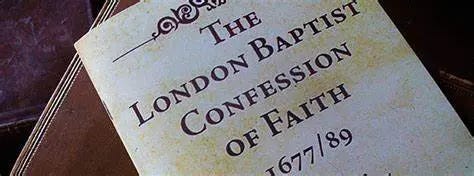
In 1677, the Second London Baptist Confession of Faith was published anonymously, because attaching their names would have identified the signers as enemies of the state and church. In 1689, after the Glorious Revolution and the Act of Toleration, they were legally allowed to assemble, so they republished the confession under their own names. Those were the men who wrote that “God alone is Lord of the conscience, and hath left it free from the doctrines and commandments of men which are in any thing contrary to his word, or not contained in it.” The same paragraph goes further, and says, “to believe such doctrines, or obey such commands out of conscience, is to betray true liberty of conscience,” and requiring “an implicit faith, and an absolute and blind obedience, is to destroy liberty of conscience, and reason also” (2LBCF 21.2). Men who had watched neighbors get paid to report an “unauthorized” sermon understood that a conscience under observation is a conscience under pressure.
The sword and the eye
Investigating a particular person for a particular crime is ordinary justice. Paul says the magistrate carries the sword as God’s servant for our good, “a terror not to good conduct, but to bad,” and “an avenger who carries out God’s wrath on the wrongdoer” (Rom. 13:3-4). Peter says the same, that governors are “sent by him to punish those who do evil and to praise those who do good” (1 Pet. 2:14).
The point made by Paul and Peter is that the sword follows the deed. It is aimed at the wrongdoer, and the singular matters, because it presupposes a particular person who has done a particular thing. In other words, there is a specific accusation, and a specific answer. The magistrate’s authority begins with identifying the unlawful act and works backward to the person who committed it. The requirement of the Fourth Amendment to the US Constitution that a warrant describe “the place to be searched, and the persons or things to be seized” is a civil expression of the same logic. Particularity is what distinguishes a magistrate from a warden.
Total, permanent, suspicionless watching over a whole population inverts the biblical order. It begins with everyone and narrows afterward, if at all. There are no defendants because there is no decision on who the defendant will be. The entire population is a standing pool of suspects being treated as guilty until proven innocent of unspecified, previously undetermined crimes. That is not the sword described in Romans 13.
Exhaustive knowledge of every man’s comings and goings is an incommunicable attribute of God. The surveillance state is counterfeiting something that belongs to God alone, and counterfeit omniscience in the hands of those who can imprison you is a disaster waiting to happen. Jesus said, “Nothing is covered up that will not be revealed, or hidden that will not be known. Therefore whatever you have said in the dark shall be heard in the light, and what you have whispered in private rooms shall be proclaimed on the housetops. I tell you, my friends, do not fear those who kill the body, and after that have nothing more that they can do. But I will warn you whom to fear: fear him who, after he has killed, has authority to cast into hell. Yes, I tell you, fear him!” (Luke 12:2-5). He had just warned the disciples about the leaven of the Pharisees, which is hypocrisy (Luke 12:1). The exposure He promises is first a warning. Every secret you have is already known, and the Judge who knows it does not need a warrant, a subpoena, or a camera on a pole. That is why “I have nothing to hide” is the wrong answer for a Christian. You already know you have plenty to hide and that God has seen it all. What the gospel offers is a verdict already rendered in Christ, which is the only reason a man can stand under total exposure without terror. The men Jesus spoke to directly were about to be hunted down for preaching, and He told them the worst their hunters could do was kill them.
I don’t expect American Christians to be rounded up by the end of the year. That isn’t the point. Tyranny rarely opens by shutting down churches. It opens by building the apparatus and persuading everyone that the apparatus is for their good, and that part is well underway. The historic positions of the church on sex, marriage, the nature of man, gender roles, creation, and the exclusivity of Christ are already described as harmful by some institutions with real power. Once a belief is harmful, holding it stops being “doing nothing wrong” and becomes a reason to watch, then to restrict, then to prosecute. Ask yourself what a man who holds your file and disapproves of your convictions would do with 526 photographs of your car.
Trusting that no watcher can usurp the omniscient, omnipresent God who does all things well is what makes Christians useful in this fight rather than hysterical about it. We can be vocal without panic, because our safety has never depended on how the argument turns out. We should fight warrantless searches and bulk data collection, oppose the cameras, and insist on the Fourth Amendment, using every ordinary means available to citizens: city council meetings, contract votes, state legislatures, and the courts. Americans have privileges most of the world can only imagine, and those privileges have given the church room to work. We should exercise our rights as citizens while trusting the sovereign hand of God.
Langley wants us to compromise. May it never happen. The freedom of your children and grandchildren is at stake.
Jeremy Bentham, Panopticon; or, The Inspection-House (Dublin: Thomas Byrne, 1791).
Chatrie v. United States, 609 U.S. (2026).
Carpenter v. United States, 585 U.S. (2018).
“Schmidt v. Norfolk: The Flock Camera Lawsuit,” DeFlock ILM.
Infrastructure Investment and Jobs Act, Pub. L. No. 117-58, § 24220, 135 Stat. 429 (2021).
United States v. Jones, 565 U.S. 400, 415 (2012), quoting People v. Weaver, 12 N.Y.3d 433, 441-42 (2009).
United States v. Moalin, 973 F.3d 977 (9th Cir. 2020).
Privacy and Civil Liberties Oversight Board, Report on the Telephone Records Program Conducted under Section 215 of the USA PATRIOT Act and on the Operations of the Foreign Intelligence Surveillance Court (Washington, DC: PCLOB, January 23, 2014), 11.
Canada (Attorney General) v. Canadian Civil Liberties Association, 2026 FCA 6 (January 16, 2026).
Religion Act 1592, 35 Eliz. 1, c. 1 (commonly dated 1593).
Conventicle Act 1664, 16 Cha. 2, c. 4.
Conventicles Act 1670, 22 Cha. 2, c. 1.
Thank you for the informative and biblical take on this issue. Certainly watching it unfold which is concerning and sometimes wonder who else sees the potentially nefarious side of it.
Literally read the word “panopticon” for the first time this morning and the second time just now.
Good timing. It’s all so very troubling.