


There is a peculiar irony unfolding across Western Civilization. For decades, our institutions decided that the engineer, the data scientist, and the software developer were the heroes of the modern age. Philosophy was, at best, a luxury, and focusing on ethics was intended to fulfill HR requirements rather than actually shape decision-making. STEM was the future; the humanities were the past. And so, our universities, companies, government agencies, and cultural gatekeepers began defunding, dissolving, and disposing of the very disciplines that had asked human beings, for three thousand years, one of the most important questions of all: Should we?
And now, the machines have arrived. They are coming for the engineers first.
By The Numbers
Goldman Sachs issued a now-famous report estimating that approximately 300 million full-time jobs worldwide could be exposed to automation due to generative AI. The McKinsey Global Institute adds that AI could automate up to 30% of hours currently worked across the U.S. economy by 2030. The World Economic Forum (AKA The Illuminati) projects that more than 7.5 million data entry jobs will be eliminated by 2027, the largest anticipated job loss in any single profession.
These are the projections of investment banks and management consultancies. These are the people who built the economy that is now being automated.
According to IEEE Spectrum, overall employment among programmers in the United States fell by 27.5 percent between 2023 and 2025. Hugo Malan of Kelly Services stated, “What nobody predicted was that the biggest impact by far would be on programmers.” A Stanford Digital Economy Study found that employment for software developers aged 22 to 25 declined nearly 20% from its peak in late 2022. Entry-level hiring at the fifteen biggest tech firms fell 25 percent from 2023 to 2024. A survey of hiring managers found that 70% believe AI can already do the work of interns, and 57% trust AI’s output more than that of recent graduates.
We told every young person in America to study code, to abandon the essay for the algorithm, to trade Shakespeare for Python. Now the machines write Python too.
The Prophet of Abundance
Speaking at the Viva Technology conference in Paris in 2024, Elon Musk declared that in the best-case scenario, “probably none of us will have a job.” Work would become “optional,” something one might do as a hobby, the same way a person might grow vegetables in a backyard. At the U.S.-Saudi Investment Forum, he predicted that within a decade or two, work will be optional, and that money itself will “stop being relevant”, like oxygen, so abundant one ceases to think about it.
In December 2025, Musk posted on X that “there will be no poverty in the future and so no need to save money.” In its place: not universal basic income, but universal high income. No details were forthcoming regarding mechanism or timeline, just the vision, vast and gleaming, from the richest man on the planet to the rest of us still paying mortgages.
One does not wish to be churlish about visions. The prophets had them. But the prophets, to a man, also paired their visions with moral demands. They did not announce that the lion would lie down with the lamb and then decline to address the lamb’s reasonable concerns about the interim period. Musk’s vision includes a question he does not appear to have noticed: If the machine does everything, what is a human being for?
He sensed the abyss, briefly. At VivaTech, he paused and asked aloud: “If the computer and robots can do everything better than you, does your life have meaning?” He then answered his own question by suggesting that perhaps humans would give AI meaning. Man, the crown of creation, repurposed as the emotional support animal of the algorithm.
A Civilization That Forgot to Ask Why
The defunding of wisdom was never only a university problem. It ran through every major institution we have. In the corporate world, the last thirty years produced a thoroughgoing cult of the technical. Companies built ethics departments as legal shields, genuine inquiry being something they could not afford or did not want. They hired compliance officers to protect against liability and excluded philosophers from asking whether the product should exist. The question “Can we build this?” received billions in capital. The question “Should we build this?” received, at best, a paragraph in an annual report.
Government followed suit. The great policy arguments of our age have been almost entirely technocratic. We debate the mechanics of healthcare delivery without asking what healthcare is actually for or whether it’s the government’s responsibility to fund it. We debate the efficiency of education systems, setting aside the question of what a human being is and what it means to become one. We have filled our regulatory agencies with economists and engineers, and excluded theologians and philosophers. The result is a government that can model outcomes and measure productivity, but cannot articulate purposes or say what all the productivity is for.
This is not entirely the fault of the technocrats. We asked for them just like the Israelites asked for a king. Didn’t go so well. Now, the important questions about the common good, what justice requires, what it means to be human, go unasked because we have gradually stopped educating citizens who knew how to ask them.
The universities are where this failure was most nakedly visible. It is there that civilizations supposedly decide what is worth knowing. And what they decided, over a generation, was that the humanities were a luxury the market would not support. West Virginia University eliminated 28 majors and 143 faculty positions, among them world languages, linguistics, and music. Missouri Western State University cut majors in English, history, philosophy, political science, economics, sociology, art, Spanish, and French. Clarkson University closed its entire School of Arts and Sciences. In North Carolina, a law made arts and humanities professors ineligible for distinguished professorships at public universities; only STEM programs qualify. The University of Wisconsin’s president suggested shifting away from liberal arts toward career-specific programs, particularly for institutions serving low-income students, as though the poor have less need of wisdom than the wealthy.
The American Academy of Arts and Sciences reports that the number of humanities bachelor’s degrees conferred nationally fell 18 percent from 2012 to 2021, with declines exceeding 25 percent in most of New England, the upper Midwest, and the Pacific Northwest. We looked at the cathedral and decided the flying buttresses were unnecessary. We kept the nave because it held more people, and demolished the spire because nobody lived in it.
What the Liberals Did to the Liberal Arts
The defenders of the humanities have not always been worth defending. The liberal arts in their classical form were a rigorous training in how to think, how to read, how to speak, how to reason, and how to inhabit the moral universe with some degree of integrity. Grammar, logic, rhetoric. Arithmetic, geometry, music, astronomy. Above these, the great inheritance of the West: Homer and Virgil, Plato and Aristotle, Augustine and Aquinas, Dante and Shakespeare, Calvin and Burke. The Great Books were assigned because they addressed, with depth and seriousness, the questions every human being in every age must eventually face: What is justice? What is love? What is death? What do I owe my neighbor? What do I owe God?
Over the past several decades, the academic humanities exchanged this inheritance for a set of questions considerably smaller and more recent. Gender studies displaced moral philosophy. Critical theory displaced history. Postmodern literary criticism, in which no text means what it says and every author is secretly confessing a will to power, displaced the actual reading of texts. The great books were placed under suspicion. The tradition was declared a conspiracy.
The result was self-destruction. Students arrived hoping to encounter the permanent questions and were handed the provisional answers of mid-twentieth century French philosophers instead. Parents who sent their children to study the wisdom of the ages watched them return fluent in resentment and innocent of Cicero. When the budget committees gathered to decide which departments to cut, the humanities faculty, having spent a generation arguing that their own tradition was a vehicle of oppression, found themselves unable to make the case that it was worth funding. They had sawed off the branch and were surprised to find themselves on the ground.
The tragedy is real, but the cure is recovery, not demolition. The moment requires a return to the Great Conversation: the books and arguments that formed the conscience of Western civilization across three millennia. It is the recovery of the conviction that the dead have something to say to the living, that Aristotle’s question about the good life and Augustine’s question about the restless heart are not academic curiosities but the most urgent questions of our moment. We need that conversation now, perhaps more than ever before.
The Lance Armstrong Principle
There is an argument made in AI circles, sometimes explicitly and more often as an unspoken premise, that says: we cannot slow down, because if we do, someone else, like China or a less scrupulous company, will get there first. We have no choice but to race.
This, I will call the Lance Armstrong Principle. When Armstrong was winning everything in the cycling world, he did not get into doping because he was a villain. He doped because everyone was doping, and if he didn’t do it, he had no chance of winning. Check out his 30 for 30 episode on Netflix. The system had been so comprehensively corrupted that individual virtue had become structurally irrational. The honest cyclist finished last. By the logic of the race, the honest cyclist was a fool.
The same logic now governs the AI industry. As one analysis observed, when the leading AI company signals internal panic, “the danger is that it might pull the entire sector into a race for speed.” It overrides technical readiness and safety margins. The competitive pressures are severe. Investors have expectations, and there are high-stakes geopolitical risks involved. Nobody thinks they can afford to ask whether the race itself is wise. They can only run faster.
The Armstrong defense actually establishes that a corrupt system produces corrupt incentives. It does not establish that corruption is therefore acceptable. Armstrong’s defense was a confession: of personal weakness, yes, but also of systemic failure. The question he never asked was: Should the race be run this way at all?
That question requires ethics. Ethics requires philosophy. Philosophy requires the liberal arts. We cut them.
Even inside the industry, something like conscience occasionally surfaces. Anthropic CEO Dario Amodei said in a 60 Minutes interview that he is “deeply uncomfortable with these decisions being made by a few companies, by a few people.” When Anderson Cooper asked, “Who elected you and Sam Altman?” Amodei answered: “No one. Honestly, no one.” This is the confession of a man who knows that what is happening exceeds the authority of those doing it. The honest answer to that confession is that more people formed by the Great Tradition ask questions that cannot be answered with a benchmark.
The Pre-Fall Gift
The deepest problem with the Musk vision is theological.
Christians have long known that work entered the world before the Fall. God placed Adam in the garden to “work it and keep it” (Genesis 2:15), before the serpent, before the curse, and before the sweat and thorns of Genesis 3. Work is the form given to human dignity before sin existed. The curse of Genesis 3 does not introduce work; it curses work, making it painful and frustrating. What the gospel restores is the meaning of labor, its participation in God’s creative and sustaining purposes.
John Calvin was instrumental in developing a doctrine of vocation: the conviction that every lawful occupation, pursued faithfully and for the good of one’s neighbor, is an act of service to God. The cobbler glorifies God by making excellent shoes. The magistrate glorifies God by pursuing justice. The teacher glorifies God by forming minds. There is no sacred-secular divide in this vision, only faithful work and unfaithful work, work offered to God and work offered only to self.
What becomes of this vision when work is optional?
Musk imagines a world in which human beings, freed from labor, pursue whatever they find meaningful. This assumes that meaning is generated from within, that the self, freed from external obligation, will naturally flower into purpose. The entire testimony of human history argues otherwise. Purpose is forged in obligation, in service, in the irreplaceable weight of being needed. The man who builds a house for his children knows a satisfaction no recreational activity can replicate, because the house matters to someone beyond himself. The surgeon who heals, the farmer who feeds, and the pastor who walks with the dying all have a sense of calling. They participate in something larger than themselves. A universal income, however high, cannot manufacture that.
Aristotle understood this before the incarnation. Eudaimonia (human flourishing) was the full actualization of human capacities in virtuous activity, achieved through engagement with the world and with other persons. Thomas Aquinas insisted that the active life and the contemplative life were complements, the hand and the mind of a single vocation to love God and neighbor. Augustine wrote that our hearts are restless until they rest in God, and he did not mean restless in the sense of unemployed. He meant restless with love, with longing, with the irreducible hunger to give oneself to something worthy of the gift.
A civilization of optional work, sustained by machines and subsidized by universal high income, is the negation of this vision.
The Question We Are No Longer Qualified to Ask
We have arrived at the most consequential ethical crossroads in human history. The questions of what a person is for, what work is for, what technology is for, and what it means to flourish have never been more urgent. We have spent the last three decades systematically defunding, dismissing, and dissolving the academic disciplines whose entire purpose was to address precisely these questions, while simultaneously allowing that same dismissal to infect our corporations, our government, and our cultural common sense.
Philosophy asks: What is the good life? We cut it. Ethics asks: What obligations do we have to one another? We cut it. History asks: What happens when power outruns wisdom? We cut it. Theology asks: What is the human person, made in the image of God, called to be? We cut it. Literature asks: What does it mean to suffer, to love, to die, to hope? We cut it.
STEM asked: Can we? We funded it without limit.
Now the machines can code. They can analyze data, draft legal briefs, read radiology scans, and write marketing copy. The one thing the machines cannot and will never be able to do for reasons having nothing to do with processing power is care. They are made in no image that matters.
We need the humanities. We need theologians who understand purpose and vocation, philosophers who understand anthropology, historians who understand what happens when technology outruns wisdom, and ethicists who can walk into a boardroom and make the engineers productively uncomfortable. We need citizens formed to ask hard questions.
The Spire Was Not Decorative
There is a famous Chesterton observation about the man who tears down a fence without asking why it was built. The reformer who cannot give a reason for the fence has no business removing it. The fence, it turns out, was holding back something that needed to be held back.
We tore down the humanities because they seemed ornamental. Those who thought themselves sufficiently enlightened saw the humanities as something to study when one could not do something useful. The implicit argument was that the liberal arts were a finishing touch, pleasant for those who could afford them, but not load-bearing. You could remove them without structural consequence.
But they are load-bearing. They hold back the question Can we? from swallowing the question Should we? The humanities insist, with tiresome repetition across three thousand years of civilization, that the technically possible and the humanly wise are different things. They form people who can stand in the room where the decision is being made and say: What is this for? What does this cost? Who bears the cost? What are we becoming?
We fired those people. In some cases, we convinced them to fire themselves by persuading them that their tradition was an oppression to be dismantled rather than a gift to be passed on. Either way, the room is now full of very capable people who can tell you exactly what can be built, and almost nobody is trained to ask whether it should be.
The question was never Can we build a machine that does everything a human does?
The question was always: What is a human being?
We should have kept the people who knew how to ask it.
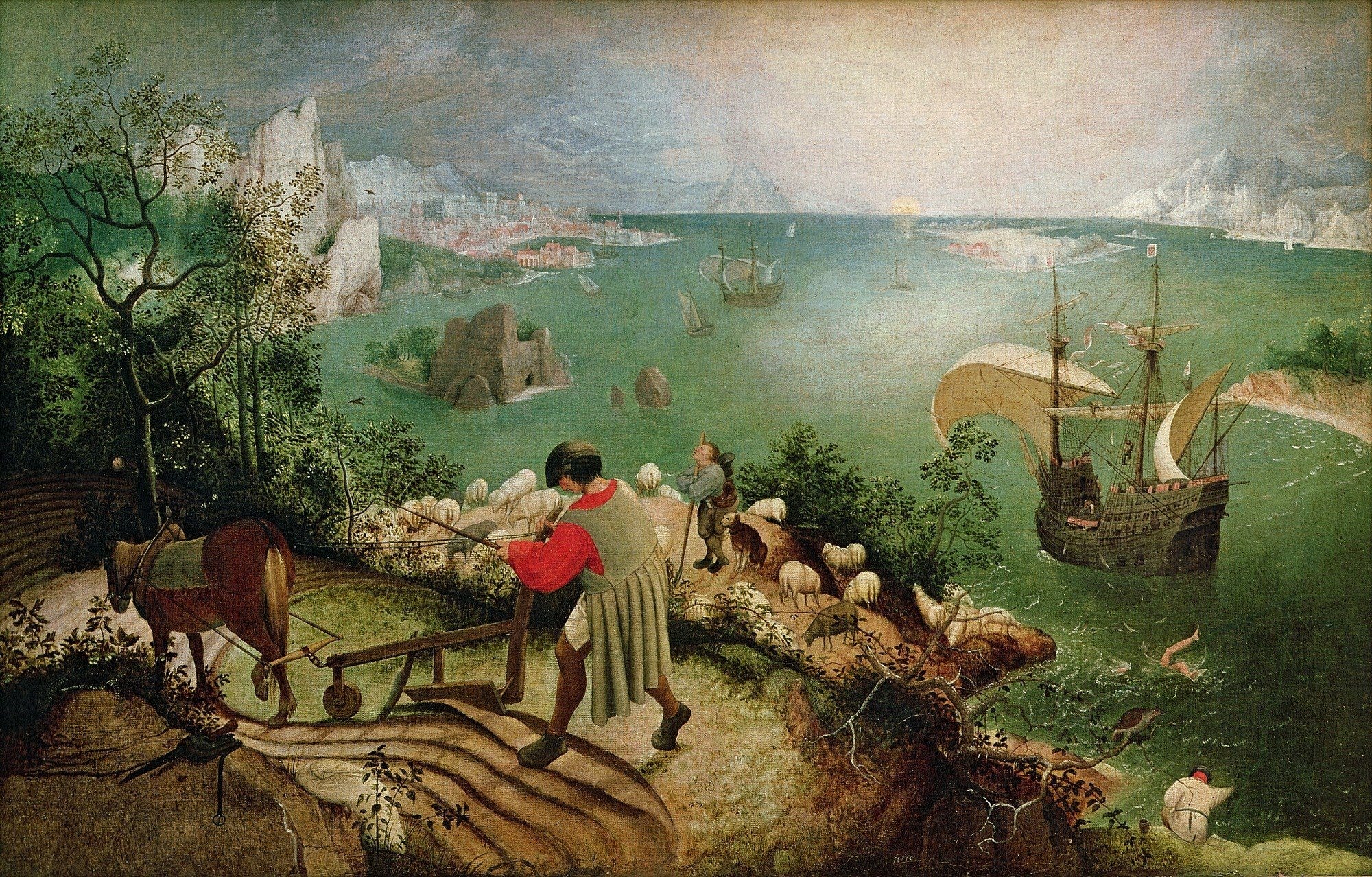
The painting at the top of this article is Landscape with the Fall of Icarus by Pieter Bruegel the Elder (c. 1558). This Renaissance masterpiece depicts the mythical fall of Icarus, who flew too close to the sun with wax wings crafted by his father, Daedalus, and ignored warnings, melting into the sea. Icarus’s hubris and ambition lead to his downfall, yet the world (ploughman, shepherd, ships) continues indifferently. Notice Icarus in the background with his legs splashing in the water.