


For over 18 years, I have been a preacher, a teacher, a writer, and an academic. I pay close attention to words. At least twice every month, I listen to the sermon I preached that week, and I usually read articles or papers I write six or eight times after they are published to learn what I could do better. When I do interviews or podcasts, I listen to them. It only took a few years before I was comfortable hearing my voice. My goal is to continue improving my communication; however, more important than reading edited publications or listening to crafted sermons or lectures, I try to pay attention to what I say in my daily conversations.
Years ago, I read a book (I wish I could remember what it was) in which the author recalled a time when she gave a sales pitch at a business meeting. She was convinced that she hit a home run. The response in the room was positive. People were engaged. The goal was accomplished. When she left the room, her boss asked, “How do you think it went?” She said, “I think it went great! We are going to close that deal.” Immediately, her boss replied, “You sound stupid when you always say ‘um.’ You need to stop doing that.” Ouch. That’s probably not what anyone wants to hear, but reading that inspired me to pay closer attention to my speech patterns. What do I say that makes me “sound stupid” or confused, unsure, or uncomfortable with the English language?
Most people rely on filler words in conversation. We have become so accustomed to hearing them that we can usually tune them out. But I assure you, now that I am drawing your attention to them, you cannot not notice them.
Filler words are words that fill the gaps in our speech. For many people, it happens when thinking of what to say next. For others, they have become so ingrained they cannot get through a sentence without them. Have you, like, had a conversation with, like, a teenager lately? Even though I have been on a quest for years to eliminate unnecessary fillers from my discussions, they still creep in. We are creatures of habit, and we are imitators of what we hear. Have you ever traveled to a foreign country, and by the end of the trip, you started to sound a little more like your hosts? Not everyone agrees with my heroic efforts to improve our interactions, but I never mind raining on a parade.
With the risk of sounding like a snobbish bore (please don’t forget, I already admitted I am still a work in progress), I want to point out eight fillers I hear most often and offer a few suggestions:
1. Um
This is the most common filler word and the most difficult to eliminate, in my experience. It is the go-to “I am thinking” sound we make when attempting to gather thoughts. As strange as it may be, record yourself in a conversation sometime and listen to it. How often did you say, “Um…”? Instead of uttering that meaningless locution, try pausing and waiting until your thoughts are clear.
2. So
Many years ago, I was visiting a good friend in New York, and it struck me how often I heard people start sentences with the word “So.” For added pizzaz, some of my interlocutors would say, “So, so, so…” in a quick staccato. I can happily begin a sentence with an adverb, but hopefully, it makes sense. After that trip, it seemed like the trend picked up steam, and I started hearing it in other parts of the country. My hopes that it was regionally isolated amongst those who do not realize people actually live in places between NYC and LA were dashed. This filler seems to attempt to add emphasis, but when everything is emphasized, the power evaporates. It is like an email with an exclamation point at the end of every sentence! In this case, the excitement is front-loaded. Dial back the enthusiasm—not everything needs sparkle.
3. Like
This one is so, like, obvious, like, I probably don’t even need to, like, mention it. My children are particularly fond of me attempting to eliminate this from their sentence structure. Just ask them. It is a particularly prevalent sin among younger generations, and we will all be better off when it ends. What does the sentence, “We were, like, eating our lunch” actually mean? The intent was to say, “We were eating our lunch,” but it sounds like the individual was doing something similar to eating lunch, but not exactly. The only tip I have to offer with this one is to stop. Please. I am begging you.
4. Just
Most Christians have sat through (or uttered) a “just” prayer: “Lord, we just want to thank you…Lord, we just want to ask you…” This is often a well-meaning attempt at humility; however, to say “just” in this context is to make it a small thing. Next time you call your friend and say, “I just want to ask if you can help me move next Saturday,” stop and consider whether or not the magnitude of what you are asking is really “just” a little something. I would rather roll around in an ant pile than involve myself in lending my middle-aged body to a relocation adventure. I have done it enough myself to fill a lifetime. If I don’t have a good excuse to say “no,” I am sure I will be there, but don’t you dare say you are just asking me to help.
5. I feel like/this feels like
We sure are an emotional bunch these days. Everyone seems to be feeling instead of thinking or believing. “I feel like” or “this feels like” is not really a filler. It is just incorrect in most instances. Around the time everyone was taught that feelings were more important than declarative statements, this sneaky rhetorical nuisance crept in. If someone says, “I feel like the sky is particularly blue today,” I want to ask, “What does that feel like?” I try not to be annoying, so I never ask (unless we share a last name), but how often do you say you “feel like” something that is not a feeling at all? It might seem like the sky is especially blue today, or you might think it looks extra blue today, but the sky isn’t giving you a warm hug. It doesn’t feel like anything. What are you communicating if, for example, you are sitting in a planning meeting and say, “I feel like we should update our website?” You may be attempting to put out some chill vibes, bro, but you aren’t sounding very confident. Tell the people what you think or believe. Leave the “I feel like” to describe physical realities.
6. You Know?
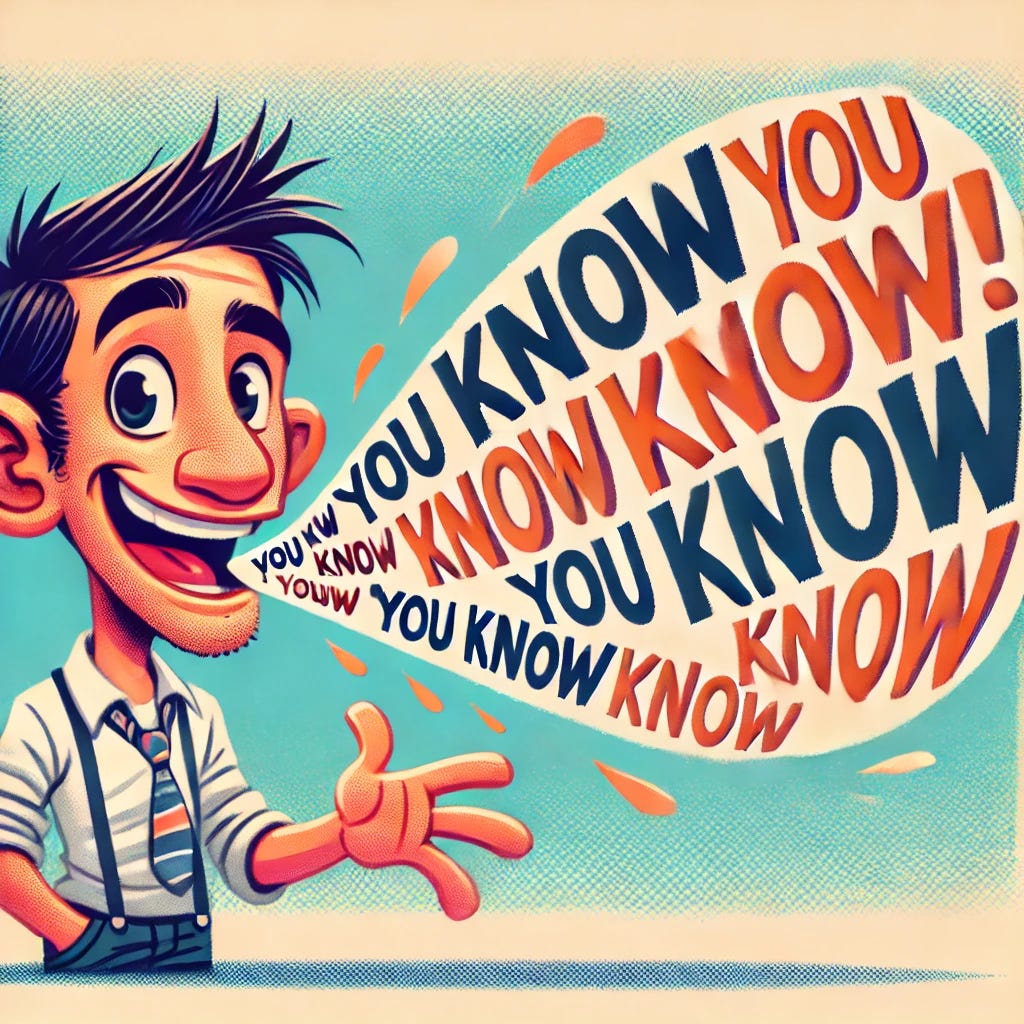
Good luck trying to escape a conversation without hearing this one, you know? It is the new “um” for many people—a cultural colloquialism that has become a cozy blanket for many English speakers. We inherently desire to bring others along with us in a conversation, and “you know” is an unconscious attempt at doing so. It is probably important to point out there are appropriate times to use the phrase, like most of the fillers I have identified. Nevertheless, it is so overused in most people’s speech that it has lost rhetorical effectiveness. I recently read an article about a podcast about storytelling, but the writer could not pay attention to the content because the speaker said “you know” so often. He was so distracted that he listened again and counted over 300 “you knows” in a 27-minute episode. Do you really need to check my engagement in the conversation over 11 times per minute? That seems excessive, you know?
7. Right?
I recently listened to an interview with a well-known billionaire investor, and he ended most of his sentences with, “Right?” This verbal cue is, at best, an attempt to build consensus, but it often sounds condescending. It is like saying, “I know you agree with me. Reasonable people agree with me.” It just so happens I didn’t agree with anything the man was saying, but had I been in the conversation, he wouldn’t give me the chance to do otherwise. Building consensus involves formulating a coherent argument with facts, explaining positions, or conveying beliefs. Don’t assume your listener agrees or even understands what you are saying. It is better to let them tell you what they think or ask follow-up questions, right?
8. 100%
My highly unscientific conclusion is that this is the latest assertion du jour to creep into modern parlance. It is not exactly a filler, but it is annoying enough to draw my sword. I presume it picked up steam with the introduction of the red 100% emoji on the iPhone. Perhaps I am too old to understand how “100%” is more fashionable or straightforward than saying “I agree.” In most instances, it is a wild exaggeration. I think text lingo should occupy its rightful place and advance no further. But I also have no idea what a Skibidi toilet is. God help us all if that ever becomes common vernacular for the over-16 crowd.
There you have it. Your public speaking will improve if you work on eliminating these fillers and phrases from your regular conversations. So, it takes time, you know, and you will never be 100%, right? But I feel like it’s just, like, worth the effort. Give it a shot.
Again, I’m sorry for pointing these out—now you cannot avoid hearing them.