


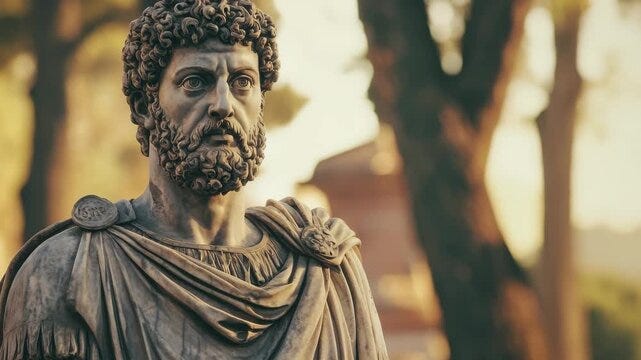
There is a man you follow on Social Media. You may not know his name, but you know his words. His quotes appear between fitness advertisements and political hot takes, rendered in clean fonts over photographs of mountain ranges or foggy forests. “... remember that whatsoever lies outside of the bounds of this poor flesh and breath is none of yours, nor in your power.” He has been dead for eighteen centuries, and he has never been more popular.
Marcus Aurelius, Roman Emperor from 161 to 180 AD, philosopher, commander of legions, last of the so-called Five Good Emperors, is having a moment. Ryan Holiday has sold millions of copies of books built largely on his thoughts. The Daily Stoic newsletter reaches hundreds of thousands of inboxes every morning. Meditations (a book Aurelius never intended to publish, written in Greek as a private set of self-rebukes and reminders) has become a staple of the productivity shelf, sandwiched between Atomic Habits and Deep Work, marketed as a guide to executive performance and personal resilience.
This is one of history’s more spectacular ironies. The man who spent a lifetime fighting distraction, resisting flattery, and disciplining his mind against the seductions of power and pleasure has become content. I suspect his interview on the Joe Rogan Experience would get a lot of listens. He had a lot to say. A lot of it is worth contemplating, but when it is a brief encounter between cat videos and political commentary, it is rather difficult to absorb.
Truth be told, Marcus Aurelius would have found the modern West incomprehensible and distasteful. He had certainly seen the “type” in his day. He just never imagined they would be quoting him.
The Book Nobody Was Supposed to Read
To understand what Aurelius actually did, you have to understand what the Meditations actually is. It is not a self-help book or a leadership manual. In fact, strictly speaking, it’s not a book at all. It’s a running argument of Aurelius with himself.
Aurelius wrote it in Greek because it was the language of philosophy, the tongue in which serious things were said. He called it ta eis heauton: “things to oneself.” He wrote it across the final decade of his reign, probably in military camps on the Danube frontier, in the spare hours between commanding a war and governing an empire. There is no evidence he ever intended anyone else to read it. It was a private discipline.
This matters because it changes everything about how to read the text. When Aurelius writes, “begin the morning by saying to thyself, I shall meet with the busy-body, the ungrateful, arrogant, deceitful, envious, unsocial,” he is not offering a productivity tip. He is doing what every serious practitioner does at the start of a hard day. He is preparing for whatever scenario he may face.
The philosophical tradition behind him was Stoicism, which he had absorbed from teachers like Junius Rusticus and from close reading of Epictetus, a former slave whose Discourses remained Aurelius’s constant companion. The Stoics had a technical vocabulary for the problem of attention. They called the mind’s governing capacity the hegemonikon, or the ruling faculty, the thing that, when it works correctly, keeps you from being swept away by phantasiai, or the impressions that constantly assault you from outside. Every sensation, every rumor, every insult, every flattering report is an impression. The undisciplined mind takes them as they come and reacts to them, but the disciplined mind pauses, examines the impression, and decides what it actually is before responding.
The Meditations is, in large part, a manual for this practice. Book after book, Aurelius returns to the same exercises: do not be mastered by your impressions, return to the present moment, remember the brevity of life, distinguish what is in your power from what is not. He knew he hadn’t mastered these things, so he wrote them down and reflected on them. He was fighting every day to keep his ruling faculty intact. And he was doing it while governing sixty million people and managing a frontier war.
What the Stoicism Renaissance Is Actually Saying
The revival of Stoic philosophy in popular culture is not without value. Epictetus and Aurelius have things to teach about resilience, about distinguishing what lies within your control from what does not, and about the danger of caring too much for reputation and comfort. These are real insights expressed with a directness that shames most contemporary writing.
But the revival has a problem that its promoters don’t even recognize, and that is that the medium through which it spreads is the precise antithesis of what it teaches.
Consider the irony. Aurelius’s core discipline was refusing to be yanked around by stimuli, controlling what got access to his ruling faculty, and pausing before reacting. He practiced this in solitude through writing. He was engaged in what we might call a battle against the ancient equivalent of the social media feed: the flood of news, gossip, flattery, petitions, and rumor that poured through every hour of an emperor’s court.
Social media is an impression engine. It is a system architecturally designed to bombard the hegemonikon with precisely the stimuli Aurelius spent his life resisting. Every notification is a phantasia. Every algorithmic feed is optimized for your ruling faculty’s capture. The dopamine loop that keeps you scrolling is the mechanism by which phantasia bypasses your deliberate attention and hijacks your reaction. The average American now touches their smartphone over 2,600 times per day. The average person unlocks their phone within ten minutes of waking. Teenagers report spending nearly 5 hours a day on social media alone. Aurelius wrote that the first act of the morning was to anticipate the assault and prepare the mind before it arrived. We have arranged our lives so that the assault begins before our eyes are fully open. And in the middle of all this, we share his quotes.
The Stoicism renaissance is not actually a recovery of Stoic practice at all. It is consuming Stoic aesthetics. There is a significant difference. Practice requires time, solitude, repetition, and the willingness to be uncomfortable. Aesthetics just requires following someone who finds a quick quote and pastes it on a pretty background to share. One reshapes the hegemonikon. The other flatters it while leaving it exactly as empty as before.
But the problem runs deeper than individual hypocrisy and the attention economy, because even if practiced seriously, Stoicism runs into a wall, and I think Aurelius knew it.
The Melancholy Undertow
If you read the Meditations closely, you will notice something the productivity gurus don’t point out. The book is suffused with a quiet, persistent sadness. Aurelius keeps returning to the theme of impermanence with an urgency that exceeds philosophical detachment. He writes of great emperors who are now dust. He notes that even Alexander the Great and his mule driver ended up in the same condition. He reminds himself that everything he values will be forgotten, that the universe is in flux, and that his judgments are ultimately of no consequence in the scale of cosmic time. He mentions these things dozens of times, in varied forms, as if repetition might finally fix the problem. If he ever found peace, he wouldn’t need to keep reminding himself.
Those passages reveal a man talking himself back from the edge. The Stoic framework provides Aurelius with tools, but the tools don’t provide hope. Stoicism ultimately offers resignation where resurrection is needed. Aurelius really wanted death to mean less than it does, but he tried to convince himself to accept it as natural.
Stoicism’s god is impersonal. It does not love. It does not hear prayer. It cannot raise the dead. It can be admired and aligned with, but not known, or addressed, or trusted with anything as vulnerable as grief. Aurelius had a wife who may have been unfaithful, children who died young, a son who would grow up to be the catastrophic Commodus, and he faced all of it with a framework that told him these things were externals, beyond his control, not to be mourned.
So in the end, the Meditations is what an attempt at self-mastery looks like when it has no outside help. It is magnificent in many ways, but it is entirely insufficient.
What Marcus Aurelius Never Had
Christianity and Stoicism share more than either tradition’s partisans are always comfortable admitting. Both insist on the priority of the inner life over external circumstance. Both demand discipline, attention, and the subordination of appetite to reason. Both take seriously the question of how a person ought to live before they die. There is a reason the early Church Fathers engaged seriously with Stoic thought, and a reason some Stoic texts circulated in medieval monasteries. Nevertheless, the differences are enormous.
Stoicism is a constant push to govern your mind. Christianity teaches that your mind cannot govern itself; it must be renewed from outside. Paul’s injunction in Romans 12 is not “muster sufficient will,” but “be transformed by the renewing of your mind.” Transformation comes from without. The Spirit acts on the hegemonikon in ways that no journal entry can.
Stoicism resigns itself to indifference to the body. Christianity teaches that the body is a created but fallen good, destined for resurrection. The Incarnation is the permanent refutation of every philosophy that treats flesh as an embarrassment. The divine Logos assumed a body and ate fish on the shores of Galilee after rising from the dead. The resurrection of Jesus is the singular event that puts a floor under history and sets a limit on death. It is so important that Paul concluded, “If in Christ we have hope in this life only, we are of all people most to be pitied” (1 Corinthians 15:19).
Stoicism says you are sufficient if you try hard enough. The Meditations is actually all the evidence one needs to refute this claim. Every page is evidence against it. The man writing was Rome’s most powerful human being, trained by the finest philosophers of his age, possessed of extraordinary intelligence and genuine virtue, and yet he could not stop needing to re-convince himself of things he had already convinced himself of. He could not govern his impressions by willpower alone, and none of us can.
Aurelius’ problem was structural. The mind as the instrument of discipline is also the thing that requires disciplining. You cannot fix the scale by using the scale. You need something external to calibrate it.
The Christian answer to the attention economy is not fundamentally different from the Christian answer to Aurelius’s private struggle. It is the ordinary means of grace. Scripture read attentively, not scrolled. Prayer as the deliberate presentation of the mind to God rather than to the feed. Corporate worship as the reordering of affections in the presence of the living God and His people. The Lord’s Supper as the regular, physical reminder that we are not self-sufficient but that we feed on something given for us. The means of grace are the architecture of a renovated hegemonikon that does not depend on the heroic sufficiency of the person trying to maintain it.
The means of grace are external for a reason. The Stoic disciplines are internal for a reason. One assumes a self that is sufficient to the task of self-reformation. The other assumes a self that is not, and provides accordingly.
The One Thing He Lacked
Marcus Aurelius died in 180 AD on the Danube frontier, probably from the Antonine Plague, while still working. He had been emperor for nineteen years. He left behind a book he never meant to publish and a son who dismantled much of what he built. His private journals survived by some combination of providence and accident, and eighteen centuries later, they are being excerpted on the phone screens of people who are, by every measurable indicator, among the most distracted human beings ever to live.
The man who spent his life resisting the tyranny of impressions has become an impression, and the people sharing his words are doing so on the very devices that are doing to their ruling faculties precisely what he feared the court was doing to his.
We need the real Marcus Aurelius because his failure is diagnostic. He shows us what the best noble-pagan wisdom can accomplish, and where it stops. He shows us what a man of extraordinary virtue and genuine discipline looks like after decades of self-effort, and the word that keeps coming to mind, reading his private journal, is tired.
Christianity offers the thing Stoicism always reached for and never grasped: an external ground of stability and a grace that acts where willpower cannot. It provides a hope that does not require resignation to the fact of death but rests on the conquest of it. At best, in the end, one might conclude that Aurelius had the discipline, but he lacked the resurrection. The most important lesson to learn from Stoicism is that the self makes a terrible God.