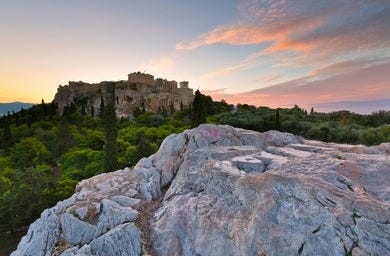
There is a slab of grey limestone northwest of the Acropolis, worn slick by twenty-five centuries of feet, low enough to climb in a minute and old enough that Athens was trying its murderers on it before Rome had walls. The Greeks called it the Areopagus, the hill of Ares. The Romans identified Ares as Mars, which is why some English Bibles still refer to it as Mars Hill. Aeschylus set the final act of the Oresteia on that rock, the scene where Athena founds a court there and tells a city addicted to blood vengeance that, from now on, it will argue its killings in court instead of settling them with knives. For centuries, it was where Athens did its public thinking.
And then, sometime around the year 51, a short, sun-worn Jew from Tarsus stood on that rock and told the most sophisticated audience in the ancient world that a Galilean laborer they had never heard of had walked out of his own tomb.
A city that provoked Paul’s spirit
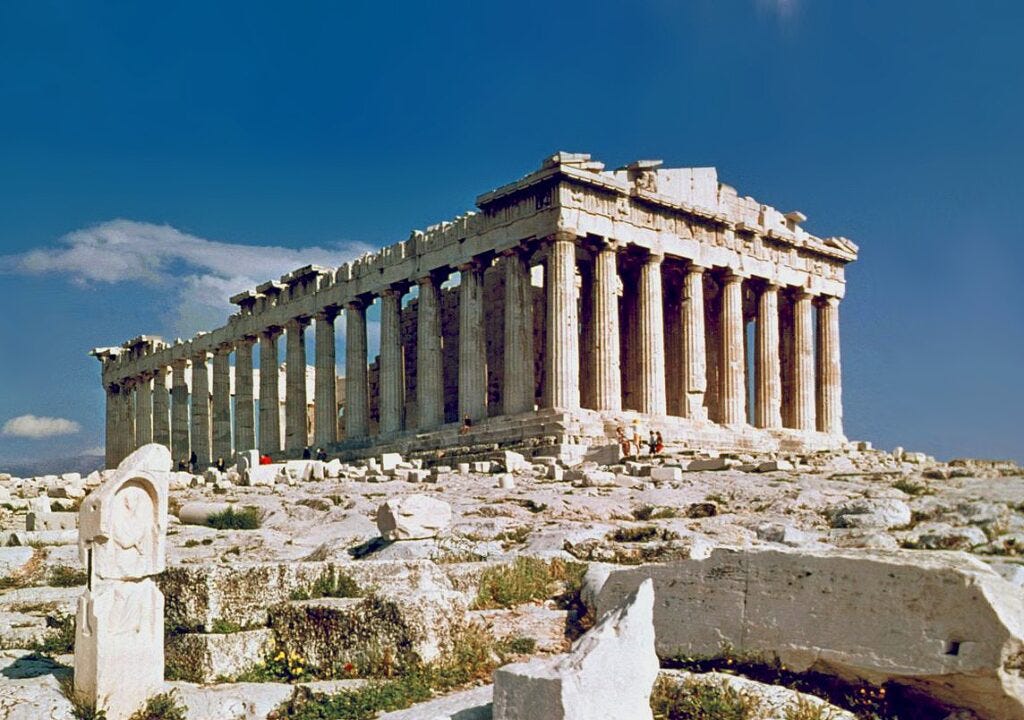
Paul didn’t go to Athens to preach. Acts says he was stranded there, waiting for Silas and Timothy to catch up from Berea (Acts 17:16), a man with time to kill in the most beautiful city on earth. Luke tells us that his spirit was provoked within him as he looked at a city full of idols. The verb is parōxyneto, from paroxynō, the root behind our word paroxysm. It describes a seizure, or a sharp involuntary fit. Athens had so many gods in marble that an old joke ran that you could sooner meet a deity on its streets than a man. Paul walked through the finest open-air gallery in antiquity and experienced something that could only be described as a near-physical reaction. The most cultured square mile in the empire, and it made him sick at heart.
Paul was not a tourist charmed by the classics. He grieved over the place first. Whatever he is doing on that rock, it is not the work of a scholar who finds the Greeks merely interesting. It is the work of an Apostle of Christ who finds them lost.
Two schools take the bait
Word gets around, and two guilds of professional thinkers come to spar with him (Acts 17:18). Luke identifies them because they hold the two great answers the ancient world gave to the question of how to live when the gods seem far away.
The Epicureans were the disciples of Epicurus, who had died around 270 years before Christ and left behind a garden and a system. Their universe was atoms and empty space, nothing more, a machine running on collisions. Their gods were real but retired, living in perfect serenity in the gaps between worlds, too blessed to be bothered with human beings. The point of life was ataraxia, freedom from disturbance, and most of the disturbance they wanted freedom from was fear. They feared death, and yet claimed it was nothing to them since the atoms simply scattered. They also feared the gods who, it turned out, were not watching. It is a gentler creed than its reputation, and a bleak one. Nobody is coming. Arrange your pleasures wisely and try not to flinch.
The Stoics were the heirs of Zeno of Citium, who had taught in the painted colonnade, the Stoa, around three hundred years before Christ. Where the Epicureans emptied the cosmos of care, the Stoics filled it. Reason ran through everything, a divine fire, a logos that was the soul of the world, and providence ordered every event down to the last spark. The task of a human being was to live according to that reason, to want what nature wanted, to reach a calm past the reach of fortune. Their piety could sound almost biblical. Cleanthes, one of their founders, wrote a hymn to Zeus that called men the god’s own offspring. Their error was that they had made God and the world the same thing, so that the divine had no more freedom, and no more mercy, than the weather.
So these men listened to Paul, and then they called him a spermologos (Acts 17:18). The word is a reference to a bird, the kind that hops around the marketplace pecking up scattered seed, and by extension it means a scavenger of scraps, a magpie of other people’s ideas, a babbler who has only read the backs and inside jackets of books. They think he is a peddler of foreign gods because he keeps preaching about Jesus and the resurrection, and some of them seem to have heard "resurrection" (anastasis) as the name of a new goddess he was importing alongside her consort. The philosophers thought Paul came with cheap, secondhand ideas from the provinces.