


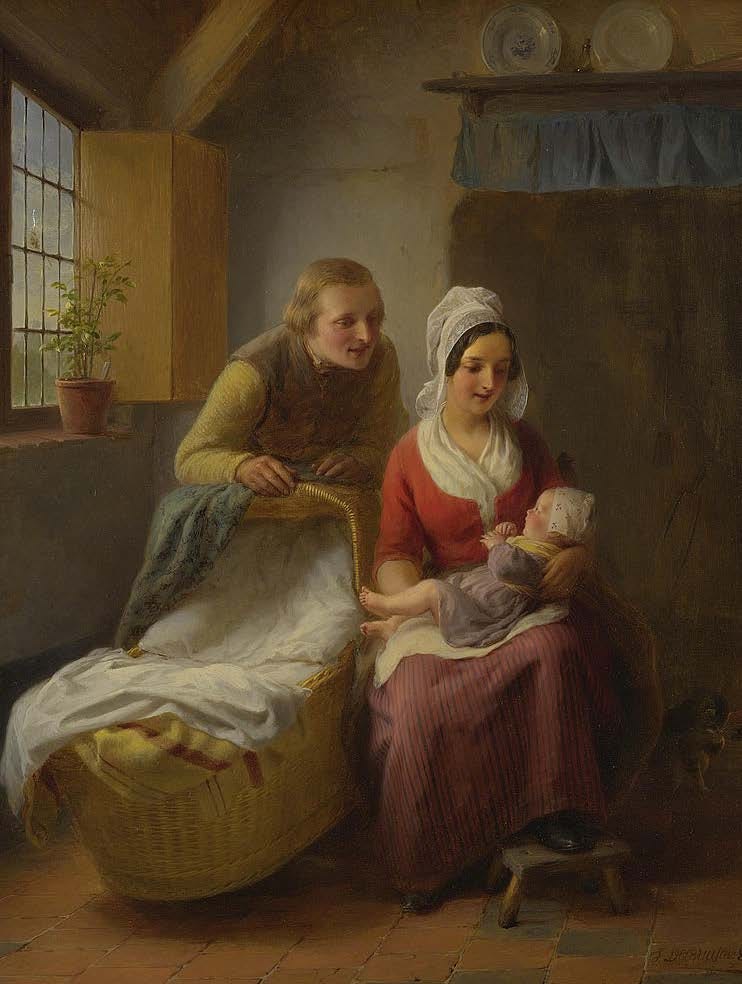
The First Born, by François Antoine de Bruycker
The United States recorded a total fertility rate of 1.62 in 2023, the lowest since the federal government began keeping birth records.1 Demographers call this “below replacement level,” meaning Americans are not producing enough children to maintain the current population. South Korea came in at 0.72 the same year and will halve its population within two generations, without a single war or famine, having accomplished through prosperity what historically required mass death.2
The secular analysis runs economically. Children are expensive, cities are dense, student loan debt is large, and daycare in most American metros costs more than a mortgage payment. These pressures are real and explain some of the decline, but they do not explain why the wealthiest, most medically equipped, most comprehensively child-insuring civilization in history is producing fewer children than subsistence farmers in previous centuries managed while dying of crop failure.
What a fertility rate actually measures
A fertility rate measures desire. It measures what a civilization has decided its future should be. Societies produce children because they intend to continue. They stop when the future is of little concern.
At the height of the postwar baby boom in 1957, American women averaged more than 3.7 children.3 The people living through that period had survived a depression and a world war; they believed the future was worth populating, and they acted accordingly. The generation now in its primary reproductive years grew up with a different mindset: education, career, financial stability, the perfect relationship, and, when all conditions are optimal, and both parties have achieved sufficient self-fulfillment, possibly one child.
The biblical case for children
Psalm 127:3 says, “Behold, children are a heritage from the LORD, the fruit of the womb a reward.” The Hebrew word translated “heritage” is the same word used for Israel’s covenant inheritance of the promised land, for the portion God apportions to His people and transfers across generations. Children are described in the same theological category as covenant inheritance. They are what God gives, not what couples produce when conditions are finally right.
The command in Genesis 1:28 precedes the fall. “Be fruitful and multiply and fill the earth” was addressed to image-bearers in an unfallen garden with unfallen bodies in an unfallen marriage. It is the first instruction God gave to humanity about what to do with itself. The Abrahamic covenant is expressed in terms of fruitfulness. “I will make you exceedingly fruitful, and I will make you into nations” (Genesis 17:6). Barrenness in the patriarchal narratives is a covenant crisis, which is why God intervenes to resolve it. Sarah’s womb, Rebekah’s, Rachel’s, and Hannah’s are each central to the drama of the narrative. The generation that produces no next generation has, with great efficiency, decided to shut down.
Psalm 128:3 describes the flourishing household: “Your wife will be like a fruitful vine within your house; your children will be like olive shoots around your table.” The sign of blessing is not career advancement or financial security, but olive shoots, even with all the crying, diapers, discipline, and expenses.
When fertility became the problem
The oral contraceptive pill received FDA approval in 1960, three years after American women averaged more than 3.7 children. What it supplied was the mechanism for a premise that sex and procreation are separable, so fertility is a condition to be managed rather than a gift to be received, and the default marital posture should be prevention rather than openness. The total fertility rate fell below replacement by 1972.
Whatever one concludes about particular contraceptive methods, the cultural effect of normalizing contraception has been to train a generation to think of children as an active decision rather than a received gift. In this framework, children arrive when the couple decides to stop resisting them, and abortion is often the endpoint of the logic. More than 63 million abortions were performed in the United States between Roe v. Wade in 1973 and the Dobbs decision in 2022.4 Guttmacher Institute data from 2014 found that 13% of abortion patients identified as evangelical Protestant.5
A people trained for sixty years to treat fertility as a condition to be managed, and sex as an activity whose procreative consequences can be negotiated, has been formed by the same premise that the abortion culture requires—the premise that children are optional. When contraception fails, the therapeutic self decides it cannot accept the interruption.
The therapeutic self in the pew
In 1966, Philip Rieff described a new kind of person in The Triumph of the Therapeutic: someone whose primary obligation was to his own psychological well-being and whose operating question in any situation was what it cost him personally.6 Christopher Lasch traced the same development in The Culture of Narcissism in 1979, documenting a civilization that had collapsed inward and treated self-cultivation as the central project of a human life.7 Neither man was writing about evangelical churches, but both were describing what was already beginning to take shape.
The therapeutic self entered evangelical churches through a side door labeled “common sense.” Young couples are regularly told they need to “be ready” to be parents, as if that’s ever possible. “Financial stability” before children is responsible stewardship, as if financial stability for most people isn’t always “a little bit more.” The counsel sounds wise, but it reframes the entire theological question from “Do we receive this heritage from the Lord?” to “Have we optimized conditions for this personal project?”
Any pastor who has done premarital counseling has sat across from a couple whose marriage plan includes no children and a confident expectation that the pastor will affirm their thoughtfulness. Having and raising children, however, is one of the main purposes of Christian marriage. Lyman Stone of the Institute for Family Studies has found that most religious groups in America are having fewer children than they need for long-run stability.8 Even weekly church attenders, who still show a fertility advantage over the general population, average approximately two children per woman, which falls short of the 2.4 needed to offset conversion losses. The fertility problem is the church’s problem.
What the church should do
None of this is an argument for mandating family size or condemning couples with one or two children. The God who opens and closes the womb is sovereign, and unfortunately, many couples who want children are unable to have them. The couple walking through infertility does not need to feel guilty. I often encourage them to take advantage of opportunities to adopt.
The church should recover its theology of children before it loses them. For some Christians, repentance is part of this recovery. The evangelical sitting in the pew who has had an abortion or who has organized the last decade around the project of self-actualization rather than receiving what God gives as a gift must turn afresh to the gospel. Not condemnation, but the announcement that there is forgiveness for what the therapeutic self has done, and that the same grace that covers past failures also promises a better future.
The birth rate is not a policy problem waiting for better parental leave legislation or more affordable housing. It is the number produced by a culture that worships itself. The Lord who commanded fruitfulness in an unfallen garden has not changed. The values of the culture have, and not for the better. So, make babies. Our future depends on it, and I promise, you’ll be far more fulfilled because of it.
Joyce A. Martin, Brady E. Hamilton, and Michelle J.K. Osterman, “Births: Final Data for 2023,” National Vital Statistics Reports 74, no. 1 (Hyattsville, MD: National Center for Health Statistics, March 18, 2025), https://www.cdc.gov/nchs/data/nvsr/nvsr74/nvsr74-1.pdf.
Organization for Economic Co-operation and Development, Korea’s Unborn Future (Paris: OECD Publishing, 2024), https://www.oecd.org/en/publications/korea-s-unborn-future_75aa749c-en.html.
National Center for Health Statistics, Vital Statistics of the United States, 1957, vol. 1, Natality (Washington, DC: U.S. Government Printing Office, 1959).
National Right to Life Committee, “Abortion in the United States” (Washington, DC: NRLC, 2023), https://www.nrlc.org/uploads/factsheets/FS01AbortionintheUS.pdf.
Jenna Jerman, Rachel K. Jones, and Tsuyoshi Onda, Characteristics of U.S. Abortion Patients in 2014 and Changes Since 2008 (New York: Guttmacher Institute, 2016), https://www.guttmacher.org/report/characteristics-us-abortion-patients-2014.
Philip Rieff, The Triumph of the Therapeutic: Uses of Faith after Freud (New York: Harper and Row, 1966).
Christopher Lasch, The Culture of Narcissism: American Life in an Age of Diminishing Expectations (New York: W. W. Norton, 1979).
Lyman Stone, “America’s Growing Religious-Secular Fertility Divide,” Institute for Family Studies (blog), August 8, 2022, https://ifstudies.org/blog/americas-growing-religious-secular-fertility-divide.
I love what you said. We are a couple who faced infertility and adopted two children. We would’ve had more had we been able to have them naturally. Children are a gift and I’m seeing that more and more in my grandchild. They are a wonder that reminds us of the beauty and grace of God.
Great post and analysis. This made me think of a recent trip to a bigger city in our area and the number of dogs we saw versus that of children (and I say this as someone who loves dogs).