


“Mistakes were made.” The modern public apology. Passive voice, mistakes commit themselves, and no one, it turns out, is actually responsible. From there, the script: He has been listening to the affected community and educating himself. This is not who he is. He is doing the work. He does not deserve our forgiveness and asks only for a chance to earn back our trust. Published on social media late Friday afternoon to catch as little attention as possible, and then the world moves on.
Of course, nobody believes a word of it, but that’s not the point. Now it’s all about grading his performance, and unfortunately, we’ve been trained to think of most statements that way. We try to figure out the real motive behind a compliment. A man doesn’t resign from his job to spend more time with his family; he was fired. We look past what is said to what is actually going on, dismissing the surface for what we think is the truth.
The school of suspicion
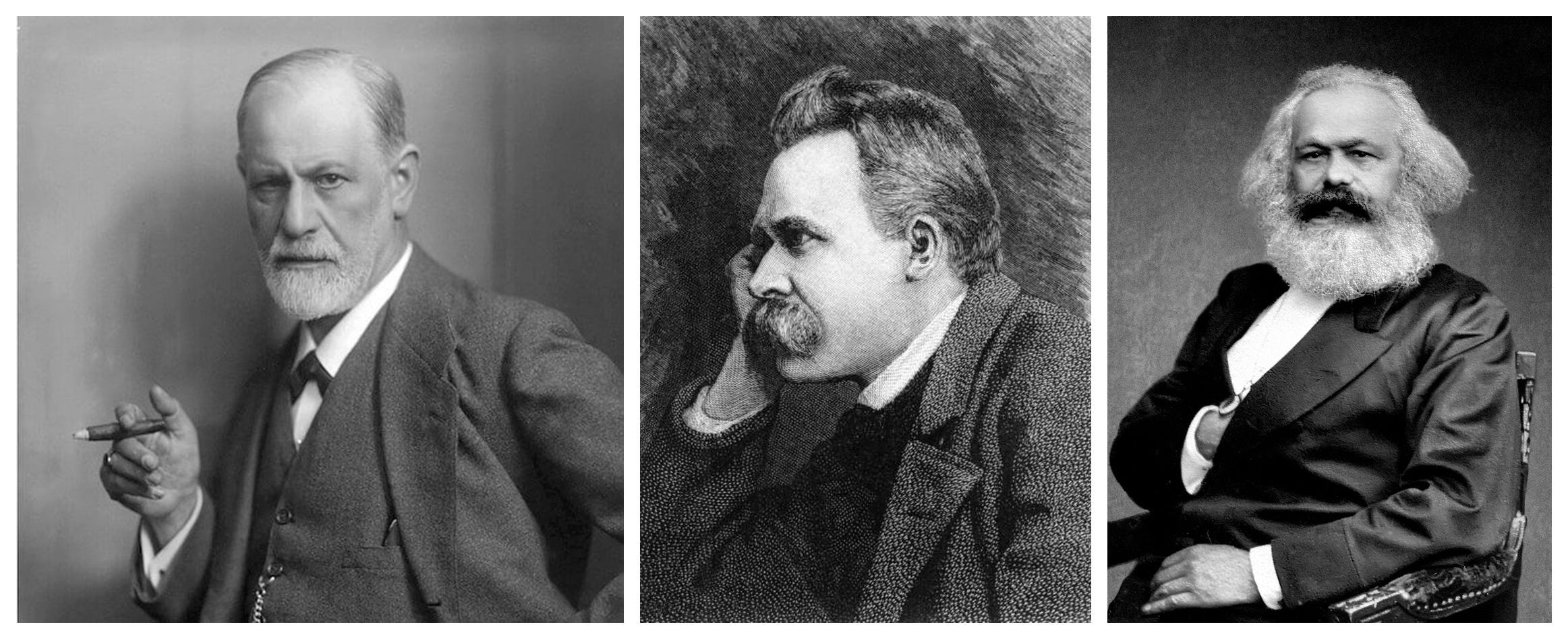
In 1965, in a long study of Freud, the French philosopher Paul Ricoeur set two ways of reading against each other. One he called interpretation as the restoration of meaning, the patient work of listening to a text in order to receive what it says. The other he described by its governing instinct. “Over against interpretation as restoration of meaning,” he wrote, “we shall oppose interpretation according to what I collectively call the school of suspicion.” Ricoeur points to its founders: “Three masters, seemingly mutually exclusive, dominate the school of suspicion: Marx, Nietzsche, and Freud.”
This wasn’t the garden-variety doubt Ricoeur was describing. “These three masters of suspicion,” he wrote, “are not to be misunderstood… as three masters of skepticism.” They shared a conviction that ran deeper than doubt. Consciousness itself is a liar, the mind’s account of its own reasons is a cover story, and what it covers is some interest or drive the mind will not admit even to itself. Ricoeur explained they resolved “to look upon the whole of consciousness primarily as ‘false’ consciousness.”
All of it, he argues, they did in the service of truth. The three aimed “for a new reign of Truth, not only by means of a ‘destructive’ critique, but by the invention of an art of interpreting.” Behind the lie, the masters expected to find a truer word, and it required tearing down the false surface to reach it.
Three unmaskings
Karl Marx supplied the template. The ideas a society treats as neutral, eternal, and simply true are, he argued, the ideas of whoever holds the power: “The ideas of the ruling class are in every epoch the ruling ideas.” Marx continues, “The class which is the ruling material force of society is at the same time its ruling intellectual force.” In other words, law, morality, religion, and the whole furniture of the mind follow from who controls production. He compressed the claim further, writing, “It is not the consciousness of men that determines their existence, but their social existence that determines their consciousness.” To read a law or a creed rightly, on this account, you look past what it claims to the material interest it secures. Language is a receipt for power.
Nietzsche took that same suspicion into morality and philosophy. He laid out what he had come to see in the great systems: “I have gradually come to realize what every great philosophy so far has been: a confession of faith on the part of its author, and a type of involuntary and unself-conscious memoir.” The philosopher thinks he is reasoning toward truth, but he is actually confessing his temperament and calling it logic. Behind the argument stands an appetite, and Nietzsche called it “the will to power.” He claimed that “We are unknown to ourselves, we knowers... we have never looked for ourselves.” We can’t fully understand our own minds, even when we’re reading and thinking deeply. The noblest values we proudly hold up may actually be clever masks hiding our real, less noble motives.
Freud took the operation into the family and dreams. The waking mind, Freud described, is a small, lit room in a large, dark house, and the reasons we give for what we do are later edited for respectability. A dream is a wish the sleeper could not admit, smuggled past the filters. A slip of the tongue is actually the truth escaping. The patient is the last authority on himself, because the self keeps its real business below the floor of awareness.
Ricoeur saw an identical shape to what each of the masters of suspicion was suggesting. What the reader faces, he wrote, is “not only a threefold suspicion, but a threefold guile.” Consciousness does not merely err. It deceives on purpose, and it starts with the self.
Suspicion is older than its masters
Identifying power as the self-interest hidden under its justifications is old news. The Hebrew prophets were never quiet about it. Amos stripped the piety off men who “trample on the needy” and kept their feast days. Nathan walked David into a story and sprang the hidden trap to expose his sin. Long before Marx, the Bible taught that the human heart hides its own motives from itself. Jeremiah wrote the chilling verdict: “The heart is deceitful above all things, and desperately sick; who can understand it?” (Jer. 17:9).
Augustine of Hippo looked at Rome, and at every empire that called its conquests peace, and he called the drive underneath the imperial self-description the libido dominandi, or the lust of rule. The earthly city, he wrote, “though it be mistress of the nations, is itself ruled by its lust of rule.” He was as unsentimental about human motive as Nietzsche was fifteen centuries later, but what set Augustine apart was what he saw as the solution.
Augustine exposed the lust of domination in order to break it and reorder it under a love that seeks the other’s good. He tore the mask off Rome to call Rome to repentance, and left the possibility of the city standing. The prophets did the same. They exposed the racket in order to summon the nation back to its covenant obligations. Suspicion, in this older world, was a servant. It worked for repair, and it answered to a standard of the good. The Reformed tradition later identified this as the noetic effects of sin. In other words, the fall reaches the mind, so that reason itself bends toward self-justification. Calvin described the human mind as a perpetual factory of idols, forever manufacturing gods that flatter it. The suspicion the masters would systematize was, in this light, a secular doctrine of the fall. It saw the corrupted heart clearly.
What the masters changed
The masters changed the ends of the suspicion. They cut it loose from any good above the critique, and once suspicion answers to nothing higher than itself, exposure becomes its own end. The point of reading is no longer to heal what you have unmasked or to call it back to what it should be. The point is to expose it, and then to expose the next thing, because there is no standard left in whose name you could ever stop and say anyone is telling the truth.
That method turns on everything, including itself. If every stated reason is a cover for an unstated interest, then a sincere reason has been ruled out before it is heard, and the person who offers one has only demonstrated how well his cover is built. Any argument is itself more maneuvering to be decoded. A denial confirms the charge. Silence confirms it, too (“silence is violence”). The suspicious reading is unfalsifiable.
And it consumes its own foundation. Nietzsche saw this coming. If the will to truth is the will to power in a scholar’s gown, then that judgment is also the will to power in a gown, with no better claim on anyone than the moralities it strips. Suspicion universalized has sawn off the branch it sits on. What it leaves is a reader who can no longer be persuaded of anything, only made to confess, and who therefore stops reading altogether and simply decodes. Trust becomes the tell of a person who has not yet grasped that everyone is playing him. The masters of suspicion removed the possibility of a cure, the hope that a will can be remade, and a word honestly meant and believed.
Carl Trueman traced how the migration went from a method used by a few nineteenth-century intellectuals to one that eventually influenced the entire culture, until the psychologized self that looks for hidden power plays in every word is simply what a modern person is taught to be. The habits Ricoeur described in 1965 as the tools of three difficult thinkers are now the most common approach of modern readers examining a text message.
The cost at close range
Once this approach is removed from the library and brought into a marriage, it stops being interesting and starts doing damage. Noticing hidden motives was never the problem. The damage comes when the noticing serves nothing above itself, when it has no goal beyond winning points, so that it never resolves into anything.
A wife might hear her husband apologize and instantly wonder what the hidden content is. Her aim is to establish that she was wronged, not to be reconciled. The husband might hear her forgiveness and look for the leverage she is banking for later. Neither one of them is approaching with trust. Each is attempting to find the hundreds of small ways the will to power will bite them. Suspicion is often right about the particular, but it is death to the whole.
At scale, an expert in a field is heard as a mouthpiece for his funders, an apology is considered a PR cleanup, and a posture of humility is a sneaky backdoor to put everyone to sleep before the strike. Rooms are now full of people decoding one another, with no one able to say a simple thing and be believed.
Charity, the Apostle Paul wrote, “believes all things, hopes all things” (1 Cor. 13:7). That kind of love cannot get started on a person you have decided in advance is running a con, because it has been ruled out before the first word. Suspicion offers real safety from being fooled, but the price is never being known. The person who cannot be taken in also cannot be reached.
Reading in good faith
The Christian answer refuses to be naive, but it puts the suspicion back under the good it was always meant to serve.
“Whoever,” wrote Augustine, “thinks that he understands the Holy Scriptures, or any part of them, but puts such an interpretation upon them as does not tend to build up this twofold love of God and our neighbor, does not yet understand them as he ought.” The test of a reading is whether it builds love, past whether it is clever, and past whether its suspicions happen to be correct. A reading can be accurate about a hidden fault and still fail if all it does is convict.
Turned toward persons, Augustine’s rule inverts the burden of proof that suspicion assumes. Suspicion opens by treating the mask as given and demanding that sincerity prove itself, usually to a standard no sincerity could meet. Charity opens by crediting good faith and takes the most generous version, only moving away from it when the evidence forces it. In general, well-meaning philosophers strive to operate on a principle of charity, interpreting their opponent at his best before they respond (Steelman). But the Christian version rests on a command to love beyond simply being fair in an argument.
Nobody should assume it is virtuous to be fooled. Charity that cannot recognize a wolf feeds the wolf. The same Scripture that commands love commands testing. “Do not believe every spirit,” John wrote, “but test the spirits to see whether they are from God, for many false prophets have gone out into the world” (1 John 4:1). Paul warned the Ephesian elders that wolves would rise from among their own number and told Timothy to identify the men doing damage. The Puritans frequently wrote about judging charitably. Jonathan Edwards preached a sermon in his series on 1 Corinthians 13 against the censorious spirit, the habit of assuming the worst of a brother, and set against it the charity that “thinks no evil.” Judging charitably never meant believing every claim a man makes. It meant believing the best the evidence will bear and refusing to believe worse than the evidence requires. Suspicion is available and useful, but should be used to look for the hidden thing in order to heal it, after credit is first extended.
This reconciles Ricoeur’s two ways of reading. He set the restoration of meaning against the school of suspicion. Under charity, the two become a sequence and a servant. You may have to suspect in order to see, and you suspect in order finally to restore, to hand back a truer and more hopeful account of a man rather than the one he was defending. Exposure serves repair, or it is not Christian.
Libido Dominandi, Panta Pisteuei
Augustine’s Latin for the disease is libido dominandi, the lust to rule that hides beneath the reasons the powerful give for their power, and beneath a good many of the reasons the rest of us give too. He believed it was real, and that it was in himself before he ever found it in Rome. The Confessions he wrote are the record of a man suspecting his own motives down to a boyhood theft of pears, refusing to let himself off. He is not a naive reader of the human heart. He firmly believed that lust could be broken, reordered, and put under a stronger love that wants the good of others. Suspicion of the self, in Augustine, is the beginning of health, because it runs toward confession and cure.
Paul’s Greek for the cure is charity. He writes, panta pisteuei, “believes all things” (1 Cor. 13:7). The verb is pisteuei, from pistis, faith, the same root Paul uses for saving faith in God, now turned toward a neighbor’s word. Love’s first motion toward what someone says is to credit it. It does this with its eyes open. The deceit goes to the cross, the one place suspicion’s evidence can be taken in full and absorbed without destroying the person it convicts. A Christian can afford to begin with trust because he is not the last court. He can risk being wrong about a motive and occasionally being played because the final reckoning is not his to secure.
The reading that love does
The celebrity apologies will keep coming, and some of them are exactly what everyone assumes they are. Suspicion is often accurate, and cynicism is right often enough to seem like wisdom. But a reader who has settled in advance that every apology is a maneuver has not reached wisdom. He has reached a permanent alibi for never having to forgive, since forgiveness would require him to accept a word as accurate and free of ulterior motives, and he has already ruled that category out. He is safe from ever being fooled, which is the same thing as being unreachable.
To read for the hidden thing in order to mend it, with your eyes fully open and your credit extended first, costs more than suspicion and sees further than cynicism. It can be deceived, it knows that, and it reads in good faith anyway, because it answers to a love that outlasts the occasional con. That is the reading of the God who justifies the ungodly, who takes sinners at the word of a righteousness credited to them and not their own. It is open to anyone with the nerve to be sometimes wrong for the sake of ever being trusted.
Are you familiar with a BBC show from the 70’s called the Prisoner. Occasionally, I’m reminded of the episode called Checkmate. It has to do with authority, suspicion and trust.