


“The celebrity is a person who is known for his well-knownness.”
-Daniel J. Boorstin, Former Librarian of Congress
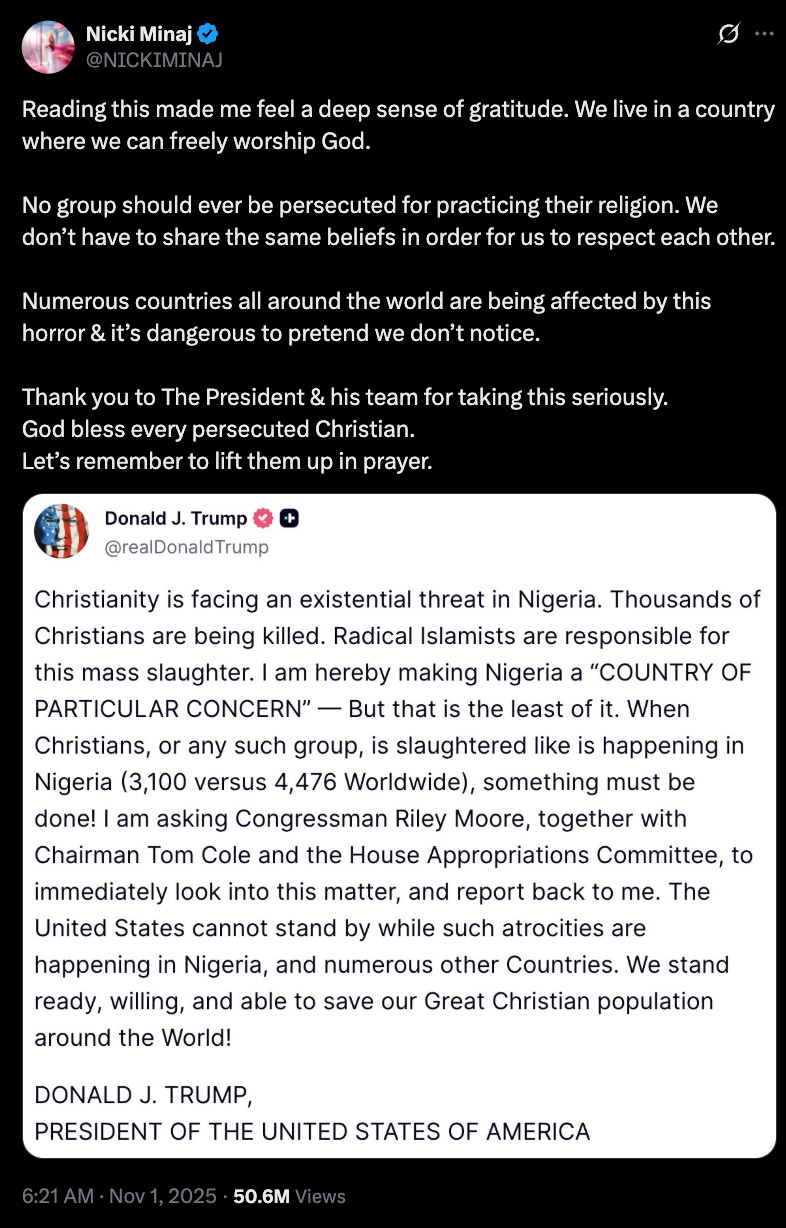
On November 1, 2025, President Donald Trump posted on Truth Social that “Christianity is facing an existential threat in Nigeria.” In response, female rapper Nicki Minaj posted on X:
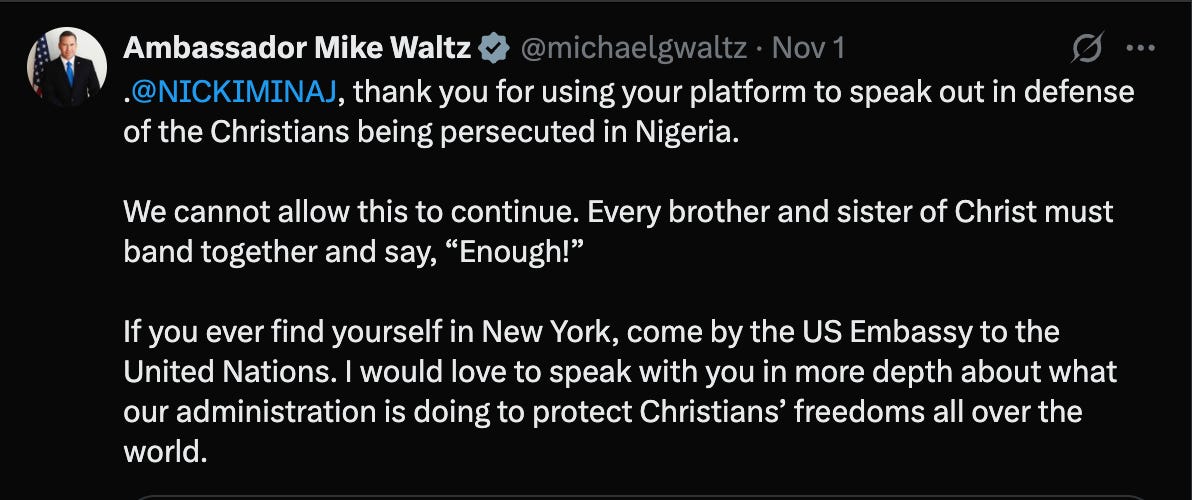
Minaj has made comments about violence in Nigeria in the past, but this time she got the attention of UN Ambassador Mike Waltz:
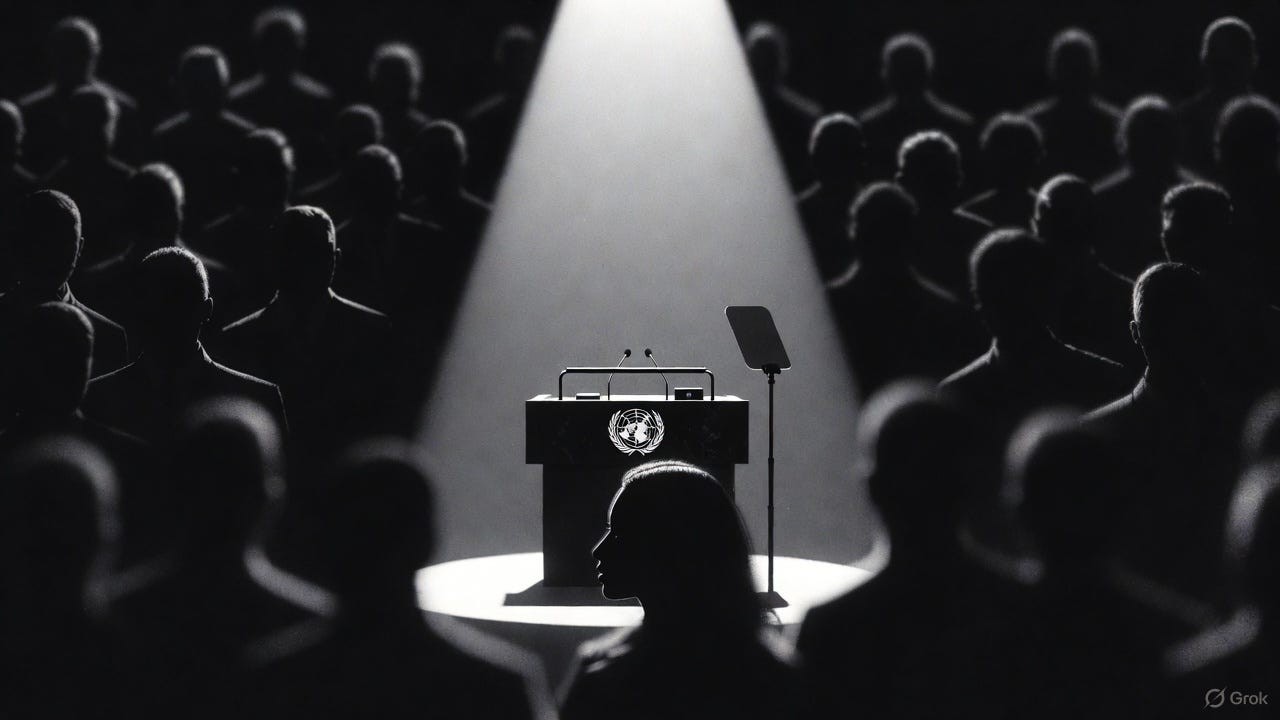
Then, on November 18, 2025, Minaj delivered a short speech at a special panel event hosted by the United States Mission to the United Nations in New York City. The event, creatively entitled “Combating Religious Violence and the Killing of Christians in Nigeria,” was organized by the Trump administration and moderated by Fox News host Harris Faulkner.
Minaj’s remarks were perfectly fine; polite, heartfelt, and a straightforward reminder of the headlines that first caught her attention; however, her invitation itself is another reminder that fame, not knowledge, is often the only credential necessary to unlock global microphones.
I am not lacking for critiques of Minaj and her music, but I don’t blame her for going to the UN. She was invited; she showed up. Good for her. But what does she actually know about Nigeria and what’s really going on? Familiarity with a few widely circulated articles or social-media threads does not constitute expertise. In an era when information is abundant and attention is fleeting, the line between awareness and authority has grown perilously thin.
Celebrity has long won its war on expertise. At that United Nations panel, Nigerian scholars, activists, and citizens with real knowledge and experience undoubtedly offered careful, hard-won analysis. Missionaries and aid workers who have spent decades among the people they serve almost certainly spoke with authority born of proximity and sacrifice. Yet almost none of that reached the wider world. A single rapper walked in, and the cameras followed. The rest vanished into the background hum of a news cycle that mistakes visibility for legitimacy.
I lay no claim to a United Nations podium, nor do I seek one. For the past fifteen years, however, Nigeria has been the quiet center of my life’s work: helping to plant two churches, founding a seminary, traveling to eight states, preaching in cities and remote bush camps alike, returning each year for six to eight weeks of ministry. The most recent reported attack occurred less than thirty minutes from the town where I spend the bulk of my time.
I mention this only to mark the distance that separates sustained presence from momentary prominence. Nicki Minaj has never claimed expertise on Nigeria. The deeper issue is not her appearance at the panel; it is our readiness to let fame stand in for understanding. When serious suffering is filtered through the lens of celebrity, we must at least ask whether the attention we finally give is the attention the situation truly needs, or whether it chiefly serves those who already have the world’s ear.
Last week, I published a longer essay tracing Nigeria’s history and the forces that have brought it to this present crisis. The picture that emerges is inevitably more complicated than any headline can contain. Violence is real and grievous. Thousands of professing Christians, among others, have been killed. But religious identity is only one thread in a much larger tangle. In Nigeria, “Christian” is often a cultural label applied to anyone who is not Muslim, whatever their actual devotion. Generations of tribal conflict, North-South division, colonization, political rot, corruption, poverty, and desperation cannot all be boiled down to religious persecution.
Islam is unabashedly evil, and the rot of Shariah Law has plagued Northern Nigeria for far too long. Thankfully, many in the West are finally waking up to this reality. I grieve every life taken through violence, and I mourn especially when Christians are targeted for their faith. Yet sorrow must not become sentimentality, and solidarity must not blind us to complexity.
Nigeria does not primarily need celebrities repeating narratives, no matter how well-intentioned. It needs structural reform, honest governance, equitable resource management, and patient reconciliation across the lines that have bled for generations. Above every reform, however, Nigeria, like every nation, needs the Prince of Peace to reign in human hearts. Only Christ can break the cycle of retribution and greed that no policy alone can end. Until He is acknowledged as Lord by Fulani and Berom, by northerner and southerner, by governor and governed, no amount of celebrity attention or international spotlight will reach the root. That is a work only God can do, and I pray He will.