


It seems that, in these modern times, the highest praise we give to a film, a song, a novel, or a room in a gallery is that it has done its job the moment we feel something. We don’t tend to ask anything more of it. We don’t often ponder whether a poem is true or false; we don’t tend to think about whether a novel can make a person better or worse; we usually fail to ask questions about a painter’s objective or marvel at a sculptor’s craft. Now, it just has to land with something more significant than a shoulder shrug.
Matthew Arnold was one of the most listened-to critics in the English-speaking world in the second half of the 1800s, a school inspector by trade who spent his evenings deciding what an educated person ought to read and why. In 1880 he wrote an introduction to a poetry anthology, an essay called “The Study of Poetry,” and he opened it with a prediction:
“There is not a creed which is not shaken, not an accredited dogma which is not shown to be questionable, not a received tradition which does not threaten to dissolve. Our religion has materialised itself in the fact, in the supposed fact; it has attached its emotion to the fact, and now the fact is failing it. But for poetry the idea is everything; the rest is a world of illusion, of divine illusion. Poetry attaches its emotion to the idea; the idea is the fact. The strongest part of our religion today is its unconscious poetry.”
Arnold was watching Christianity lose its grip on educated Europe. Geology had stretched the age of the earth past recognition, Darwin had supplied a story about origins that needed no Eden, and German scholars were taking the Gospels apart sentence by sentence. Arnold didn’t think the doctrines would survive the century, but he wasn't particularly sad about it since he had a replacement ready. Religion, he suggested, made one fatal mistake: it tied its emotion to facts, to an actual creation and an actual empty tomb, and now the facts are giving way. But poetry, he said, never made that mistake. Poetry never asked you to believe its claims were true. It only asked you to feel them. So, for Arnold, poetry is safe exactly where religion is exposed. Hand the sacred over to art, and you get to keep the reverence after you have let go of the beliefs.
Here was Arnold’s wager: If you keep the cathedral and dismiss its God, you can let beauty stand in the emptied sanctuary doing the pastor’s job, consoling us in our hardships and binding a people together around something higher than appetite. Arnold thought it was a rescue. He could see what was coming for a civilization that loses its religion and puts nothing in its place, and he thought great art would take over and do the job. He called poetry “a criticism of life,” a way of judging how we live against the highest things we know, and he believed we could still tell the highest from the low. Keep the greatest lines of the greatest poets in your head, he said, and use them “as a touchstone to other poetry”; it is “an infallible touchstone for detecting the presence or absence of high poetic quality.” Judge everything against the best. Refuse to rank a minor early poet with Milton. There is a real order of worth, and a trained soul can feel it.
Well, I think it’s safe to say we’ve tried Arnold’s experiment in the West for over a century now and it has been a complete failure. But it failed in a way he never saw coming because it actually failed twice.
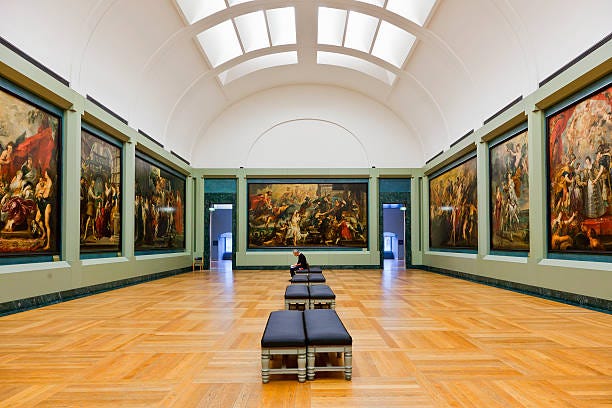
The first failure is the one he should have seen coming. The consolation of a belief doesn’t last long once a civilization stops holding the belief to be true. An unbeliever can be genuinely moved, deeply impressed, and overwhelmed by a requiem or a painting on canvas or a perfectly worded verse. But the deep reverence Arnold was counting on to hold a whole people together was the aftershock of a conviction. A Christian at a graveside is steadied by the resurrection because he believes it actually happened. A body walked out of an actual tomb, so the steadying force is the truth of the matter, not the present feeling. If you take out the fact and rely on the feeling, it might provide some balance for a while, but it eventually thins out and cuts away the foundation. Arnold thought the emotion could be separated from the truth-claim and still mean something, generation after generation. That’s a rather tall order at the scale of an entire culture. The reverence in the concert hall is real, but it’s borrowed. It is revived by a memory of when everyone believed music pointed at something. Teach enough generations that transcendence is a mood they produce in their own skulls, what will remain? It loses its authority to command anyone. The galleries are hushed, but fewer people can even figure out why. Believe it or not, the benches in front of paintings on the wall aren’t just there to take a break so you can make sure you didn’t miss anything on social media.
The second failure is the ruin of Arnold’s own life’s work. If you cut beauty off from truth, you lose the standard along with it. Arnold wanted poetry to save high culture, to preserve a real “best” against the “to each his own, beauty is in the eye of the beholder” leveling that was on its way with mass democracy and mass print. A secular critic can still judge, of course. Nobody has to believe in God to hear that Bach goes deeper than the jingle in a car commercial. But the trouble sits underneath the judgment. Once you have said that art’s job is to move me rather than to show me something true, you have handed final authority to feeling, and feelings have no reply for the man who shrugs and moves on without a further thought. The critic can still rank, but on what basis does he say his ranking is anything more than his personal taste? “Is this good” becomes “does this move me,” and then even worse, “does this move me this week,” or “right now?” The touchstone falls out of his hand.
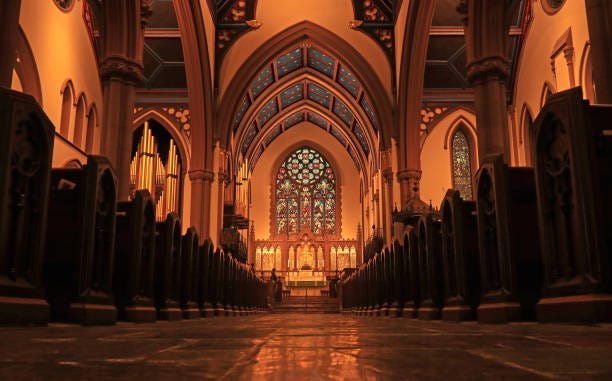
Arnold’s entire project needed the one thing he was discarding. He needed a real order of value outside the self that a judgment could be right or wrong about. Christianity was always the answer. It taught that beauty was a signpost, that the glory in a Bach fugue or a Venetian dome was on loan from the God it was giving just a small glimpse of. Human art rises highest when it catches some of the splendor already poured into the world God made because it is passing on something that is true. Arnold tried to keep the signpost, but then eliminate the One the signpost was pointing to. He wanted all of us to set off on an objective trail with no objective end.
This is the trade the modern West made, and now we’re paying the price. We wanted the cathedral without biblically ordered worship, the moral seriousness of a people under judgment without any Judge. The Bible Arnold tried to ease out the door describes the mechanism he was counting on. What can be known about God, Paul writes, is plain in the things he has made, so that beauty is one of the ways the world keeps confessing its Maker (Romans 1:19-20). “Splendor and majesty are before him,” the psalmist says of the LORD, “strength and beauty are in his sanctuary” (Psalm 96:6).
Beauty has always been a signpost, and the ache it stirs is the pull of the One it points toward. If you stand in one of our beautiful, reverent, God-emptied galleries, what you will feel more than anything is the absence. You might be moved for a time, but without an objective end in sight, the movement will have no meaning.