


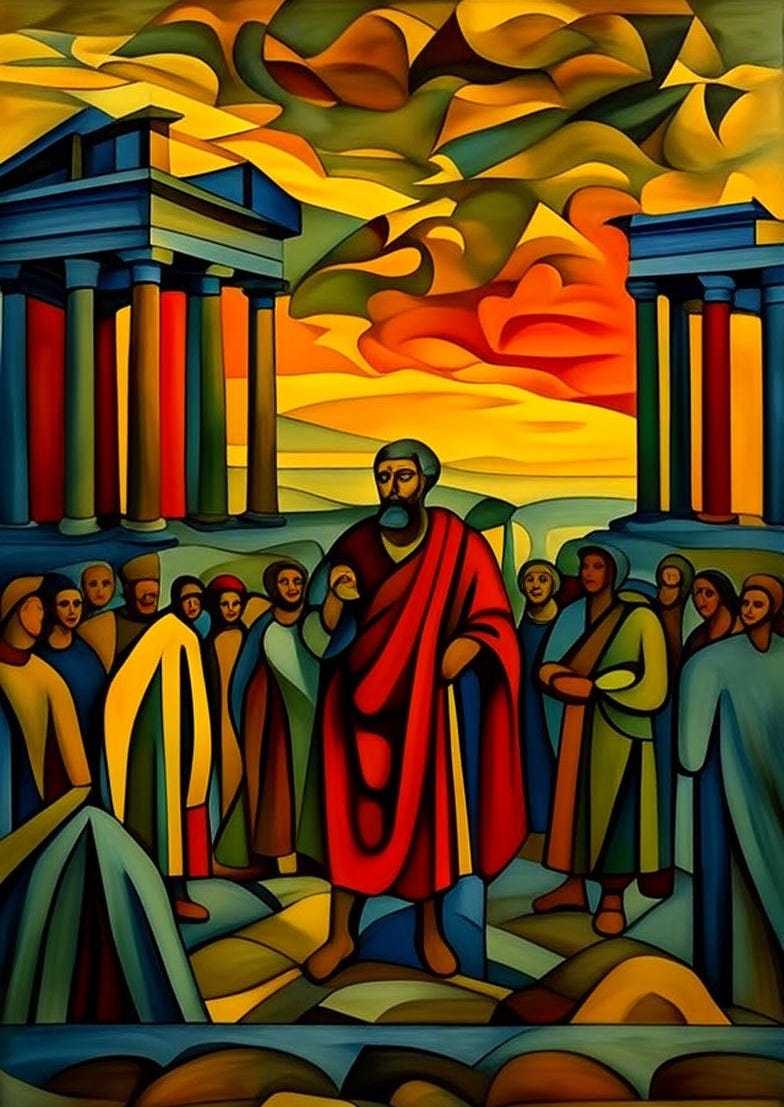
The Apostle Paul was a Jew from Tarsus, a Roman citizen, and a former Pharisee. He was also thoroughly entrenched in the Greek intellectual tradition that dominated the eastern Mediterranean in the first century. When he stood on the Areopagus in Athens and quoted Greek poets, he was speaking the native tongue of the educated Hellenistic world. And the deepest dialect of that tongue, whether people had read the dialogues or not, was Platonism.
Many Christians assume that any trace of Greek philosophy in the New Testament was a necessary evil, an accommodation Paul made when speaking to Gentiles. But Paul wasn’t reluctantly borrowing Greek ideas; he was plundering them. He walked into the intellectual heart of the Hellenistic world, spoke its native language better than the natives did, and then showed that every true instinct in that language found its fulfillment in Christ.
In Paul’s day, Platonism was the air that educated people breathed. It wasn’t any more necessary to read the Republic or the Phaedo to be a Platonist than it is to read Freud today and use the word “ego.” Paul, a man who could argue with Stoics and Epicureans on their own turf (Acts 17:18), breathed the Platonic air too. The evidence is scattered across his letters in the form of echoes, allusions, and inversions.
The Body as Tomb and the Body of Resurrection
In Plato’s Phaedo, Socrates calmly drinks the hemlock while explaining that true philosophers practice dying all their lives because the body is a prison, even a tomb (sōma sēma). The soul’s goal is to escape the corpse entirely. Four hundred years later, the Apostle Paul cried out, “Wretched man that I am! Who will deliver me from this body of death?” (Rom. 7:24).
The phrase “body of death” was not everyday Jewish language; it was the proper response to the old Platonic sōma sēma. Every educated listener in the Roman world would have heard the echo and thought, “Yes, exactly, the body is death.” But Paul does not draw Plato’s conclusion. He does not look forward to the body’s disposal. He gives thanks to God through Jesus Christ (Rom. 7:25) and later spells out what that deliverance is: “It is sown a natural body; it is raised a spiritual body” (1 Cor. 15:44). The same flesh that is currently a “body of death” will be raised imperishable, glorious, powerful, bearing the image of the man of heaven (1 Cor. 15:42–49). God is not going to abandon the body to the tomb; He is going to raise it as a temple. Plato’s answer was ascetic contemplation and eventual escape of the soul. Paul’s answer was resurrection. Plato wanted to get rid of the body. Paul insisted that God would redeem it.
Immortality of the Soul and Resurrection of the Dead
Some in Corinth were saying, “There is no resurrection of the dead” (1 Cor. 15:12). Many scholars believe these were not Sadducees, but educated Greek Christians who happily accepted the immortality of the soul but found the Jewish idea of resurrection crude or unnecessary. But Paul’s response was uncompromising: “If Christ has not been raised, then our preaching is in vain and your faith is in vain” (1 Cor. 15:14). The gospel is not a soul-escape; it is bodily renewal, seed becoming plant (1 Cor. 15:35-49), mortality putting on immortality. The Platonic hope of disembodied contemplation is replaced by embodied, communal, cosmic renewal.
The Divided Soul and the War Inside
In the Republic and Phaedrus, Plato dramatizes the soul as internally fractured. He explained it as a charioteer trying to control two unruly horses of appetite and spirit, dragging man’s reason in contradictory directions. Paul describes the same civil war with the technical vocabulary of Hellenistic psychology: “For I delight in the law of God, in my inner being, but I see in my members another law waging war against the law of my mind and making me captive to the law of sin that dwells in my members” (Rom. 7:22-23). The analysis is similar, but the prescribed cure is not. Plato recommended more philosophical contemplation and discipline; Paul said the only solution is crucifixion and resurrection with Christ (Rom. 6:1–11) and the gift of the life-giving Spirit (Rom. 8:11).
Heavenly Patterns and the True Reality
Plato’s Timaeus says the visible world is a moving image of eternal archetypes. The author of Hebrews (who I believe is Paul) said the earthly tabernacle is a “copy and shadow of the heavenly things” (Heb. 8:5). Paul himself said the Old Testament ceremonial were “a shadow of the things to come, but the substance belongs to Christ” (Col. 2:17). The entire conceptual architecture is found in Plato’s cave and Timaeus. Yet the content overturns everything: the ultimate Form, the final Archetype, is not an abstract Idea of the Good but the crucified and risen Jesus, “the image of the invisible God” (Col. 1:15).
The Foolishness of the Cross as the New Wisdom
Plato had spent a lifetime attacking sophistic rhetoric and empty persuasion. Paul agreed that human wisdom was bankrupt, then took the argument to a place Plato never dreamed: the cross. This is the wisdom and power of God. The true philosopher is not the one who ascends by intellect to the Forms but the one who is crucified with Christ and knows him in power made perfect in weakness.
Paul Perfected Plato
To an audience steeped in the dream of escaping mortality, Paul announced that the immortal God had entered mortality and defeated it from the inside. To a world that prized the contemplative ascent of the soul, he preached descent of the Son who “humbled himself by becoming obedient to the point of death, even death on a cross” (Phil. 2:8) and was therefore exalted above every name. To people who saw the body as a tomb, Paul promised it would become a temple. He didn’t baptize Platonism; he hijacked the deepest structures of Hellenistic thought, like dualism of appearance and reality, the divided soul, and the hope of transcendence, and recentered them on the story of Jesus’ death and resurrection. Paul spoke better Greek than the Greeks. And then he showed them that the eternal Logos had taken on flesh, been nailed on the cross outside Jerusalem, and risen on the third day. The questions Greek philosophy could only ask, the gospel alone could answer, because in Christ “are hidden all the treasures of wisdom and knowledge” (Col. 2:3).
Beautifully said, thank you.