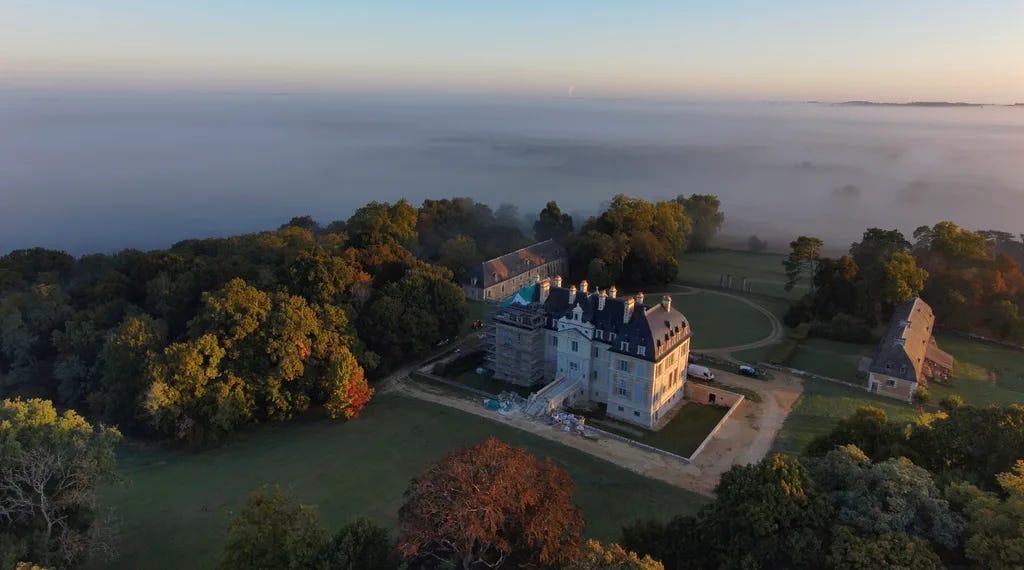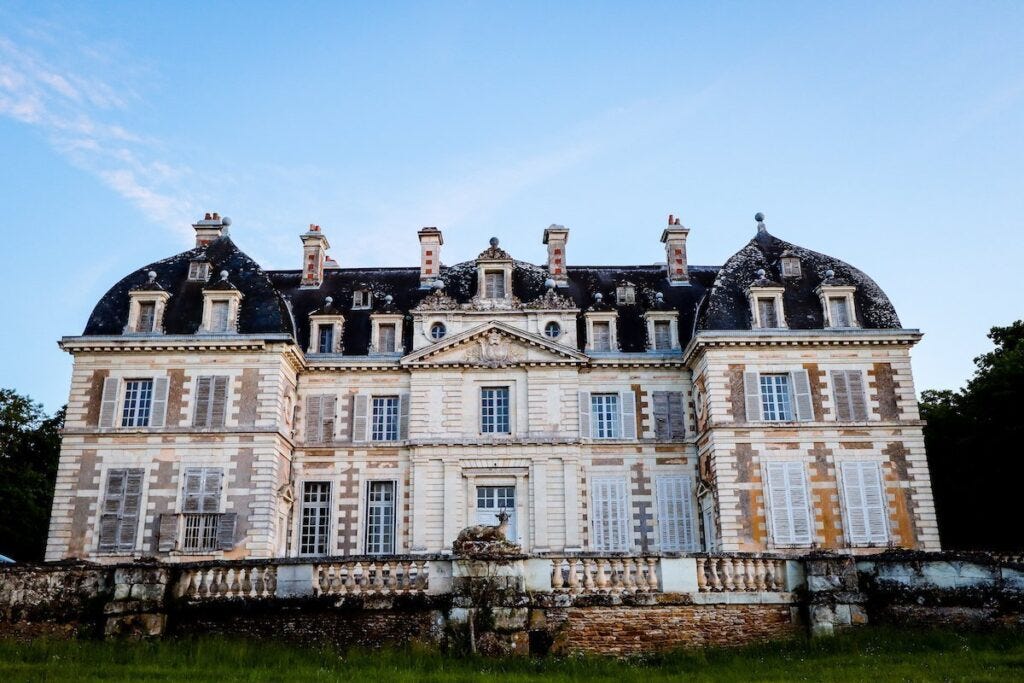
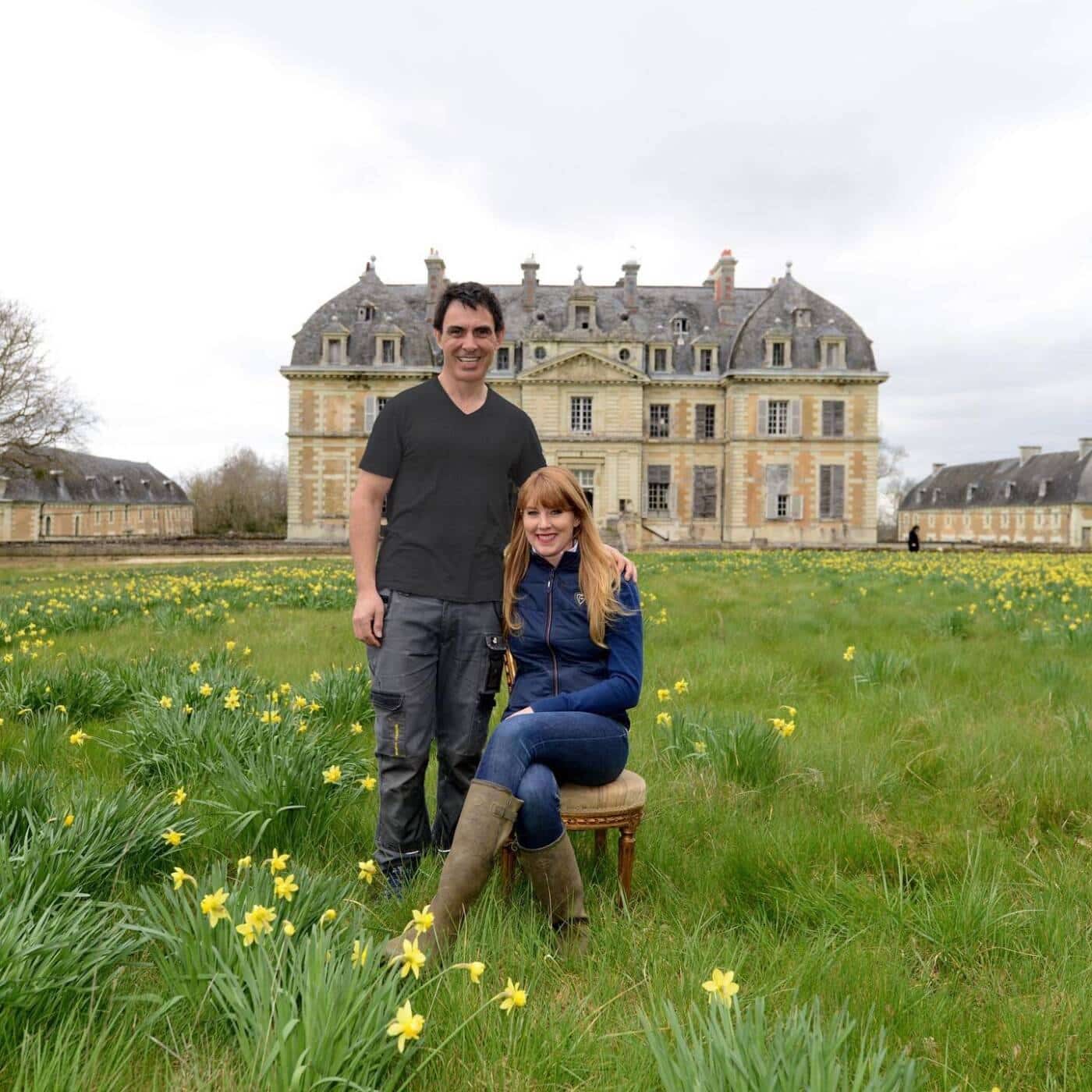
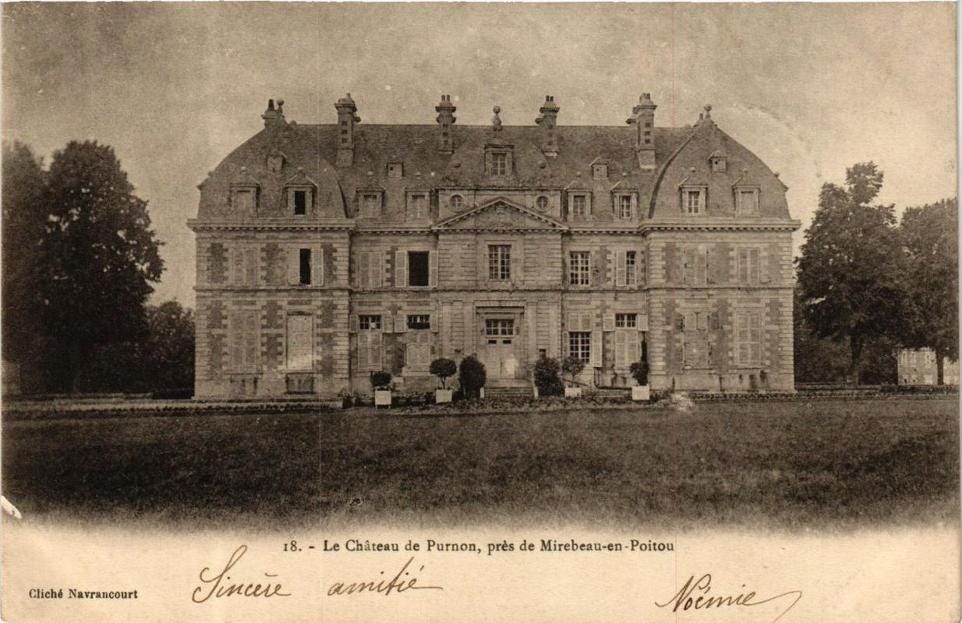
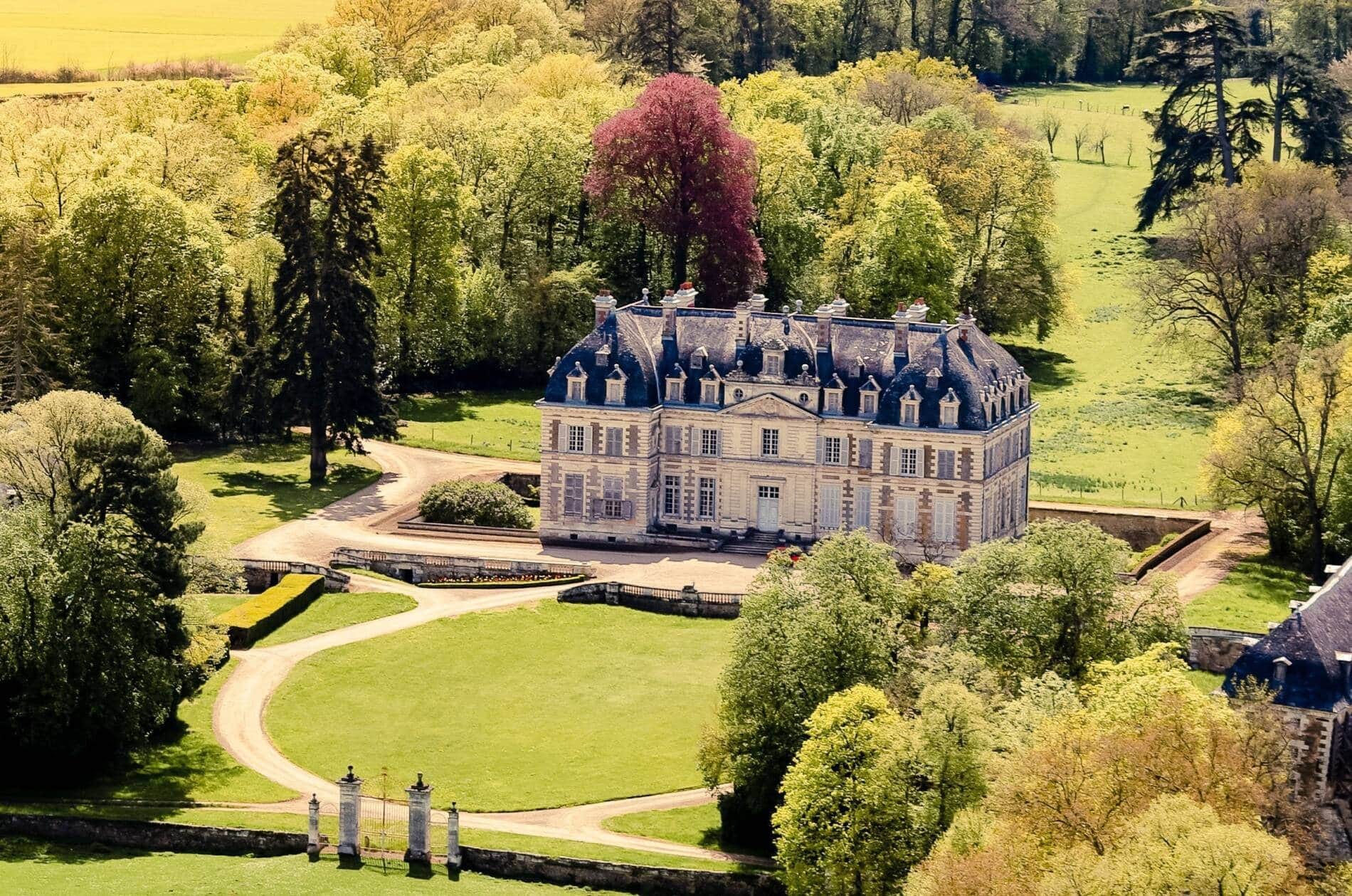
Château de Purnon is at the end of a three-kilometer avenue through a forest in Verrue, Vienne, France. Tim Holding and Felicity Selkirk decided to purchase the Château in November 2019. Rain was coming through the roof and into the second floor, which had begun to rot. The forest had crept back across the grounds. 1,200 square meters of slate overhead were close to failure. Tim had been a state politician in Australia; Felicity had built a web business in Melbourne; neither had restored so much as a cottage. They bought the place anyway, for €740,000, from eleven heirs of the family that had held it since the 1890s, and then quickly learned that the first stage of the work alone would cost nearly €2.8 million.
Ruins are common enough. What made Purnon rare was that no one had ever emptied it. Most great houses have been cleared a dozen times over, the goods sold off, inventoried, and stripped by each new owner in turn. Purnon changed hands once, to the de Rochequairie family in the 1890s, and then sat through a century of decline with its entire past life still inside. Furniture sat in the attic where it had been placed a hundred years earlier. Cupboards held fabric no one had unfolded in decades. The working parts of a household from the reign of Louis XVI were still in their places, as though the staff had walked out one afternoon and never come back. The house was built between 1772 and 1788 for Antoine-Charles Achard, Marquis de la Haye, a colonel under Louis XVI, to a design by Laurent Bourgeois. The original design drawings surfaced in the château’s own archives in 2021, and it went up partly from stone salvaged from a ruined neighbor, an act of reuse before it was ever finished the first time. The Château has 105 rooms, and every one of them still has something to say.
The wallpaper under the wallpaper
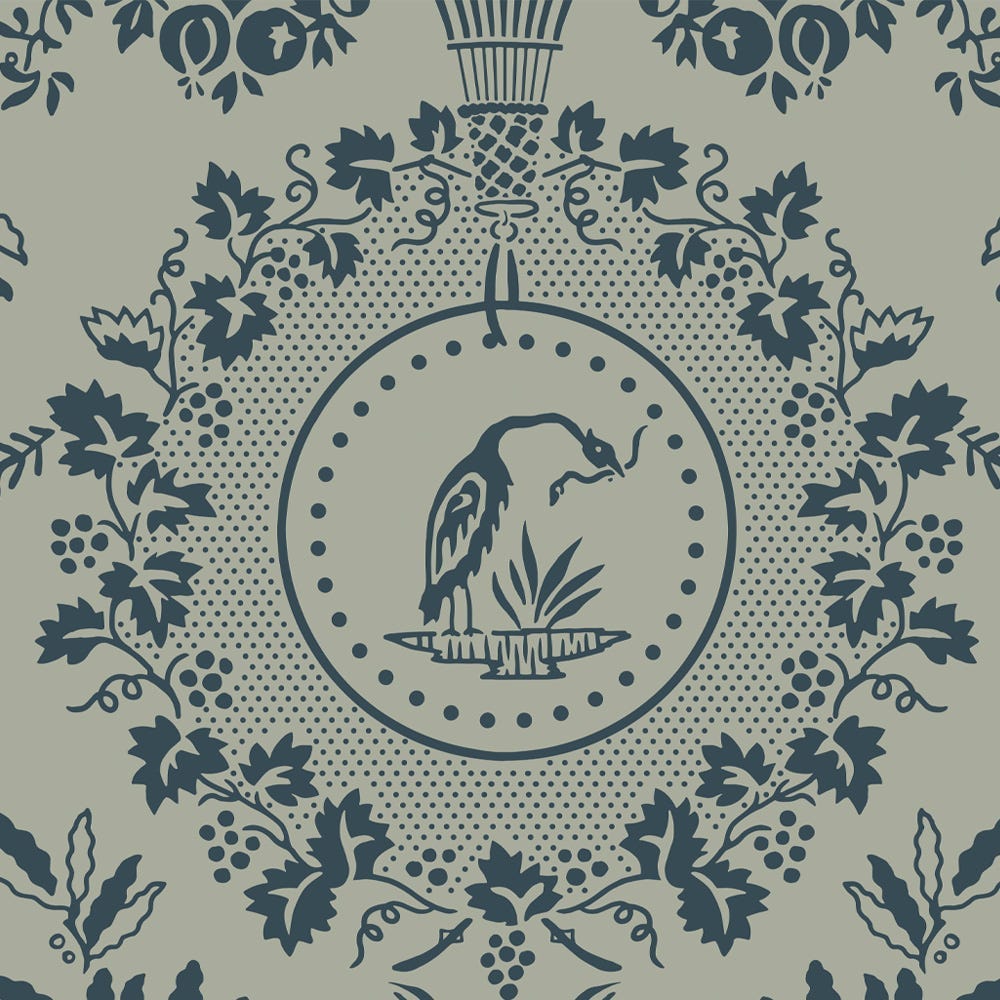
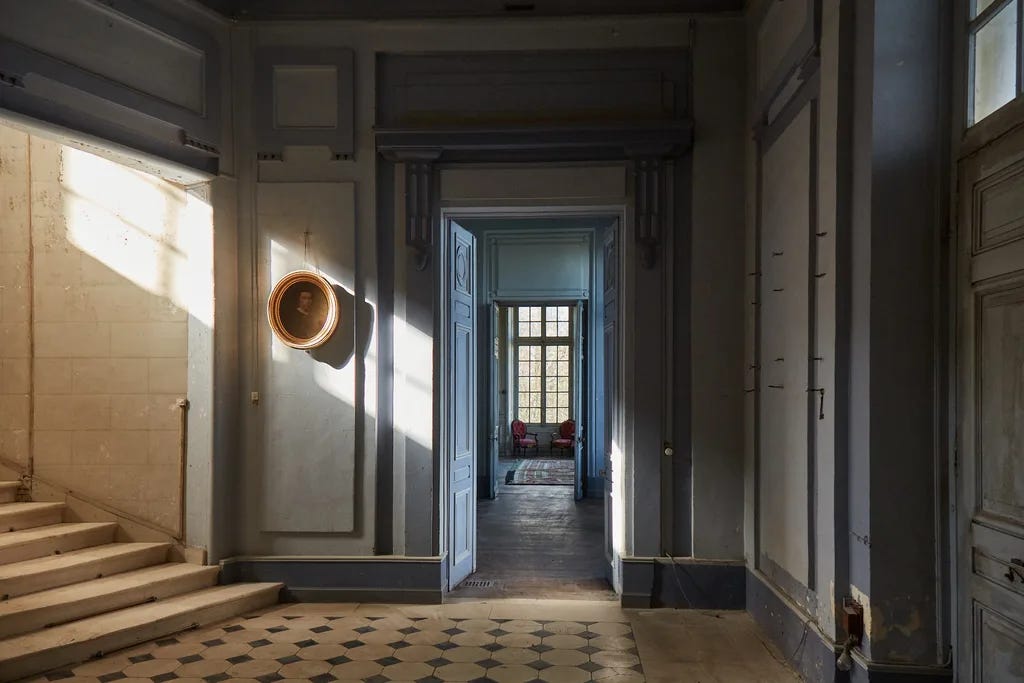
In a small room on the first floor, beneath layers of duller, later wallpaper, a geometric pattern surfaced. Someone in the nineteenth century had pasted the new fashion over the old, and someone after that had done it again, and under both, the eighteenth century had waited in the dark. That first patch sent them searching the whole house. A folding screen, once used to divide a great room into smaller, warmer spaces during a banquet, revealed a paper featuring herons. A floral scrap of paper found in the attic, half its color gone, had crowned the bed of the marquise’s own mother.
Some of the blue paper still on the walls carries a maker’s name: Jean-Baptiste Réveillon, the leading wallpaper manufacturer in France. Réveillon’s works in the Faubourg Saint-Antoine held a royal warrant and employed three hundred hands. In the spring of 1789, a rumor ran through Paris that Réveillon meant to cut his workers’ wages. A crowd burned the factory to the ground, soldiers fired into it, and dozens died. It was one of the first killings of the French Revolution, months before the Bastille. Réveillon fled France, but his paper went up on the walls of Purnon. Auguste, the marquis’s eldest son and a schoolmate of Napoleon Bonaparte, was to inherit the house, but he died during the Revolution.
Two stone busts of kings, Henri IV and Louis XV, who had stood on the roofline and fallen, were lifted down, repaired, and set back on their parapet. A billiard table, likely the oldest to survive in France, came out of the attic in pieces and was made whole. Cut into the stone, here and there, were marks to catch the sun at the winter solstice, an old wish to set a building in time with the turning year. Behind the plaster, the masons who raised the walls had left their own names and dates. An outbuilding held a carriage. A drawer held two dinner menus from a Belle Époque evening, course after course that no one had eaten in a hundred years. The couple records everything, and something like half a million people now follow the château’s slow return on YouTube. That’s how I first discovered it, and now I look forward to every new update. Honestly, I’m kind of obsessed.
Of course, one may look at the entire estate and conclude that none of it was necessary. No one needed to block-print herons onto paper that would spend its life folded behind a screen. The forty-seven thousand slates on the roof were each cut by hand, by men who knew no eyes below would ever see them up close. Two stone kings were carved and hauled to a parapet the birds keep closer watch on than people do. The builders gave the hidden work the same care as the visible. They believed that a thing worth making is worth making beautiful and excellent, no matter what.
Savageness
In The Stones of Venice Vol. II, John Ruskin asked why the rough, uneven, hand-cut ornament of a medieval cathedral is worth more than the smooth perfection that replaced it. The first quality of Gothic, he wrote, is savageness: its roughness, its refusal of polish. To a Victorian trained to prize finish, that looked like a defect. Ruskin called it the mark of a free man.
He wrote about the workman: “You must either make a tool of the creature, or a man of him. You cannot make both. Men were not intended to work with the accuracy of tools, to be precise and perfect in all their actions.” Demand flawless, machined perfection from a carver, and you get it only by making him a machine, grinding away the judgment and invention that make him a person. Let him be imperfect, and the wall shows something no machine can leave: a mind at work, a man deciding and creating. The goblins and blunt figures on an old cathedral front, Ruskin wrote, “are signs of the life and liberty of every workman who struck the stone; a freedom of thought, and rank in scale of being, such as no laws, no charters, no charities can secure.” From this he drew the rule that governs a place like Purnon: “no good work whatever can be perfect, and the demand for perfection is always a sign of a misunderstanding of the ends of art.”
He had watched the opposite spread through industrial England, and he saw it as a wound. “It is not that men are ill fed,” he wrote, “but that they have no pleasure in the work by which they make their bread, and therefore look to wealth as the only means of pleasure.” A man who makes nothing he can love spends his life buying what he cannot make. At Purnon, the older arrangement is briefly visible again: a roofer shaping slate by hand, and a mason cutting fresh tuffeau to sit against stone laid two centuries ago, work slow enough and free enough to leave a mark.
We have no right to touch them
Ruskin valued the old stone for a second reason. A building, he thought, is how people keep memories. “We may live without her, and worship without her,” he wrote of architecture, “but we cannot remember without her.” It is worth having not only what the dead thought and felt but “what their hands have handled, and their strength wrought, and their eyes beheld, all the days of their life.” Touching a wall that the eighteenth century built is a way of reaching the eighteenth century.
From this, he drew a hard rule of ownership. The man holding the deed is not the only owner. “We have no right whatever to touch them. They are not ours. They belong partly to those who built them, and partly to all the generations of mankind who are to follow us.” The living are a thin slice of the people who have a claim to a Château like Purnon. The dead built it to last. The unborn have not yet had their turn beneath its roof.
For that reason, Ruskin hated the word restoration, and would have watched a project like Purnon with a narrowed eye. Done badly, he wrote, restoration is “the most total destruction which a building can suffer: a destruction out of which no remnants can be gathered: a destruction accompanied with false description of the thing destroyed.” He had seen restorers scrape the weathered, hand-worked skin from a medieval church, replace it with a crisp modern guess, and hang a plaque calling a copy the original. Better, he said, a true building left honestly worn, and let go when its hour comes, than one killed and dressed in a lie.
Purnon holds to Ruskin’s standard. The work takes place under the watchful eye of Frédéric Didier, chief architect of France’s historic monuments and of Versailles. A classified monument may be touched only by artisans trained in heritage crafts, using old materials and methods, which is much of why the bill climbs into the millions. The reassembled billiard table is the real one, its own pieces recovered from the attic, not a prop bought to fill the room. Where the original wallpaper could not be saved, the couple refused to counterfeit it; they carried the surviving fragments to Farrow and Ball, who printed a set of papers from them, named for the family, and sold openly as what they are. Walking the rooms with the designer, Felicity has said, felt like seeing her own home through another’s eyes, watching patterns come back into the light that had been dark since the end of the eighteenth century.
The eyes of the house
It would be easy to file all this under taste and call it a wealthy couple’s costly enthusiasm for old wallpaper. It is nearer to a moral argument than what is abandoned in most of what is built today. When Felicity says the thing that first held them was the symmetry, “Purnon is all about symmetry and harmony,” she is repeating a claim the classical world made and the modern world has jettisoned. Beauty is real; harmony and proportion belong to the world and not to the mood of the one looking. Roger Scruton spent his career defending it. The ordinary sense of what fits, he wrote, the instinct that lays a table well or sets a moulding true, is a “minimal beauty,” the way rational creatures “strive to achieve order in their surroundings and to be at home in their common world.” Much of what a settled people makes is “home building, erecting in the teeth of change and decay, the permanent symbols of a settled form of life.”
The things around you right now were mostly built on the opposite premise. It is certainly true of my house and almost everything in it. The cabinet is faced with cheap wood over pressed dust, made to hold together until the warranty lapses. The wall has the thinnest coat of cheap paint instead of meticulous craftsmanship or ornate paper. The fixtures were the cheapest, and they will end up in the landfill inside ten years. Scruton saw where that logic ends. A modern block built to be gutted and raised again every generation is, he wrote, “an extremely expensive and ecologically destructive tent.” My windows are far too few and built to withstand a hurricane. The windows of an older house, framed and proportioned, “are the eyes of the house.” What our building is good at now, Scruton said, is “the hard work that is being constantly expended on losing knowledge.” Purnon is a château built on the assumption that it would outlive everyone who touched it, and so worth the hidden slate and the paper behind the screen.
Trees they will not sit under
Tim and Felicity have written down why they do it, and one paragraph is essentially Ruskin’s rule worked out in real life. “We know that we are part of an endeavour that will leave a legacy long after we are gone. When we walk around Purnon we admire the epic trees planted by people who would never live to sit in their shade. We give thanks that people of vision had the generosity to build something for those who would come after them. We hope that, by protecting something precious from the past, we too can leave something for future generations.” They cannot finish the house in their lifetime, and they know it; that’s not the point. The aim is to save what they can and hand it on. “We never came here hoping to play Lords and Ladies.” Tim and Felicity call themselves custodians, tenants of a house that belongs more to the dead and the unborn than to them.
This is the logic of every good thing that takes longer than a lifetime to make. It moved whoever set the oaks along that three-kilometer avenue, and it moves a mason to sign a stone he will not live to see weather. Such work cuts against nearly everything now made and bought, which is built to return its worth inside our own short span and leave the future to fend for itself. To labor for people you will never meet makes sense only if you understand and value that the world survives longer than a single life, and you are only a link in the long chain.
Making all things new
The instinct that saves the old thing rather than scrapping it has a name older than the château. When Jesus spoke of the world to come, the word Matthew records is palingenesia, from palin, again, and genesis, beginning. The ESV renders it as “new world,” and some older translations as “regeneration” (Matt. 19:28). It is the same word Paul uses for the “washing of regeneration” by which a man is saved (Titus 3:5). It points to this world carried back to what it was made for, not a second world brought up from nothing while the first is completely thrown out. The creation is groaning, Paul writes, waiting to be “set free from its bondage to corruption” (Rom. 8:21). He uses the language of rescue and repair. And the voice from the throne at the end says, “Behold, I am making all things new” (Rev. 21:5). All things. The same ones, made new, with no replacement wheeled in over the grave of the first.
A God who works that way is not indifferent to a small apartment or a grand château. He doesn’t treat what he has made the way we treat a dishwasher past its warranty. He raises the same body that was sown perishable and makes it imperishable; he keeps what can be kept and redeems what looked past all saving. The whole shape of redemption is a restoration of the honest kind Ruskin wanted, and it would not pass over the marble cut lions, the hand-painted wallpaper, or the meticulously cut stone. He wouldn’t ignore the names the masons pressed into the wall so that someone, someday, would know they had stood there.
I hope to visit Purnon with my wife one day. I would love to see and touch the details, admire the craftsmanship, and feel the weight of history one scarcely experiences in the modern world. At Purnon, a house that was never emptied is being filled again. That is what Tim and Felicity mean by reawakening, and it is a small and truer rumor of the morning when everything that was ever worth making is made new.