


The self-help industry addresses time based on a single, irrefutable premise: you have the same 24 hours as everyone else. The same 168 hours per week as every titan of industry, every great artist, every person you admire from a respectable distance while scrolling through their highlights and wondering what is wrong with you.
The premise is true, but the proposed remedy of better scheduling and morning routines will not fix the gap.
The 24-hour problem was diagnosed in considerable detail roughly two thousand years ago by a Roman statesman who was simultaneously one of the wealthiest men in the empire, an advisor to a murderous emperor, a playwright, a philosopher, and the author of one of the most devastating indictments of human time-wasting ever written. His name was Lucius Annaeus Seneca, and he understood something about busyness that productivity apps and planning journals have not improved upon since.
The Man Who Wrote About Time on Borrowed Time
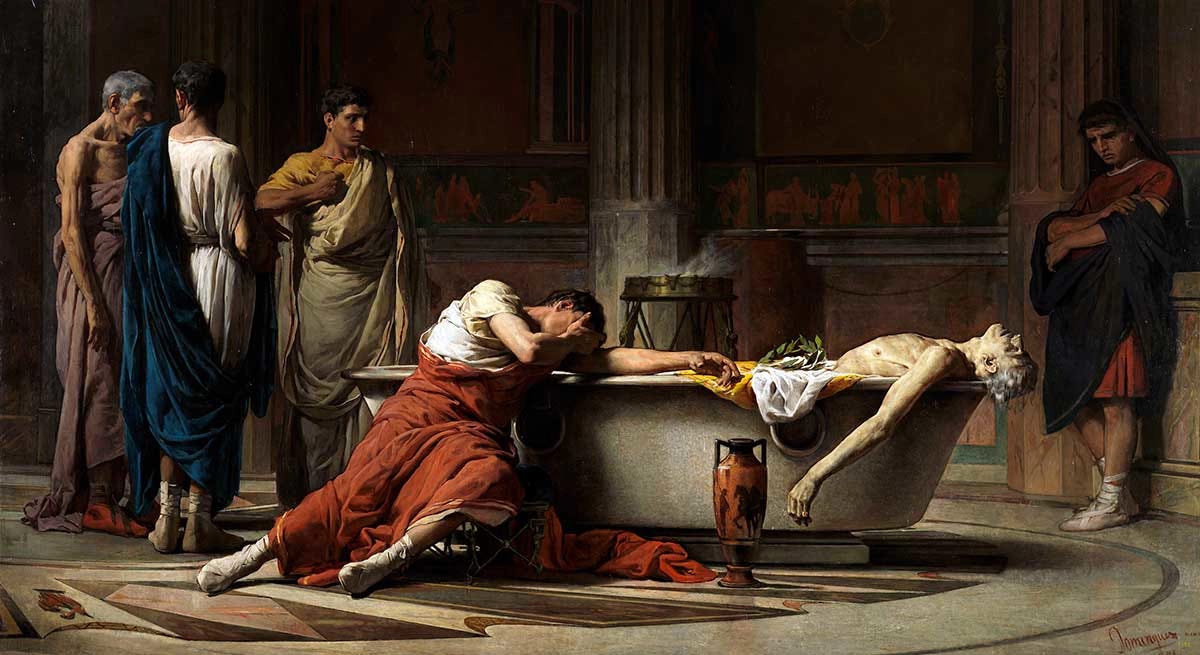
Seneca was the kind of figure that ancient Rome produced with some regularity and modern civilization finds increasingly rare: genuinely great and genuinely compromised at the same time. He wrote beautifully about the simple life while maintaining houses in multiple cities. He emphasized Stoic detachment even as he accumulated enormous wealth. And he wrote On the Shortness of Life. It is perhaps the most penetrating short essay in Western letters on the subject of wasted time. He wrote it while serving a court that would eventually order him to kill himself, which he did, in 65 AD, with the unhurried composure he had written about for thirty years.
The essay is addressed to his father-in-law, Paulinus, but it’s just as pertinent to all of us. One of his opening lines has never been improved upon: “It’s not that we have a short time to live, but that we waste a great deal of it.”
The argument unfolds from there with the ruthless clarity of a good doctor delivering a diagnosis. Life, Seneca insists, is generous. The problem is a catastrophic mismanagement of it. We burn through our hours on trivialities, anxieties, social obligations that serve no one, and pleasures that leave us emptier than we arrived.
His sharpest observation concerns what can be called “the busy man.” It’s a person so consumed by obligations, appointments, and activity that he is never, for a single hour, genuinely at leisure. But leisure in the classical sense is time that belongs to you, given to contemplation, study, and the cultivation of wisdom (Check out Pieper’s classic work Leisure: The Basis of Culture). The busy man has given away all his hours. He is never available to himself. He is, in Seneca’s wise assessment, always about to live.
In his Letters to Lucilius, Seneca is direct: “Nothing, Lucilius, is ours, except time.” The one commodity that cannot be replaced, replenished, or borrowed back has been, he notes, “forced from you, or filched away, or has merely slipped from your hands.” Notice that he highlights three modes of loss, in ascending order of embarrassment: some time is stolen by genuine obligation, some by lesser thieves who get away with it because we don’t protest, and some simply evaporates because we weren’t paying attention.
That was ancient Rome. Seneca was describing a world with no smartphones, no social media, no algorithmically curated feeds engineered by teams of behavioral scientists to maximize the number of minutes you stare at a screen. He was describing the baseline human condition and the ordinary tendency to let time drift, long before anyone had industrialized it.
What the Algorithm Did to Seneca’s Problem
The attention economy did not emerge accidentally. It was engineered by some of the most talented people in the world, with billions of dollars of investment and decades of behavioral research. The goal has been to accomplish what Seneca described: to steal time in ways you barely notice, by increments too small to mourn individually.
This is Seneca’s “filched away” at an industrial scale.
The self-help response is better habits, phone-free mornings, app timers, and the discipline to keep your devices in another room. These are not bad ideas. But they are trying to fight a structural problem with personal willpower, and the outcome of that contest is predictable. Seneca recognized that the problem was not simply a matter of trying harder. The busy man does not lack effort. He is often working very hard. The question is what he is working toward, and whether the hours add up to anything that, at the end of a life, could be called a life well lived.
“All the rest of existence is not living,” he wrote, “but merely time.”
This is the question the productivity industry evades: what is the time for? Everyone wants to be more efficient, but in the service of what vision of the good life? A faster morning routine that frees up ninety minutes for more screen time has not solved Seneca’s problem.
In contrast to Seneca, several other men are examples of those who actually solved the problem and whose use of time was so extraordinary that it strains credulity to learn the details. They didn’t solve it with systems, but a right vision of the end.
Thirteen Hours a Day in Northampton
Jonathan Edwards rose at four or five in the morning and spent thirteen hours in his study. According to George Marsden’s definitive biography, this was his ordinary routine. He studied prayerfully, interweaving prayer and reading so that the two were less distinct disciplines than a single continuous act of the mind submitted to God.
He was reading with a pen in his hand, jotting observations on scraps of paper that he would sometimes pin to his coat during outdoor walks so he wouldn’t lose the thread before he could record it properly. He rode on horseback through the New England woods with ink and paper, stopping when a thought came to him. His mind was never fully off the work, because the work was the orientation of an entire life.
Edwards wrote Freedom of the Will, The Religious Affections, Original Sin, The End for Which God Created the World, and thousands of sermons and treatises, all while pastoring a congregation, raising a large family, and corresponding extensively with theologians and missionaries across the Atlantic world. He became president of what would become Princeton University, though he died of a smallpox inoculation five weeks after taking the position.
His Resolutions, written as a young man before he had produced most of what he is remembered for, are the private architecture beneath the public achievement. Resolution 5: “Resolved, never to lose one moment of time; but improve it the most profitable way I possibly can.” Resolution 6: “Resolved, to live with all my might, while I do live.” Resolution 17: “Resolved, that I will live so, as I shall wish I had done when I come to die.” Resolution 37: “Resolved, to inquire every night, as I am going to bed, wherein I have been negligent, what sin I have committed, and wherein I have denied myself.”
He resolved to do a review every night. Self-examination that held each day up to the light of eternity and asked whether it had been lived accordingly.
The Sick Man of Geneva
Edwards was extraordinary, and John Calvin was something else entirely. He suffered from chronic asthma, recurring migraines, kidney stones, hemorrhoids, pleurisy, and pulmonary tuberculosis that caused him to cough up blood regularly. For much of his ministry in Geneva, he did not sleep more than four hours a night because his ailments kept him awake. He ate very little and, by all accounts, was a physically wretched man in constant pain.
Calvin preached over two thousand sermons in Geneva: twice on Sundays and on weekdays on alternating weeks, often for more than an hour at a time, without notes. Between 1540 and early 1564, he published commentaries on nearly 50 books of the Bible, totaling 45 volumes in English translation. His collected works (Corpus Reformatorum) run to fifty-nine volumes. He wrote the Institutes of the Christian Religion through multiple expanding editions, founded the Geneva Academy, corresponded with reformers across Europe, and oversaw the governance of a city.
When his illnesses kept him from his desk, Theodore Beza recorded that Calvin would ask for his books and dictate, lying on his bed, to secretaries working in shifts. He did not stop when he was sick. He adapted.
Calvin was similar to Thomas Aquinas, who maintained an average output of roughly 12 handwritten pages per day for 25 years, spanning an enormous range of subjects and citing 164 authors from across the ancient and medieval worlds. He reportedly dictated to multiple secretaries simultaneously, holding different lines of thought in parallel as each scribe worked on a separate text.
These men were undoubtedly less comfortable, more constrained, and more physically burdened, but what they were not was distracted.
The Prince of Preachers on Saturday Night
Charles Spurgeon is the figure most likely to provoke disbelief among modern men. In fifty-seven years of life, he managed what the most reliable accounts describe as the equivalent of three lifetimes of work.
Every week, he preached four to ten times and read five to six substantial books. By the end of his life, he had amassed a personal library of over 7,000 volumes. He wrote approximately 150 books. His published sermons fill 63 volumes. He founded the Pastor’s College and the Stockwell Orphanage and led 60 ministries connected to the Metropolitan Tabernacle. On average, he personally wrote five hundred letters per week.
Spurgeon did it all while suffering from severe gout and recurrent, debilitating depression that he described as a darkness that had no bottom.
His weekly schedule was a masterpiece of structured intention. Monday was reserved for correspondence and sermon revision. Wednesday was a day of rest with his family. Saturday evening, after dismissing dinner guests at 6 p.m., he would sit with his wife Susannah, who would read the text aloud to him while he thought through the sermon, noting its divisions in purple ink on half a sheet of notepaper. He prepared the Sunday evening sermon in a few hours on Sunday afternoon. The preparation was intense and brief because the reading done all week was the real preparation; the Saturday session was merely the crystallization.
When David Livingstone expressed some wonder at Spurgeon’s output, Spurgeon replied: “You forget, Mr. Livingstone, there are two of us working.” He was a man whose every hour was consumed with Christ. He believed his time was his on loan, that the One who had given it could multiply it, and that his job was to be faithful with the hours given rather than anxious about their quantity.
Quite a different relationship to time than what Seneca had.
Buying Back What Has Been Sold
Paul’s instruction in Ephesians 5:16 is typically rendered as “redeeming the time” or “making the best use of the time.” The Greek is more vivid: exagorazomenoi ton kairon, or buying back the time, or ransoming it. The word exagorazo is a marketplace term. It describes the act of purchasing something that has been previously sold or held captive. Paul’s point is that the time has been taken. It must be bought back.
This is an eschatological claim, not a productivity metaphor. Paul frames the injunction with the phrase that precedes it: “because the days are evil.” The urgency of time is a response to the nature of a fallen world in which time is under siege, in which the Enemy is patient, and the work is enormous.
Seneca saw this in pagan terms. He understood that time was finite and that the person who perpetually deferred genuine living was already, in some meaningful sense, dead. He believed that most people die without having truly lived.
But what Seneca lacked was the ground beneath the urgency. His counsel to use time well ultimately resolves into a counsel to practice resignation: to accept that time will end, that achievement will be forgotten, and that the wise man should be indifferent to this. For the Christian, the time is being redeemed by being caught up into something that will not be lost. Work done in faithfulness to a calling, in obedience to a God who raises the dead, is not work that ends with the grave.
Edwards, Calvin, and Spurgeon were extraordinary because they had a better account of what time is for. Their hours were ordered by a vision of God’s glory and the eternal consequence that made the ordinary distractions of their era seem genuinely absurd. Calvin dictated from his sickbed because he believed the Reformation of the Church was the most important work happening in the world, he had been given a role in it, and he was not going to waste it on sleep he didn’t need.
This is what Seneca was reaching for but could not find. He saw that time was precious. He saw that it was being squandered. He could tell you all the ways it slips away. But what Seneca could not tell you is why it was worth saving.
The Same 24 Hours
Yes, you have the same 24 hours as Jonathan Edwards, John Calvin, Charles Spurgeon, Thomas Aquinas, and Seneca.
The days are not short. We make them short by treating them as our own to dispose of as we wish, and by building lives around the management of impressions and the consumption of content. Hour by hour, day by day, we defer the formation of our soul and the service of others to some calmer season that never comes.
You have 24 hours ahead of you. Make them count.
The painting at the top of the article is Jean-Léon Gérôme’s The Death of Seneca (1871). It depicts the philosopher’s forced suicide in a marble Roman bath, surrounded by mourning companions.
Reading Seneca now. Love this post - great work!