


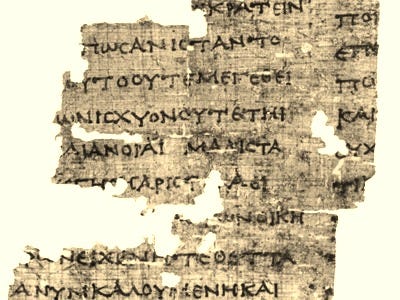
Years ago, when I was doing my master’s work, I was assigned Thucydides to read. History of the Peloponnesian War is a brick. I haven’t tried, but I think it could prop open a door. It is eight books on a squabble between two Greek city-states that ended twenty-four centuries ago. I assumed I was in for a long, dry march through troop movements and land grudges. I assumed I would survive it rather than enjoy it.
Thankfully, I was wrong. I have returned to Thucydides many times since my first read. It is good writing, full of intriguing speeches, numerous pearls of wisdom, and most of all, an honest author who tells you up front he might disappoint you. He knew his readers wanted a good story, but he also knew if he was going to write history, it would not always be the action-packed tale the reader longs for.
You may not like it
Thucydides opens the whole work by explaining his method. He is describing how he handled the raw material of the war:
[Far] from permitting myself to derive it from the first source that came to hand, I did not even trust my own impressions, but it rests partly on what I saw myself, partly on what others saw for me, the accuracy of the report being always tried by the most severe and detailed tests possible.
He didn’t trust his own memory of the events he lived through, nor did he just accept what others said. Every account got cross-examined, checked against other reports, and then the surviving outcome made it onto the page. It is not an easy standard, and the cost is the reader’s interest:
The absence of romance in my history will, I fear, detract somewhat from its interest; but if it be judged useful by those inquirers who desire an exact knowledge of the past as an aid to the interpretation of the future... I shall be content. In fine, I have written my work, not as an essay which is to win the applause of the moment, but as a possession for all time.
The true version is the less entertaining version. The pleasing account with heroes and clean motives and a satisfying story arc would have likely won him more readers, but his goal was accuracy, not popularity. He called it “a possession for all time,” and that is exactly why we are still reading it today.
In many ways, Thucydides’ instinct is strange by our standards. The viral accounts of our day are designed to flatter the reader, or bend the facts for a more compelling narrative.
Changing Words
Thucydides described the civil war that tore through Corcyra, and he paused to point out something he had seen happen across the Greek world once the war began. Society split into factions, and he observed:
Words had to change their ordinary meaning and to take that which was now given them. Reckless audacity came to be considered the courage of a loyal ally; prudent hesitation, specious cowardice; moderation was held to be a cloak for unmanliness; ability to see all sides of a question, inaptness to act on any.
Words flip and recklessness becomes courage, caution is turned into cowardice, and moderation is weakness. The ability to see more than one side of a question gets redefined as an inability to commit. The moment the factions hardened, the descriptive words stopped describing reality and started determining allegiance. The meanings of words depended entirely on which side you were on.
This is the collapse of shared factual reality. Once a society splits deeply enough, the conversation changes. The concern for what actually happened fades to the background while the meaning of words moves to the forefront. Thucydides watched it happen, and he told us it would keep happening, “as long as the nature of mankind remains the same.”
In its modern iteration, this game is played with things like “Misinformation,” which can mean “a true thing my tribe would rather you not repeat,” or “a true fact without all the details.” A man can do something and have one group call him a patriot while the other calls him a traitor. If Thucydides didn’t have a funny name and some recognition, one might read him and think he was doom scrolling X and commenting on it. But he recognized something that comes out in every generation: human beings under pressure will, by nature, react in predictable ways.
History belongs to whoever won the argument
Most of us have heard more than once that history is written by the winners, and it is not entirely untrue. The winners often name the war, canonize their dead, and conveniently lose the documents that made the whole ordeal look bad for them. But Thucydides shows us this is not always the case. He was an Athenian, and Athens lost. The Peloponnesian War ended with Sparta victorious, Athens’ walls pulled down, and its empire gone. And yet the most favored account of that war was written by a foe of Sparta. And not just any foe. Thucydides served Athens as a general, and after he failed to save a city, he was exiled. He died before his work was ever finished; it breaks off mid-sentence years before the war ended.
So the cliché needs to change. History is written by whoever wins the argument, not necessarily the battle. Sometimes all it takes is a more gifted writer. The printing press and universities helped in the past, and social media presence helps today. The victor on the field can still lose the fight over the story, but the story is what everyone eventually reads and believes. The survival of a story is often how propaganda gets mistaken for truth.
Disappointment in a textbook
I went looking through my daughter’s AP history textbook not long ago. These books are written for every AP student in the country, so the standard is applied across the board. These are written for the best and brightest kids, and I wanted to see what they were being taught as the story of the world.
Disappointed, but not surprised, the historical events the writers even bothered to address were concise summaries without context or nuance, and each one was presented as a simple historical fact. Nothing indicated that anyone at the time saw it differently. Nothing suggested that the meaning of an event was ever contested. How would I know? Because I’m old enough now that events I lived through are now in history books, and I know nothing was actually like what the short summaries make them out to be. Real events are always messier and far less obvious than a few sentences can describe.
Unfortunately, the entire AP history book was written that way. Every conflict had a tidy narrative of winners and losers. What they didn’t skimp on was the moral conclusion the students are supposed to reach. History is presented as black and white, but that is not how life works. It is not how the world operates. Real events are made by people with mixed motives and no idea how any of it will turn out, and a textbook that scrubs all of that away is teaching a fable with dates and names. No wonder it is so easy to convince a college freshman there is such a thing as “The Right Side of History.”
Nuance is king
Read a few biographies, and you learn quickly that nuance is king. It is the account. Better yet, read autobiographies, where a person tries to explain his own decisions from the inside, and you will quickly realize the tidy cause-and-effect textbook account is often nowhere near the truth. There is hesitation, second-guessing, and competing loyalties at play. The summary just tells you something happened with the result, but the autobiography tells you what he was afraid of, what he did not know, who he was trying to protect, and why the obvious choice did not seem so obvious at the time.
Almost all history gets flattened in the retelling, and the flattening tends to slant toward a conclusion the reteller wanted you to believe. That is no surprise. We learn that a war was fought and won, or a policy passed and failed. We get the raw facts (maybe) and the outcome, but we learn almost nothing about the other arguments. Yet, the details are where the honesty lives, and the details are the first thing cut when the story has a point to prove. Conclusions are easy when you’re down the road looking back. The deliberation that produced the conclusions is the hard part, and that’s the part that actually teaches us something.
I have to admit, there’s a bit of a trap I set for myself. A keen historian will notice my argument itself cuts against Thucydides. His account of the war is the standard text and we have very little from his own day to compare his account. Xenophon continued the story where Thucydides left off. Diodorus and Plutarch cover the same ground, but they wrote centuries later and rely heavily on his work to do it. So Thucydides is not really one witness among several. If my entire point is to distrust the single dominant narrative and demand corroboration, how do we know Thucydides’ account is accurate? Who cross-examines the cross-examiner?
To make matters even more challenging, he explains what he did with speeches he recorded. He admitted that he could not remember them word for word, understandably, and neither could his informants, so:
my habit has been to make the speakers say what was in my opinion demanded of them by the various occasions, of course adhering as closely as possible to the general sense of what they really said.
In other words, he wrote the speeches himself. He put words in the mouths of real men, according to what he could remember or what he judged the occasion called for. I admire his honesty, but he composed much of his own book’s most famous content as the words of others. I appreciate that he didn’t hide the fact. That gives the reader a note to remember that we are reading a general sense, not a transcript.
But this is the challenge. Every account is a human being deciding what to include and how to explain it. So what do we do? Not every story is written with the goal to deceive, but humans are humans. We have agendas and desired ends, so readers have to look at every account, including the ones we love, with some reasonable suspicion and keep reading until the facts are clear.
Read widely
It is important to read more than one account of a historical event when you can, and even better if the accounts disagree with one another. Two historians drawing different conclusions show you the actual facts and the disputed matters. The disagreements are informative instead of a single confident narrator who never tells you his biases or methodology.
And please, go to the primary source. Read the actual documents. The internet makes it pretty easy in most cases. Don’t just accept someone else’s summary. Of course, there are times we have to rely on others. Most people cannot read fifth-century Greek, but the principle holds. Get as close to the source as your circumstances allow, and you will start to see where every layer of the story is bent in favor of a preferred narrative.
Clean stories rarely get printed. Reporters drop stories after one or two phone calls. Editors cut the details that don’t fit the headline, and then a few years later it ends up in a textbook as fact, and nobody checks the details. Have you ever looked to see when Washington Irving invented the myth that medieval Christians believed in a flat earth, and then the historians Draper and White turned his fiction into a thesis? Who actually knows that Christopher Columbus’s dispute with the Spanish court was about the size of the earth and not its shape? It was never about proving the earth wasn’t flat. What do you actually know about the Salem Witch Trials? Most people picture witches burned at the stake. The truth is, nineteen were hanged, and one was pressed to death. Not one was burned. Most of the time, before we learn about an event, it has been edited with an objective in mind. History is often written like a game of telephone, and the primary source is often neglected.
When we simply accept the textbook account, thinking gets siloed. The printed version becomes the respectable one, and eventually free speech gets squeezed. Alternative versions are marked as conspiracies, and anything said or written outside the accepted narrative gets branded as hateful or revisionist. But sometimes the person being shouted down is just correct. He went and read the primary sources. We really can read, study, and think for ourselves.
The cost and the possession
The flattering version of any story is always right there, telling you that your side has always been the heroes and the other side has always been the fools. It is red meat offering your favorite explanation, which is exactly why you shouldn’t trust it. Unfortunately, social media has only made it worse. Way worse. I am particularly amused every year when Supreme Court decisions drop, and everyone becomes a Constitutional law expert without ever reading the briefs, hearing the arguments, or examining the decisions. Accurate versions of events take time and effort. You have to read the long book, then take time to trace the footnotes. Develop your own convictions with relentless scrutiny. It is a slow, less flattering process, but it is true instead of tidy.
A shared factual reality is a possession, and like every possession worth having, it belongs to the people willing to work for it. Thucydides did the work twenty-four centuries ago and left it for us. The least we can do is refuse to hand our grandchildren a useless pile of fables.
I love this. It is so easy to find primary sources and read them yourselves and they are so interesting. Not just the substance but the way they are written the language the use of words. I love what you said also about the Supreme Court. I’ve taken to listen to oral arguments and then reading opinions. Last summer, I went through all the big Supreme Court cases that I could find, and that was very enlightening. As you said you’re short on taking the time to do the work. I used to argue with my father that everything was black-and-white. He used to tell me most things are gray. The older I get the more I realize that he was true.